
Quaker response to war
A chronological overview of how Friends have responded to war through conscientious objection, relief, public witness, and peace-making.
Overview: a peace testimony lived through history
From their beginnings in the turmoil of 17th century England, Quakers have been shaped by a conviction that war stands in tension with faith and human dignity. In 1660, Friends publicly declared peace to King Charles II saying that they could not fight with outward weapons. This statement became the foundation for the Peace testimony. It did not end Quakers' engagement with the world's conflicts, but it did establish the pattern by which they would respond: refusing to take up arms while seeking practical ways to relieve suffering, restrain violence, and keep open the possibility of reconciliation.
Across later centuries, Quaker responses to war have tended to gather around a recognisable set of practices. These include conscientious objection to military service; alternative service in medical and reconstruction roles; organised relief for civilians and refugees; quiet diplomacy and mediation; peace campaigning and nuclear disarmament; and the holding of public vigils or Meetings for Worship in visible places as acts of witness. Friends have also repeatedly worked alongside other peace groups and civil-society organisations, recognising that testimony is often strengthened through cooperation rather than isolation.
What follows is not an exhaustive account of every Quaker reaction to every war, but a chronological series of moments that show how these responses have taken different forms in different eras, while remaining anchored in the same spiritual commitments.
1640s-1660: Civil war, revolution and the birth of pacifism
The Society of Friends took shape in the unsettled years after the English Civil War Period, when political authority, religious conformity, and the use of force were all being fiercely contested. Many early Friends had lived through years of militia service, sieges, and political upheaval, and their preaching emerged from a world saturated with violence. Founding Friend George Fox consistently urged followers to reject outward fighting, insisting that spiritual transformation, rather than armed struggle, lay at the heart of Quaker discipleship.
In 1660, as the monarchy was restored and fears of renewed rebellion ran high, Quakers issued a public declaration renouncing violence and warfare. This was a risky step for a small and frequently persecuted religious movement, but it fixed pacifism at the centre of Quaker identity. From this point onward, Friends were known — sometimes admired, sometimes mistrusted — for refusing to participate in military activity, even when surrounding cultures assumed that loyalty and weapon-bearing went hand in hand.
1775-1783: the American Revolutionary War
The American Revolution tested Quaker commitments in especially sharp ways. Many Friends lived in colonies where loyalty to the British Crown and enthusiasm for independence divided communities and families alike. Quaker meetings generally reaffirmed the peace testimony, urging members not to bear arms or participate in military planning, even as revolutionary fervour spread around them.
Not all Quakers accepted this position. In Philadelphia and elsewhere, a small number of Friends who supported the revolutionary cause broke away to form what became known as the Free Quakers, who rejected the authority of pacifist meetings and believed participation in the war could be justified. Among those associated with this group was Betsy Ross, later famous for her link to the first American flag, whose membership became contested after her husband joined the revolutionary militia. The episode reveals how wartime pressures fractured Quaker communities and forced difficult decisions about conscience, loyalty, and discipline.
This stance brought practical consequences for many who remained within mainstream meetings. Some refused to pay war-related taxes or fines, and in certain cases property was seized in response. Friends were criticised by neighbours who saw non-participation as disloyalty, while others struggled inwardly with sympathy for political change but an unwillingness to support it through violence. The period illustrates how Quaker pacifism has often required costly personal choices rather than abstract principle.
1803-1815: Napoleonic wars and early legal recognition of conscience
During the Napoleonic Wars, Britain mobilised on an unprecedented scale, and pressure to serve in militias or naval forces became widespread. By this point, however, Quakers had already spent decades negotiating with the state for recognition of conscience, and earlier legislation had created limited exemptions from militia service for members of the Society of Friends.
These arrangements were uneven and sometimes contested, but they point toward a slow shift in public life: the gradual acknowledgement that religious conviction might justify refusal to fight. Quakers continued to argue that loyalty to the nation did not require taking up arms, while also engaging in charitable work and relief for those affected by conflict at home and abroad. The Napoleonic period thus sits midway between early persecution and the later emergence of formal legal protections for Conscientious Objectors.
1853-1871: Crimea, continental wars and organised relief
Mid 19th century conflicts pushed Quaker responses in new directions. During the Crimean War, Friends participated in wider peace debates and published reflections questioning whether warfare could ever be reconciled with Christian ethics. At the same time, attention increasingly turned to the suffering of civilians caught up in modern industrial warfare.
The Franco-Prussian War marked a turning point. British Quakers helped establish what became the Friends War Victims Relief Committee, sending aid to devastated communities and adopting the eight-pointed Quaker star as a symbol of neutral humanitarian assistance. Relief and reconstruction became, from this point onward, a central expression of Quaker peace witness: not only refusing violence, but actively repairing its consequences.
1861-1865: the American Civil War
The American Civil War confronted Quakers with a particularly painful moral landscape. The abolition of slavery was a cause many Friends had championed for decades, yet the war to preserve the Union and end enslavement relied upon vast armies and unprecedented bloodshed. Meetings wrestled with how to uphold the Peace testimony while recognising the profound injustice of slavery.
Some Quakers sought exemptions from military service on grounds of conscience; others felt torn between pacifism and the urgency of emancipation. Quaker communities also engaged in relief efforts for freed people and war-affected civilians. The period reveals how Quaker responses to war have rarely been simple or uniform, but shaped by prayerful disagreement and moral struggle within the community itself.
1914-1945: world wars and the expansion of conscientious objection and alternative service
The two world wars placed unprecedented strain on Quaker commitments to peace. During World War I, Britain's introduction of conscription in 1916 forced thousands of men to decide whether conscience permitted military service. Quakers were prominent among those who registered as conscientious objectors, some accepting alternative service in medical or reconstruction roles, others refusing all forms of military involvement and facing tribunals, imprisonment, or public hostility as a result.
To provide a constructive channel for service, Friends helped establish the Friends' Ambulance Unit, which offered a way to care for the wounded without carrying weapons. Quaker relief organisations simultaneously expanded large-scale programmes of civilian assistance and postwar rebuilding in devastated parts of Europe. These activities made visible a pattern that combined refusal to fight with energetic humanitarian response.
World War II reopened the same questions in an even darker context. Once again, many Friends claimed conscientious objection and worked in medical units, agriculture, civil defence, or refugee relief. At the same time, some Quakers concluded that the defeat of fascism was a moral necessity and chose to enlist in armed forces despite the historic peace testimony. Meetings wrestled with these divergent decisions, often seeking to hold together communities marked by sharply different convictions. The period therefore reveals both the strength of Quaker pacifist tradition and the reality of internal disagreement when global conflict appeared unavoidable.
1960s-1980s: Vietnam, nuclear anxiety and the Cold War
In the Vietnam era, Quaker witness became closely associated with public opposition to war and support for those wrestling with conscription. In the United States, Quaker organisations offered counselling to draft resisters and advocated for negotiated settlements rather than military escalation. The visibility of televised warfare brought new urgency to peace campaigning, and Friends often joined wider coalitions calling for restraint and diplomacy.
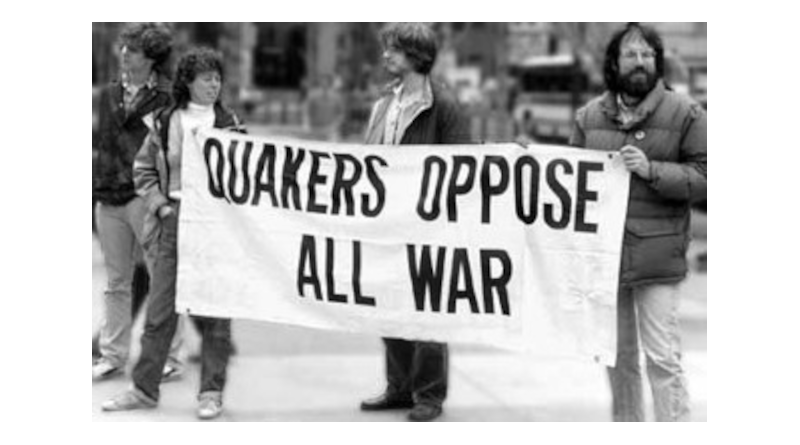
Throughout the Cold War, the threat of nuclear conflict reshaped discussions of war itself. Quakers in Britain and elsewhere supported Against the Bomb disarmament movements and participated in protests, vigils, and public Quaker Meetings near military sites and government buildings. Alongside this outward activism, Quaker agencies continued quiet diplomatic engagement through international institutions, linking spiritual conviction with policy-focused dialogue.
1990s-2000s: Gulf wars, militarisation and the cost of modern conflict
The Gulf War of 1990-1991 and later conflicts in Iraq and Afghanistan prompted fresh Quaker reflection on how warfare was changing. Some Friends wrote that modern societies risked becoming accustomed to distant, technologically mediated violence — a “conscription of money rather than bodies” through taxation and defence spending. Quaker bodies issued statements questioning the resort to armed force and urging renewed commitment to international law and peaceful resolution.
At the same time, Friends continued to collaborate with other peace organisations and humanitarian groups, recognising that the scale of modern conflict required broad alliances. Public vigils, lobbying, educational work, and participation in global peace networks became familiar features of Quaker response during this period.
2022-present: Ukraine, Gaza and contemporary witness
Russia's full-scale invasion of Ukraine in 2022 and the devastating violence in Gaza in the 2020s have confronted Quakers with urgent humanitarian crises and polarised public debate. Quaker organisations in Britain, the United States, and at the United Nations have condemned attacks on civilians, appealed for ceasefires, and stressed the need to uphold international law and protect the vulnerable.
Alongside formal statements, Friends have gathered for silent worship in public places, held candlelit vigils, supported humanitarian appeals, and worked through international channels to encourage dialogue. These contemporary responses echo patterns established centuries earlier: refusal of violence, solidarity with those who suffer, cooperation with others of goodwill, and the persistent hope that patient, principled engagement might yet open paths toward peace.