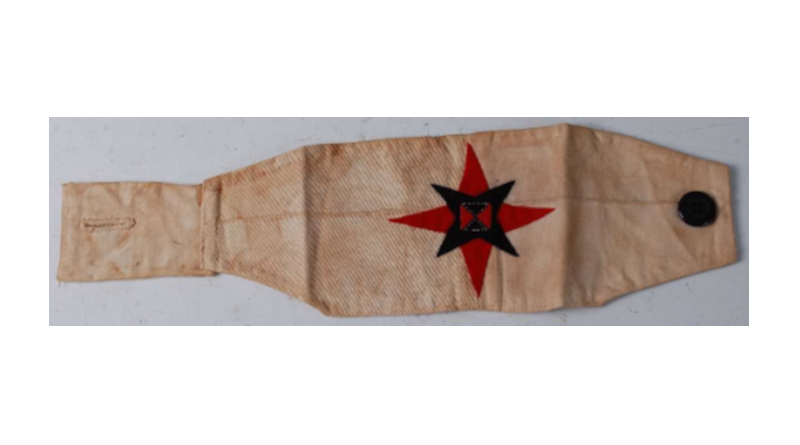
Friends War Victims Relief armband
The Friends War Victims Relief armband represents Quaker humanitarian service as an active response to war.
Friends War Victims Relief
This armband dates from the First World War and identified a volunteer working for Friends War Victims Relief. Its Quaker Star uses the design adopted in the early twentieth century. Those who wore armbands like this entered communities affected by war not to take part in the fighting, but to help civilians caught in its consequences.
The organising body behind the armband had an older history. The Friends War Victims Relief Committee (FWVRC) was first formed by British Quakers during the Franco-Prussian War of 1870 - 1871. Its work responded to immediate needs but also sought to help communities recover.
Friends provided food and other assistance, helped farmers plough and sow their fields, and worked among civilians whose homes and livelihoods had been disrupted.
Relief without taking sides
The committee worked on the principle that relief should be given according to need rather than nationality, religion or political allegiance. This allowed Quaker volunteers to assist civilians on different sides of a conflict without abandoning their opposition to war itself.
The FWVRC was revived when later conflicts created new humanitarian crises. During the Bulgarian uprising of 1876, Quaker workers helped rebuild homes for hundreds of families. During the Balkan Wars of 1912, Friends provided medical assistance and worked with refugees in Constantinople.
Rebuilding what war destroyed
The First World War brought the FWVRC into a much larger relief effort. From 1914, volunteers worked with refugees and civilians in France and elsewhere in Europe. Their work included medical care, housing and agricultural reconstruction.
Rather than providing only emergency supplies, Friends often concentrated on helping communities support themselves again. They supplied seeds, tools, livestock and agricultural machinery, helped restore damaged farmland and established medical services for civilians.
Prefabricated wooden houses were also developed so that homes could be erected quickly for families displaced by the fighting.
The work offered Friends a practical way of responding to war without participating in violence. Opposition to fighting did not require withdrawal from those affected by it. Relief workers instead placed themselves among civilian populations and dealt directly with some of war's consequences.
A continuing response to war
The FWVRC was revived again in 1940 as bombing created urgent civilian needs in Britain. Its work soon became part of the Friends Relief Service, which supported people affected by the Second World War and later worked in mainland Europe with displaced people and survivors of Nazi persecution.
These successive relief efforts contributed to a wider tradition of Quaker humanitarian work. In 1947, that tradition received international recognition when the British Friends Service Council and American Friends Service Committee were jointly awarded the Nobel Peace Prize.
The armband belonged to the practical work behind that history. For the civilians who encountered its wearer, it identified someone who had come to provide relief rather than take part in the conflict. In the middle of war, that distinction gave a simple piece of cloth a clear purpose.