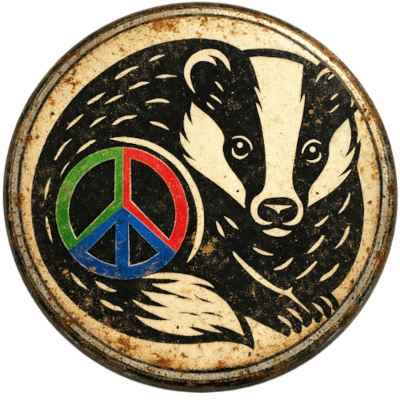
Vietnam Witness For Peace Badge
Vietnam Witness For Peace Badge captures the early, global witness of Friends against the rising tide of militarisation and the emerging conflict in Vietnam.
Quaker resistance to the Vietnam War
Among the earliest and most evocative artefacts of Quaker resistance to the Vietnam War is the Vietnam Witness for Peace badge, produced in the United States in 1961. Simple, modest, and deeply rooted in the spirit of the Peace Testimony, it predates both the dramatic escalation of the war and the mass anti-war movement. At a time when most Americans were only dimly aware of U.S. involvement in Southeast Asia, Friends were already sensing the direction of policy and responding with faithful, visible witness. This badge is therefore not just a historical object but a symbol of the clarity and moral foresight that often characterise Quaker engagement with unfolding conflicts.
United States
The badge arose in a context where American Friends were already voicing concern about militarisation long before Vietnam became a household word. In 1961, the American Friends Service Committee (AFSC) and other Quaker bodies were issuing careful warnings about Cold War brinkmanship, nuclear danger, and the misuse of military power as a means of securing global influence. For Friends, “witness for peace” was not simply a slogan but an entire orientation: a commitment to nonviolence, human dignity, and forms of engagement that refused to mirror the hostility of geopolitical rivalry.
As the decade progressed, Quakers in the United States played a distinctive role-challenging policy, supporting conscientious objectors, advocating for negotiation, and providing humanitarian relief in both North and South Vietnam. The badge, created before these efforts reached national visibility, anticipated the much larger Quaker contribution that followed. Its early date is part of what makes it significant: it is not a product of hindsight but an artefact of early prophetic resistance.
Britain
Across the Atlantic, British Friends followed developments in the United States with both solidarity and concern. Although the badge itself is American, its message resonated strongly with British Quakers, who shared a long tradition of public, peaceful testimony. In Britain, Friends were active in quiet diplomacy, refugee support, conscientious objection work, and engagement with policymakers. Wearing a badge like this would have fit naturally within British Quaker culture, where outward symbols-small, unobtrusive, but spiritually grounded-helped keep peace witness rooted in daily life.
For British Friends observing U.S. policy unfold, the badge stands as a reminder that American Quakers were among the earliest voices urging an alternative course, long before the conflict gained the attention of world media. It helps illuminate how peace witness can cross borders, shaping dialogue between Quaker communities worldwide.
Rest of the world
Globally, Quaker responses to Vietnam formed a rich network of humanitarian service and peace advocacy. Canadian Friends supported refugees and peace education; European Friends carried out relief efforts; and individual Quakers such as Nancy Pocock travelled repeatedly to Vietnam, assisting civilians, supporting negotiations, and bearing witness to the suffering that war produced.
In this broader context, the badge becomes more than a U.S. token-it symbolises a truly international Quaker conscience. It represents how Friends across the world shared an instinctive and united response: that war was neither inevitable nor moral, and that peace must be actively made through compassion, dialogue, and presence.
Easter 1961
The wording on the badge 'Witness for Peace' -connects directly with the Easter 1961 vigils held across the United States. These gatherings, drawing thousands in Washington, D.C. and many more in local communities, expressed a quiet but resolute call for alternative paths to security and global stability. Quakers played a central role in organising and supporting these silent vigils, which deliberately offered a spirit of calm moral clarity amidst rising national anxiety.
These Easter actions occurred well before Vietnam became a defining issue of the 1960s. That timing enhances the badge’s significance: it is an original artefact of the early, hopeful moment when Friends sought to steer national consciousness away from violence before escalation took hold. In this sense, the badge embodies both the courage and the foresight of 1961 Quaker witness-a testament to the enduring belief that peace must be proclaimed early, visibly, and without waiting for majority agreement.
Leave a comment