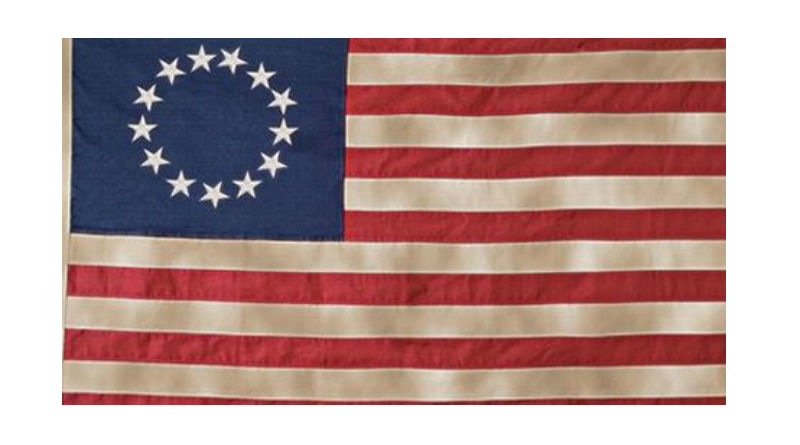
Betsy Ross flag
The forerunner to the current United States flag, the Betsy Ross flag is named after a 'Free Quaker' seamstress.
Betsy's beginnings
From a Quaker family, like many in Pennsylvania at the time, Betsy Ross (1752 - 1836) was born Elizabeth Griscom. Once her school education had ended, her father had Betsy apprenticed to an upholsterer.
It was as an upholsterer that she met her future husband, John Ross, whose uncle George Ross was a signatory on the Declaration of Independence. Since John belonged to the Church of England, the Quaker community frowned upon the couple marrying. So, they eloped when Betsy was 21.
After the elopement, her family estranged her, and her Quaker Meeting expelled her for marrying outside the faith. Her husband died a few years later during the Revolution.
Free Quakers
Betsy Ross was one of several hundred Quakers strongly drawn to the revolutionary cause, many of whom lent their support to resistance against the British.
Like other religious groups, the Society of Friends found itself divided by the war. A significant minority of Quakers went on to pay war taxes and enter military service, convinced in conscience that taking up arms against the British was justified, despite the Friends' Peace testimony.
North American Quakers, as a body, disowned any member who served in the military. By the war's end, almost 1,000 Friends had been disowned this way, the bulk of them for bearing arms.
In 1781, a few of these disowned Friends, including Ross, broke away and formed the Society of Free Quakers in Philadelphia. This small group was a refuge for Friends who actively supported American independence as well as the principles of Quakerism.
Once the war ended, Free Quaker numbers began to dwindle, as some members died and others were welcomed back into the Society of Friends or found a home in different congregations. The Free Quakers held their final meeting in 1836.
Today, the descendants of the original Free Quakers hold an annual meeting at the Free Quaker Meeting House, Philadelphia, established in 1783.

American folklore
According to folklore, the original flag was made in June 1776. This was when a small committee including George Washington, Robert Morris and George Ross visited Betsy to discuss the need for a new American flag.

The committee gave Betsy a design, but she altered it, changing the common six-pointed star to the five-pointed star.
Other than the say-so of her family, there is no tangible evidence supporting Ross' design and creation of the first American flag. However, much circumstantial evidence against her role in creating the flag exists.
This includes no records of a flag design committee, and no mention of such a meeting in letters or diaries from the period.
The Pennsylvania State Navy Board paid Ross a significant sum for making 'ship's colours', though there is no record confirming these matched the stars-and-stripes design.
Legacy of the flag
While Betsy Ross may not have designed the flag, legend around her supposed creation persists as part of American folklore. The story first started to circulate in popular consciousness around the 1876 centennial, allegedly passed down through the Ross family.
Ross was first buried at the Free Quaker burial grounds on Fifth Street, Philadelphia.
In 1975, in preparation for the American Bicentennial, her remains were moved to the courtyard of the Betsy Ross House, the home where she lived and which still stands today as a popular tourist attraction.
Whatever the truth of the story, the flag itself remains — stripes and stars, a Quaker seamstress's name stitched into it for good.