Liberty Bell
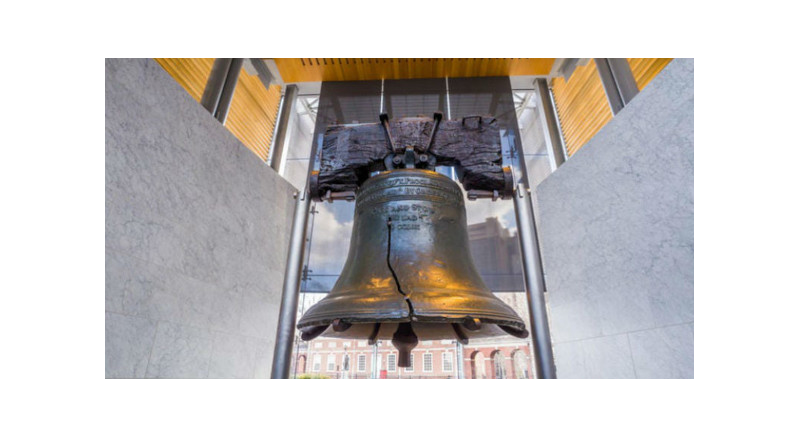
The Liberty Bell is a bronze bell, commissioned in 1751 to mark the 50th anniversary of Pennsylvania's Charter of Privileges.
Religious and civil freedoms
To mark the occasion, the Assembly of Pennsylvania commissioned a 'great bell' for the Pennsylvania State House. The 'great bell' was made in London and finally arrived in Philadelphia during August 1752. Upon its first ringing, a crack appeared in the bell and it had to be recast.
Officially known as the State House Bell, it soon became colloquially known as the 'Quaker Bell' as Philadelphia had so many Quakers living within its city.
As the official bell of the Pennsylvania State House (today called Independence Hall), it rang many times for public announcements. Most notably, it is said to have rung on 8 July 1776 to announce the first public reading of the Declaration of Independence.
An icon of American freedom, the bell carries the inscription:
“Proclaim LIBERTY throughout all the Land unto all the inhabitants thereof” (Leviticus 25:10).
Becoming a national symbol
Abolitionists first applied the name 'Liberty Bell' to the State House Bell in 1839, in an antislavery pamphlet. The name further caught on when, in 1847, the writer George Lippard published his popular story called Fourth of July, 1776.
In the story an aged bellman on 4 July 1776 is sitting morosely by the bell, fearing that Congress would not have the courage to declare independence. At the most dramatic moment, a young boy appears with instructions for the old man to ring the bell.
Lippard's story was fiction, not a record of what the real bell had done. Many Americans made the connection anyway, tying Philadelphia's 'great bell' with the freedom fought for in the Revolutionary War.
From then on, the name Liberty Bell stuck, and it became a national symbol — crack and all.
Over a century later, in 1893, former President Benjamin Harrison would say of the bell:
“This old bell was made in England, but it had to be recast in America before it was attuned to proclaim the right of self-government and the equal rights of men.”