
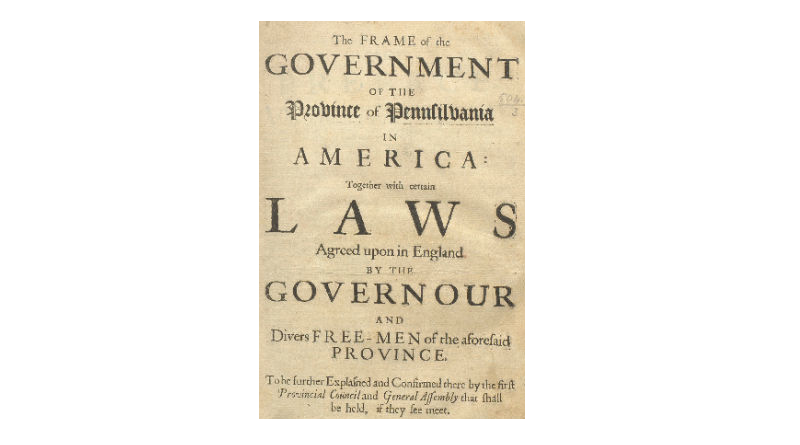
The Frame of the Government...
The Frame of the Government of the Province of Pennsylvania was written by the Quaker William Penn in 1682.
Granting of land
In 1681, King Charles II of England granted Penn land on the west bank of the Delaware River. Charles named Pennsylvania in honour of Penn's father, Admiral Sir William Penn.
The grant repaid money the Crown owed the admiral: back pay for his naval service and a separate loan made after the English Civil War.
Penn, a member of the Society of Friends, envisioned Pennsylvania as a refuge for Quakers and other persecuted groups. He argued for religious toleration on pragmatic and moral grounds, believing a tolerant society would prosper.
First governor of Pennsylvania
In 1682, Penn left England to become the first governor of Pennsylvania.
For Penn, the Frame was not simply clever statecraft. It gave force of law to a conviction he had suffered for in England.
That conviction meant freedom of worship was to be absolute.
He sought a framework to frustrate corruption and prevent any ruler from assuming unchecked power, employing a balance of powers that later influenced the framers of the United States Constitution.
To let the Frame evolve, Penn included an amending clause — the first such provision in any written constitution, and a quiet acknowledgement that his work was never meant to be finished.
The Charter of Privileges
The Frame of the Government of Pennsylvania underwent three major revisions, in 1683, 1696 and 1701. The final revision became known as The Charter of Privileges and remained in force until the Declaration of Independence in 1776.
Penn signed the Charter of Privileges for the Province of Pennsylvania and its Territories before sailing back to England. It set out a distinctive form of representative government for the New World.
Historians argue that the Charter helped lay foundations for American traditions of civil liberty, among them separation of church and state, representative self-government and freedom of religious conscience.
In 1751, to mark the 50th anniversary of Penn's Charter of Privileges, the Liberty Bell was commissioned for the Pennsylvania State House, though it cracked before ever ringing in celebration.
Influence of Magna Carta
The Frame of the Government, together with its accompanying 'Laws Agreed upon in England', drew several provisions from Magna Carta.
Law V insisted that 'All courts shall be open, and justice shall neither be sold, denied nor delayed,' echoing clause 40 of Magna Carta: 'To no one will we sell, to no one deny or delay right or justice.'
Two further laws required that trials be conducted swiftly, and that fines be kept moderate and proportionate to the offence, reflecting clause 20 of Magna Carta.
It marked the first occasion on which an American colony explicitly wrote Magna Carta into its founding constitutional framework.
Penn never saw his Frame of Government stand unchanged. It was revised three times in 19 years, rightly so, since he had built it to bend rather than break.
Ninety-four years after he wrote it, the colony he founded on liberty of conscience helped found a nation on the same idea.