
Quakers and prison
Across four centuries, the Society of Friends moved from being imprisoned for conscience to organising relief, shaping reform, and sustaining a quiet, restorative presence inside prisons.
Places of lived experience
From the earliest years of the Quaker movement, prisons were not distant institutions but places of lived experience. Long before Friends became associated with prison reform, they were prisoners themselves — confined, fined, and punished for conscience. Over centuries, this experience shaped a distinctive Quaker relationship with prisons: first as victims of persecution, then as organisers of relief, later as reformers, and finally as quiet witnesses questioning the very nature of punishment itself.
This story moves through the 17th century of persecution, the creation of Meeting for Sufferings as a coordinating body, and the widening of Quaker concern beyond Friends to prisoners as a whole. It includes a cautionary reform chapter in Pennsylvania, and a contrasting reform tradition in 19th century Britain shaped by Elizabeth Fry. It ends with modern Quaker chaplaincy and restorative practice, where silence and dignity remain central.
17th century: Imprisonment as testimony
The Society of Friends emerged in the 1650s during the unsettled decades following the The English Civil War Period. Quakers challenged both religious and civil authority by refusing to swear oaths, rejecting paid clergy, preaching without licence, and insisting on spiritual equality. These acts were criminalised, and imprisonment became a routine response.
Gaols of the 17th century were brutal places. Prisoners were not separated by offence or age, sanitation was minimal, and survival often depended on outside support. Disease was rife, and death in custody was common. For early Friends, imprisonment was not exceptional — it was a foreseeable consequence of faithfulness.
The story of James Parnell powerfully illustrates this reality. Arrested in Colchester while still a teenager, Parnell was acquitted by a jury but refused to pay a fine that implied guilt. Returned to prison, he was confined in appalling conditions, forced to climb a rope to receive food. His health deteriorated rapidly, and he died in prison in 1656. His death made him one of the earliest Quaker martyrs, later commemorated by a plaque at Colchester Meeting House.
Parnell was one among many. George Fox himself was imprisoned repeatedly, including at Lancaster Castle. The surviving key from Lancaster Prison has become a symbolic object, representing not only confinement but endurance and spiritual resolve. By the 1660s, thousands of Friends had experienced imprisonment, embedding prisons deeply into Quaker collective memory.
Meeting for Sufferings: Organising care and protest
As persecution intensified, Friends recognised that suffering needed organised response. In 1676, Meeting for Sufferings was formally established in London. Its purpose was practical and urgent: to record imprisonments, support imprisoned Friends and their families, collect funds, and petition authorities for relief.
Meeting for Sufferings documented fines, confiscations, and deaths in custody. It gathered testimony about prison conditions and sought redress through legal and political channels. This marked a turning point. Imprisonment was no longer endured only as individual witness but addressed collectively, with coordination, record-keeping, and advocacy.
Over time, Meeting for Sufferings became the recognised public voice of Quakers in Britain. Its origins in prison support shaped its long-standing concern with justice, law, and the treatment of those held by the state — a concern that would later extend far beyond Quaker prisoners alone.
From Quaker prisoners to concern for all prisoners
By the late 17th century, the worst legal penalties against Friends began to ease, particularly after the Toleration Act of 1689. Mass imprisonment for religious nonconformity declined. Yet the experience of prison had left a deep mark. Friends did not forget the gaols they had inhabited; instead, their attention widened.
Quakers increasingly visited prisons to observe conditions faced by all prisoners. They encountered overcrowding, corruption, the imprisonment of women and children, and systems that punished without regard for rehabilitation. A moral shift occurred: concern moved from the injustice of imprisoning Friends to the injustice of imprisonment itself.
This change laid the foundation for a new phase of Quaker engagement — one that sought not simply relief, but reform.
The Pennsylvania experiment: Solitary confinement and the “Eye of God”
Nowhere was this reform impulse more visible — or more troubling in hindsight — than in Pennsylvania. In the late 18th and early 19th centuries, prison reformers in the state developed what became known as the Pennsylvania system, rooted in ideas of penitence, reflection, and moral transformation.
This approach reached its fullest expression in Eastern State Penitentiary in Quaker-funded Philadelphia, which opened in 1829. Prisoners were held in complete solitary confinement, each in a single cell. The architecture was deliberate and symbolic: every cell had a small opening or skylight in the ceiling, intended to allow light to fall directly from above. This was often described as representing the “Eye of God” — a constant moral presence encouraging reflection and repentance.
Quakers were involved in the reform movement that gave rise to this system, particularly through the Pennsylvania Prison Society, which included Friends alongside non-Quakers. While Eastern State was not a Quaker-run prison, its philosophy drew on religious ideas familiar to Quakers: inward reflection, conscience, and moral transformation.
Yet the reality proved devastating. Prolonged solitary confinement caused severe psychological harm. Prisoners suffered mental breakdowns, hallucinations, and despair. What had been envisioned as humane reform became, in practice, a new form of cruelty.
The Pennsylvania experiment stands as a sobering chapter in Quaker-adjacent prison history. It shows how sincere moral intention, when allied to rigid systems and unchecked authority, can lead to harm. In later generations, Friends would look back on solitary confinement with deep unease, contributing to modern Quaker opposition to its use.
19th century: Elizabeth Fry and humane reform
While the Pennsylvania system pursued reform through isolation, other Quakers emphasised human presence and dignity. The most influential figure here is Elizabeth Fry.
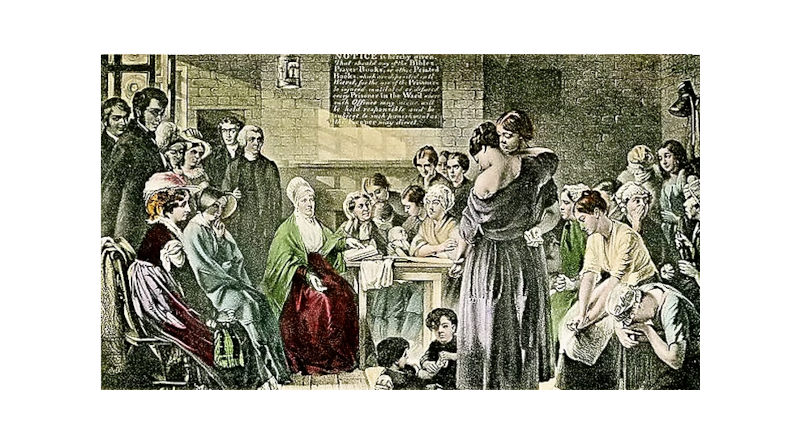
Born into a Norwich Quaker family, Fry was deeply shaped by Quaker testimonies of equality and compassion. Her visit to Newgate Prison in London in 1813 revealed women and children living in chaotic and degrading conditions. Fry responded with practical, organised action.
She established schooling for children, provided clothing, and introduced structured routines that restored a sense of order and self-respect. In 1817, she helped found the Association for the Improvement of the Female Prisoners in Newgate. Her work extended beyond charity into advocacy, influencing parliamentary debate and prison legislation, including reforms associated with the Gaols Act of 1823.
Fry's approach contrasted sharply with solitary systems. She believed change arose not from isolation, but from dignity, education, and moral support. Her influence spread internationally, and her appearance on the Elizabeth Fry £5 note reflects her lasting legacy.
20th century: Chaplaincy and quiet presence
In the 20th century, Quaker prison engagement continued through chaplaincy and visiting. Friends served within prisons not as enforcers or reform designers, but as listeners and companions. Silent worship, conversation, and presence became central practices.
This work reflected continuity with earlier centuries. Where once Friends had been confined in cells, they now sat alongside prisoners in stillness. The prison remained a place where Quaker testimonies — peace, equality, and integrity — were tested in lived experience.
Contemporary practice: Restoration and stillness
Today, many Quakers engage with prisons through restorative justice, questioning whether punishment alone can ever repair harm. Some Friends explore alternatives to incarceration, while others focus on improving conditions and supporting those inside.
Quaker prison chaplaincy remains common and an example of their work with prisoners is the creation of the Quaker-led Quiet Session Table.
A powerful modern symbol of this work is the Quaker-led Quiet Session Table, crafted by a prisoner during a Quaker-facilitated silence group. The table embodies shared humanity, dignity, and stillness — values that have accompanied Friends into prisons for centuries.
A long arc of witness with bars
From the death of James Parnell to the creation of Meeting for Sufferings; from the failures of the Pennsylvania experiment to the successes of Elizabeth Fry; from solitary cells to shared silence, Quakers' relationship with prisons traces a long moral arc.
Prisons were once places where Quakers suffered for conscience. Over time, they became places where Friends sought to relieve suffering, reform systems, and ultimately question the ethics of confinement itself. Throughout, one conviction has endured: that even behind bars, there is that of God in every person.