
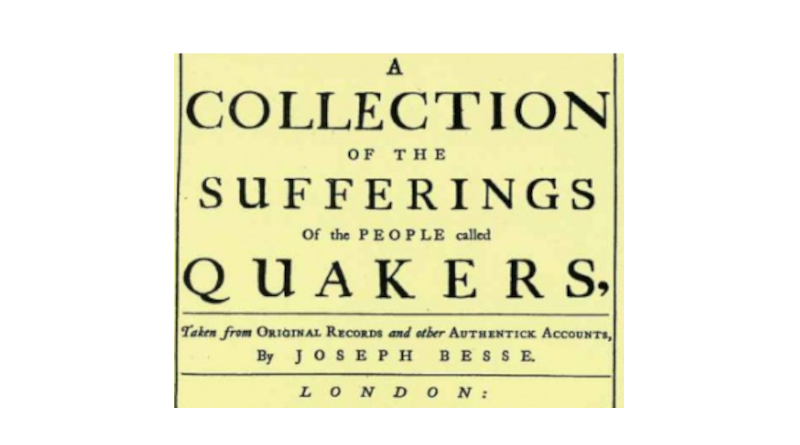
Collection Of The Sufferings publication
The Collection of the Sufferings is a 1753 written compilation that chronicles the various persecutions and imprisonments of Friends during the first 100 years of their existence.
Sufferings through the ages
When Quaker writer Joseph Besse published A Collection of the Sufferings of the People Called Quakers (full title) in 1753, he created one of the most important reference works in the history of the Society of Friends. His two-volume folio gathered together more than a century of persecution: imprisonments, fines, distraints, beatings and harassment faced by Quakers across Britain, Ireland, the Americas and Europe.
Besse's publication did not stand in isolation. It sits in a direct line of descent from the earlier Great Books of Sufferings, a series of manuscript volumes compiled in London between the mid seventeenth and mid nineteenth centuries. These books recorded, case by case, the 'sufferings' endured by Friends for conscience' sake. Besse's achievement was to transform this sprawling archival body into a structured historical narrative, turning local reports into a national and international story.
Joseph Besse and his publication
Joseph Besse, a learned Friend and writing master born around 1683, undertook an enormous labour: to gather, systematise and publish the history of Quaker persecution from the earliest years of the movement. Working from London, he had access to the accumulated archives of Meeting for Sufferings and local meetings across Britain and beyond.
His publication, issued in 1753, was arranged geographically. The first volume covers England and Wales, county by county. The second ranges further afield, taking in Scotland, Ireland, continental Europe, the Caribbean and North America. Each entry typically records the names of Friends, the dates of arrest or fining, the goods confiscated, the legal reasons given and often the outcome. Magistrates and officials are sometimes named; Friends' own statements in their defence are occasionally preserved.
The effect is remarkable. Besse's folio reads like an early human-rights record compiled with religious conviction and administrative precision. It became, and remains, a foundational way in which Friends understand their own early history of witness under pressure.
The Great Books of Sufferings
To see Besse's work in a wider Quaker context, it helps to understand the Great Books of Sufferings themselves. Beginning in the 1650s, local meetings across Britain and Ireland were encouraged to record the persecutions faced by Friends. These reports were regularly sent to London, where appointed clerks entered them into large manuscript volumes held under the care of the central body that became Meeting for Sufferings.
Over roughly two centuries, forty-four manuscript books were created. They were organised chronologically and geographically, covering Britain, Ireland, the American colonies, Europe and the West Indies. The entries describe fines for refusing to pay tithes, imprisonment for unlawful worship, seizure of property, violence and harassment, pressures to take up arms and a wide range of other legal penalties imposed on Friends because of their beliefs and practices.
The tone throughout is factual, measured and clear. Early Friends believed that truthful reporting was both a spiritual discipline and a practical necessity. The Great Books of Sufferings were kept to provide evidence of persecution, to support legal appeals, to inform petitions to the Crown or Parliament, and to give national oversight to the young movement. They helped distant meetings to feel part of a single story.
Is Besse's work one of the Great Books?
Besse's Collection of the Sufferings is not itself one of the Great Books of Sufferings. The Great Books are manuscript record volumes maintained continuously by the clerks of Meeting for Sufferings. They are working documents, never intended for wide circulation, and they remain in their original handwritten form.
Besse's 1753 work is a printed, organised publication created by a single author drawing heavily from those manuscripts. It is a public distillation of the manuscript tradition. Without the earlier Great Books, Besse's publication could not have been compiled. Without Besse, the manuscript volumes would have remained largely unknown outside Quaker circles.
The two are closely linked. The Great Books record the raw history of persecution; Joseph Besse interprets, arranges and publishes that history for a broader audience. Both are essential for understanding how Meeting for Sufferings came to see itself as the guardian of the Society's collective memory of suffering.
The creation and evolution of Meeting for Sufferings
The existence of centrally gathered records of persecution led directly to the formation of Meeting for Sufferings in 1675. London Yearly Meeting appointed a standing committee to oversee and coordinate reports of suffering, to represent Friends to government, to respond quickly to crises and to maintain national cohesion. This committee took its name from the work it was charged to oversee.
As the years passed and persecution gradually waned, Meeting for Sufferings did not simply dissolve. Its role broadened and deepened. It oversaw national Quaker business, ensured that discipline was carried out consistently across the Yearly Meeting, approved publications and acted as the main forum in which Friends could consider matters too large for individual meetings to manage alone. By the time Besse was compiling his work, Meeting for Sufferings was already functioning as the effective “parliament” of the Society in Britain.
Meeting for Sufferings today
In modern Britain Yearly Meeting, Meeting for Sufferings continues as the central representative body of Friends. Each Area Meeting appoints members, who gather several times a year at Friends House in London and, increasingly, online. The nature of 'sufferings' has changed: Friends in Britain are no longer imprisoned en masse for worship or fined for refusing tithes. Yet the need for shared discernment and corporate witness remains.
Today, Meeting for Sufferings:
- oversees long-term strategic concerns of Britain Yearly Meeting
- holds trustees and central bodies to account
- receives reports on national Quaker work and public witness
- guides statements on peace, climate justice, equality and truth
- helps articulate the spiritual priorities of Friends in Britain
In all this, the meeting continues the spirit of its original charge: to respond faithfully when Friends or others face injustice, and to keep the community attentive to the leadings of the Spirit.
Meeting for Sufferings in a global Quaker context
Although Meeting for Sufferings is central to the organisation of Quakers in Britain, it is a uniquely British institution. No other Quaker Yearly Meeting in the world uses the same name or maintains an identical structure. The body arose in the specific conditions of seventeenth century England, when Friends faced consistent persecution and needed a central committee to record fines, imprisonments, the seizure of goods and other 'sufferings'. As these reports accumulated, Meeting for Sufferings became the natural place for national coordination, defence and witness.
Elsewhere in the Quaker world, Friends developed different systems. American Yearly Meetings formed representative councils such as permanent boards, standing committees or life councils. Yearly Meetings in Australia, Aotearoa New Zealand, Southern Africa and Europe also rely on standing committees or clerks' groups that meet between annual sessions. These bodies may share some of the functions of Meeting for Sufferings - oversight, discernment and public witness - but they did not grow out of a centralised catalogue of persecution, nor do they carry the historical association with the Great Books of Sufferings.
Meeting for Sufferings therefore remains a distinctively British expression of Quaker organisational life: a body shaped by the trials of early Friends and sustained by the continuing need for shared discernment, national representation and faithful recording.
Legacy
Taken together, the Great Books of Sufferings and Besse's published Collection of the Sufferings form part of the documentary backbone of Quaker historical identity. They show how a persecuted religious minority adopted order, record-keeping and truth-telling as spiritual tools. The manuscript volumes record the lived experience of early Friends; the printed folio brings that experience into view for the wider world.
Neither Besse's publication nor Meeting for Sufferings replaced the Great Books. Rather, they illuminated and developed the tradition they inherited. Today, when Meeting for Sufferings gathers at Friends House, its members sit in continuity with both the clerks who patiently compiled the manuscript volumes and Joseph Besse, who shaped those records into a public testimony. Together, they remind Friends that faithful witness is strengthened by clear records, honest testimony and the courage to speak plainly about suffering and hope.