
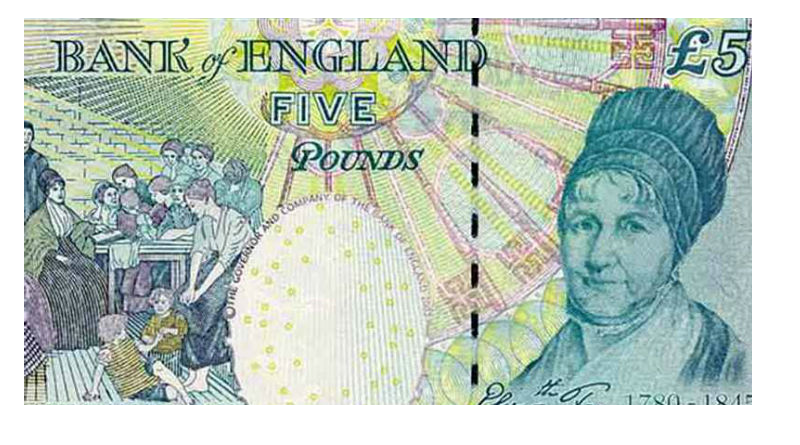
Elizabeth Fry £5 note
The Elizabeth Fry £5 banknote celebrated a pioneering Quaker reformer and later became the focus of a debate about women on British banknotes.
The woman on the £5 note
On 21 May 2002, the Bank of England introduced a new £5 note featuring Elizabeth Fry, issued on the anniversary of her birth. Queen Elizabeth II appeared on the front, while the reverse commemorated the Quaker whose prison reforms and philanthropy had earned her national recognition.
Fry's portrait was based on an engraving by Mary Martha Pearson, while the accompanying prison scene was inspired by Jerry Barrett's 1860 painting, Mrs Fry Reading to the Prisoners in Newgate in the year 1816.
The design also included prison keys, scissors and cotton reels, reflecting Fry's efforts to improve conditions and provide useful employment for women prisoners.
A woman in public life
Elizabeth Fry first visited London's Newgate Prison in 1813, where she encountered women and children living in overcrowded and degrading conditions.
She returned in 1816 and, guided by her Quaker faith, began organising practical assistance, education and employment for prisoners, working alongside other women who shared her concerns.
Her success brought growing public recognition. In 1818, Fry became one of the first women to give evidence before a parliamentary committee. Her campaigning contributed to reforms introduced under the Gaols Act of 1823.
Such public prominence was unusual for a woman in early 19th-century Britain. Fry faced criticism from those who believed her responsibilities should remain within the home. Fry herself was uneasy about the growing demand for her portrait, questioning the attention given to outward appearance.
Her influence nevertheless reached the royal household. In 1831, Fry met the young Princess Victoria and her mother, the Duchess of Kent, bringing books about slavery. In 1840, Queen Victoria donated £50 towards a refuge supported by Fry and received her at Buckingham Palace.
Through philanthropy, public speaking and organised reform, Fry had established herself as a respected public figure in a society where women were largely excluded from political power.
Women on British banknotes
The Bank of England began commemorating historical figures on its banknotes in 1970, but women remained poorly represented.
Florence Nightingale became the first historical woman to appear on a Bank of England note in 1975, featuring on the £10 denomination. When Fry joined her in 2002, the recognition extended to another woman whose humanitarian work had helped shape British society.
Yet this recognition was not permanent. In April 2013, the Bank announced that Winston Churchill would replace Fry on the £5 note, raising the prospect that no woman other than the Queen would appear on Bank of England notes.
The announcement raised a wider question about whose achievements Britain chose to commemorate.
The campaign for recognition
Journalist Caroline Criado Perez launched a campaign calling for women to remain represented on Bank of England notes. Her petition attracted tens of thousands of supporters, challenging the prospect of an entirely male selection of historical figures.
In July 2013, the Bank announced that novelist Jane Austen would appear on the new £10 note. Later that year, the Bank announced changes to the way historical figures would be selected for future banknotes.
The polymer £5 note featuring Churchill entered circulation in September 2016, and Fry's paper note ceased to be legal tender on 5 May 2017. Jane Austen's £10 note followed in September that year.
Elizabeth Fry had gained public recognition in an age when women's opportunities were restricted. More than a century and a half after her death, the removal of her portrait from a £5 note helped provoke a new debate about the recognition of women's achievements in British history.
