
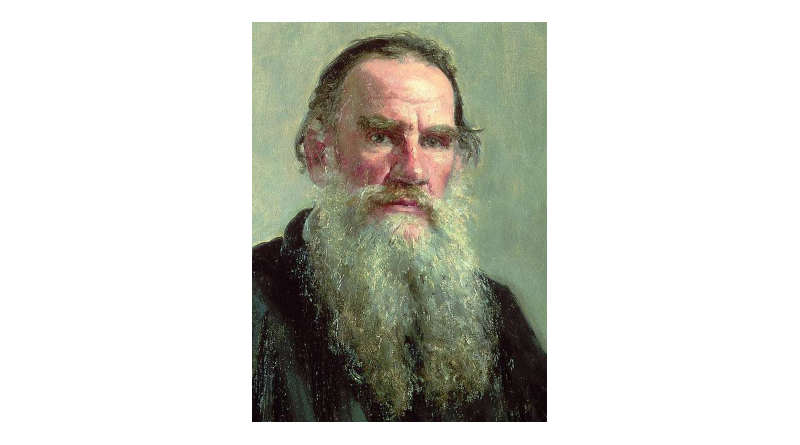
Leo Tolstoy: Writing the moral roots of modern nonviolent resistance
Russian novelist Leo Tolstoy (1828 - 1910), author of War and Peace and Anna Karenina, helped write the moral foundations of the modern tradition of nonviolent resistance.
A novelist with an unexpected influence
By the end of the 19th century Leo Tolstoy had become one of Europe’s most celebrated novelists. Yet his later writings moved beyond literature into a deeper question: whether any system built on violence could ever be morally justified.
Although Tolstoy never organised political movements himself, his ideas travelled far beyond Russia. Through readers inspired by his work, they entered struggles for justice across the world, shaping a tradition of resistance grounded not in force, but in conscience.
Tolstoy’s spiritual turning point
In the 1870s Tolstoy experienced a profound spiritual crisis. Despite his literary fame and wealth, he began to question the meaning of his life and the moral foundations of the society around him.
This crisis led him to a radical reinterpretation of Christianity. Tolstoy came to believe that the teachings of Jesus, particularly the Sermon on the Mount, demanded a complete rejection of violence. Christians, he argued, should refuse to participate in war, coercion and injustice.
He increasingly rejected the privileges of aristocratic life, dressing more simply, giving away wealth and questioning the social hierarchy of Russian society.
These convictions would shape his later writings and place him among the most influential critics of violence and state power in the modern world.
The moral philosophy of non-resistance
Tolstoy developed these ideas most fully in his book The Kingdom of God Is Within You, published in 1894. In it he argued that true Christianity requires what he called “non-resistance to evil by violence.”
For Tolstoy, refusing violence was not passive submission, but an active form of moral resistance rooted in truth and love.
Governments, he argued, ultimately rely on violence to maintain authority. A person committed to conscience must therefore refuse to take part in war or oppression, even if that refusal brings punishment.
In this work Tolstoy also recognised that small Christian communities had already been living out these principles.
“The doctrine of non-resistance has been professed by a minority of men since the very beginning of Christianity. Among these are the Quakers, the Mennonites, and other small Christian sects who have refused military service.”
Tolstoy saw in these communities proof that nonviolence was not merely an idea, but a way of life already being practised.
The Doukhobor protest of 1895
One dramatic example of these principles in action came in 1895 with a pacifist Christian community known as the Doukhobors.
On the night of 28–29 June 1895, thousands gathered in villages across southern Russia. In a powerful act of protest, they piled their rifles and swords into great bonfires and set them alight, rejecting military service and the use of violence.
As the flames rose into the night sky, the Doukhobors stood around the fires singing psalms. Their protest was not only political but spiritual: a declaration that faith and violence could not coexist.
The Russian authorities responded harshly. Many were beaten, imprisoned or exiled. Tolstoy publicly defended them and used his international reputation to draw attention to their persecution. He even used royalties from his novel Resurrection to help fund their migration to Canada in 1899.
The episode showed that Tolstoy’s philosophy was not merely theoretical. Communities were already attempting to live it out in practice.
Tolstoy’s influence on Gandhi
Tolstoy’s writings soon reached readers far beyond Russia. Among the most important was the young Indian lawyer Mohandas K. Gandhi, who encountered Tolstoy’s work while developing his philosophy of resistance in South Africa.
Gandhi was deeply influenced by Tolstoy’s insistence that injustice must be resisted without violence. Where Tolstoy articulated the moral principle, Gandhi would go on to develop it into a disciplined method of collective action.
These ideas helped shape Gandhi’s concept of satyagraha, the organised use of nonviolent resistance to confront injustice.
The two men began corresponding in 1909. Their brief exchange of letters represented a remarkable meeting of generations: the elderly Tolstoy encouraging a younger activist whose ideas would soon reshape global politics.
“The law of love is the highest and the only law of human life.”
In 1910 Gandhi named a communal settlement in South Africa 'Tolstoy Farm', honouring the writer whose ideas had helped shape his approach to resistance.
The global tradition of nonviolent resistance
The modern tradition of nonviolent resistance did not emerge all at once. It developed through a gradual deepening and transformation of ideas across generations.
In the 19th century Henry David Thoreau argued that individuals must refuse to cooperate with unjust laws. Tolstoy expanded this into a moral philosophy rooted in conscience and religious conviction. Gandhi then transformed these principles into a collective strategy capable of mobilising thousands.
Through Gandhi’s example, this evolving tradition would later inspire the civil rights movement led by Martin Luther King Jr., and many other struggles for justice around the world.
Reflections on conscience, love and nonviolence
Leo Tolstoy never set out to lead a political movement. He remained, above all, a writer and moral thinker. Yet his reflections on conscience, love and nonviolence helped shape some of the most influential struggles for justice in modern history.
From the Doukhobors burning their weapons in 1895 to the campaigns of Gandhi and the civil rights movement led by Martin Luther King Jr., his central claim remained consistent: that violence is not a necessity of justice, but a failure of it.
Through his writings, Tolstoy helped establish a tradition in which resistance begins not with force, but with the refusal to participate in injustice at all.