
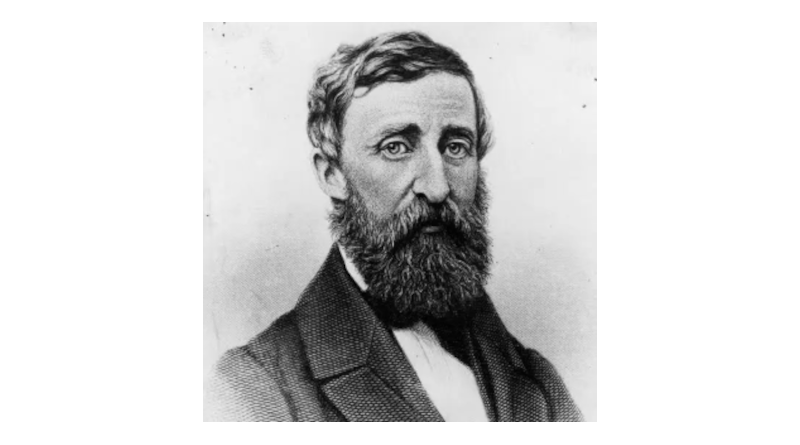
Henry David Thoreau: The forgotten father of civil disobedience
A quiet act of resistance in 1846 by American write Henry David Thoreau (1817 - 1862) helped shape the future of peaceful protest.
A quiet beginning
The modern philosophy of nonviolent protest is often associated with figures such as Mohandas K. Gandhi and Martin Luther King Jr. Yet one of its most important origins can be traced to a quiet act of protest by Henry David Thoreau.
Best known for Walden, his reflection on simple living and the natural world, Thoreau also gave the modern protest movement one of its most powerful ideas — that individuals have a moral duty to refuse cooperation with injustice.
He did not lead a mass movement or organise political campaigns. Instead, he developed an idea that would later inspire some of the most important struggles for justice in the modern world.
A protest against injustice
In 1846, Thoreau refused to pay a local poll tax in the United States. His reason was simple: he did not want to support a government that upheld slavery and was fighting the Mexican–American War.
Because of this refusal, Thoreau spent a night in jail.
The experience led him to write an essay that would later become famous around the world, Civil Disobedience, published in 1849. In it, Thoreau argued that individuals have a moral duty to resist unjust laws. For him, conscience mattered more than obedience.
“Under a government which imprisons any unjustly, the true place for a just man is also a prison.”
In doing so, Thoreau turned refusal into a form of resistance, showing that withdrawing cooperation could itself become a powerful political act.
The idea was radical for its time. Rather than using violence to overthrow injustice, Thoreau argued that citizens could refuse to cooperate with unjust systems.
From philosophy to political movement
Thoreau’s ideas remained relatively obscure during his lifetime. Yet decades later they found powerful readers far beyond the United States.
His idea of civil disobedience influenced a wider tradition of moral resistance that also shaped writers such as Leo Tolstoy. When Mohandas K. Gandhi was developing his philosophy of nonviolent protest in South Africa, he encountered Thoreau’s essay and recognised its importance.
Where Thoreau articulated the principle of resistance through conscience, Gandhi would go on to develop it into a disciplined method of collective action.
This transformation helped shape campaigns against British colonial rule. Gandhi developed these ideas into satyagraha, the organised practice of nonviolent resistance.
A chain of influence
The influence of Thoreau did not stop with Gandhi.
During the American civil rights movement of the 1950s and 1960s, Martin Luther King Jr. studied Gandhi’s methods and applied them to the struggle against racial segregation in the United States. In this way, an idea first expressed by Thoreau in a short essay helped shape movements for justice across the world.
Thoreau therefore occupies an important place in a longer historical chain: conscience challenging injustice through peaceful resistance.
An idea that travelled across generations
Thoreau never set out to create a global philosophy of peaceful protest. Yet his belief that individuals must follow conscience rather than obey unjust authority proved remarkably influential.
His ideas formed a bridge between moral thinkers such as Leo Tolstoy and the political movements later led by Gandhi and King.
Today the concept of civil disobedience remains one of the most important tools of peaceful protest. From environmental campaigns to human rights movements, activists continue to draw on the idea that injustice can be challenged through nonviolent resistance.
In that sense, the night Thoreau spent in jail in 1846 did more than mark a personal act of protest. It revealed a new way of resisting power — not by force, but by refusing to cooperate with it at all.