
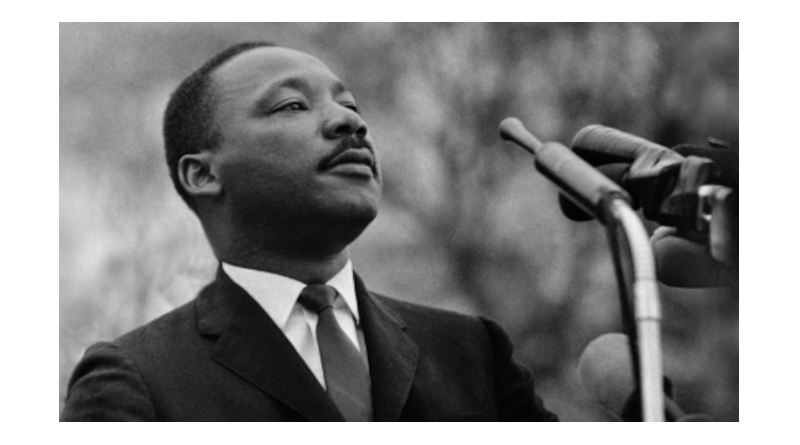
Martin Luther King Jr.: When nonviolence became a teachable method
Martin Luther King Jr. (1929 - 1968) turned nonviolent direct action into a teachable method by giving it a clear structure that could be repeated across movements.
A minister formed by segregation
Martin Luther King Jr. was born in Atlanta, Georgia, in 1929, into a family rooted in the Black Baptist church. Trained as a minister, he entered public life at a moment when segregation in the American South shaped every aspect of daily experience, enforced through both law and violence.
His involvement in nonviolent direct action emerged through the Montgomery Bus Boycott of 1955-1956, where he was drawn into leadership during a sustained campaign against racial segregation on public transport. Influenced by Christian theology, Gandhian nonviolence, and the strategic guidance of figures such as Bayard Rustin, King began to work within a form of resistance that rejected violence while confronting injustice directly.
From the beginning, the question was not only whether nonviolence was morally right, but how it could be used effectively in organised struggle.
The problem of protest without structure
King worked within a system where injustice was visible, daily, and enforced. Segregation was not abstract but built into ordinary life, upheld through law, custom, and intimidation. Those who resisted it faced arrest, harassment, and physical attack.
The problem was not only moral but practical. Violence risked reinforcing the system it opposed. Protest without structure could dissipate or turn destructive. What was needed was not simply protest, but a way of acting that could be learned, repeated, and carried forward without reproducing the logic of violence.
The question was not simply how to resist, but how to do so in a way that others could learn, repeat, and sustain.
“Freedom is never voluntarily given by the oppressor; it must be demanded by the oppressed.”
A method already in motion
King did not begin from nothing. The moral foundations of nonviolence had been articulated by Leo Tolstoy, while Henry David Thoreau had argued for the refusal of unjust laws. In India, Mahatma Gandhi demonstrated that nonviolence could operate as a method of collective action, organising campaigns that confronted political power without violence.
By the mid-20th century, nonviolent resistance had been argued and demonstrated, but it remained dependent on example. It had not yet been clearly structured in a way that could be systematically taught.
In the United States, Bayard Rustin played a crucial role in carrying these ideas forward. Having studied Gandhian nonviolence, he helped translate its principles into the context of the civil rights movement, shaping early campaigns and influencing emerging leaders, including King.
What King inherited was not a blank slate, but a method already in motion — one that required clarification and form. What was missing was not conviction or example, but a form that could be clearly taught.
The four steps of nonviolent direct action (1963)
King’s central contribution was to turn nonviolent direct action into something that could be taught, by giving it a clear, disciplined structure. He set this out most explicitly in 1963 while imprisoned in Birmingham, Alabama, during one of the most intense campaigns of the civil rights movement.
Writing from his cell in what became known as the Letter from Birmingham Jail, he explained that any nonviolent campaign followed four basic steps.
Collection of facts
The process began with understanding. Injustice had to be examined closely, not assumed. Conditions were investigated, evidence gathered, and the reality of the situation made clear. This grounded the campaign in truth rather than reaction.
Negotiation
Before direct action began, attempts were made to resolve the issue through dialogue. Nonviolence did not avoid engagement; it pursued it. Only when negotiation failed did the campaign move forward.
Self-purification
Preparation followed. Those involved were trained in discipline and asked whether they were ready to endure hostility without retaliation. This was not symbolic. It was a practical requirement, ensuring that action would not collapse into violence under pressure.
Direct action
Only then did action begin. Laws were broken openly, or normal activity disrupted, in ways that forced the issue into public view. The aim was not chaos, but tension — a tension that made injustice visible and unavoidable.
“Injustice anywhere is a threat to justice everywhere.”
This sequence mattered. Each step depended on the one before it. Remove the discipline, and action risked becoming reactive. Remove the preparation, and it could turn violent. What King described was not simply protest, but a process.
From example to teachable method
By setting out these steps, King transformed nonviolent direct action. What had existed as example became something that could be explained, taught, and reproduced.
This shift changed the scale at which nonviolence could operate. Campaigns no longer depended solely on a single leader or moment. They could be organised, prepared, and carried forward by others who understood the process.
Training became central. Workshops, preparation, and collective discipline allowed large numbers of people to act together without losing control of the method itself. Nonviolence was no longer only a moral stance or a powerful example. It became something that could be learned.
A method that could travel
Because it could be taught, the method could travel. It moved beyond individual campaigns and into wider movements, shaping how resistance was organised in the decades that followed.
Figures such as Rustin continued to develop and apply these principles, while the structure King articulated influenced movements for civil rights, social justice, and political change across different contexts.
The significance of King’s contribution lies here. He did not invent nonviolence, nor was he the first to use it. What he did was give it a form that others could take up.
Nonviolence became not only something that could be believed or demonstrated, but something that could be learned — and carried forward by others, beyond the limits of any single leader or movement.