| | by admin | | posted on 27th March 2026 | Artworks | | views 55 | |
The Problem We All Live With (1964) turns a walk to school into a confrontation with violence, exposing the tension between justice and hostility at the heart of desegregation.
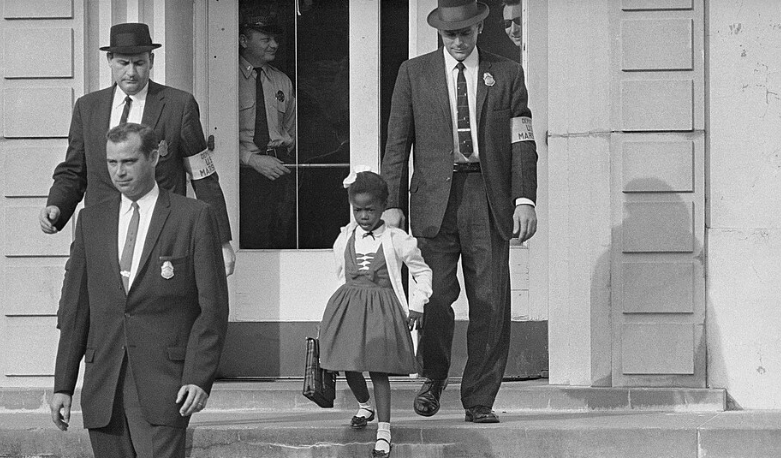
A small Black girl in a white dress walks across a pale, blank wall, her books held close, her stride steady. Around her move four U.S. marshals, their bodies cropped at the shoulders so that only torsos and arms remain, forming a protective structure without identity. The composition is tightly controlled, the girl centred and the figures advancing in step. Behind them, the wall is marked by a thrown tomato, already burst, and by racial slurs scrawled at a height above the child's head. What should be an ordinary journey is held in a field of tension.
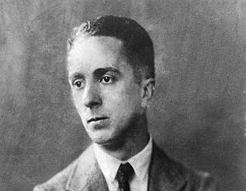
Painted by Norman Rockwell (1894 - 1978) with oil on canvas and measuring approximately 91 by 150 cm, the work uses clarity rather than distortion to make its point. Rockwell, the American illustrator and painter best known for his images of idealised American life, shifts here into something more exacting. The surface remains smooth, the forms precise, but the subject resists comfort. We are not being asked to interpret. We are being asked to witness.
Rockwell's painting draws on the real-life experience of Ruby Bridges, who in 1960 became one of the first Black children to integrate an all-white elementary school in New Orleans. Escorted by federal marshals, she walked past crowds who gathered to shout, threaten, and resist the enforcement of desegregation. Rockwell removes the crowd, but not its presence. Violence is displaced into traces: the graffiti, the broken tomato, and the pressure that enters from outside the frame.
This is not a depiction of chaos but of control under pressure. The state appears in the form of the marshals, ordered, faceless, and necessary. The child moves within that protection, but not beyond danger. The painting holds a contradiction in place: justice is being enacted, but it must be enforced against a hostile society. Protection and threat occupy the same space, and neither cancels the other.
In this work, peace is not presented as calm or resolution. It appears instead as movement sustained under pressure. The act of walking becomes a form of nonviolent presence, visible, deliberate, and exposed. The child does not confront the crowd directly, but neither does she withdraw. She continues forward.
The painting has become one of the most iconic images of the civil rights movement, widely reproduced as a visual statement of both vulnerability and resolve. It does not rely on spectacle or rhetoric. Its power lies in its refusal to look away from the conditions under which change occurs. Rockwell, once associated with reassuring images of American life, here produces something more demanding: a scene in which the nation is required to see itself without softening.
The destination is not shown. There is no school door, no point of arrival, no moment of safety. What we are given instead is the act itself, continuing across the surface.
The figures move step by step, held in formation, without resolution. The protection is real, but it is not complete; the progress is visible, but it is not finished. The painting does not close the distance it sets in motion.
And in that refusal to end, the walk continues — not contained within the frame, but carried forward beyond it, as something that must be repeated, sustained, and seen.