
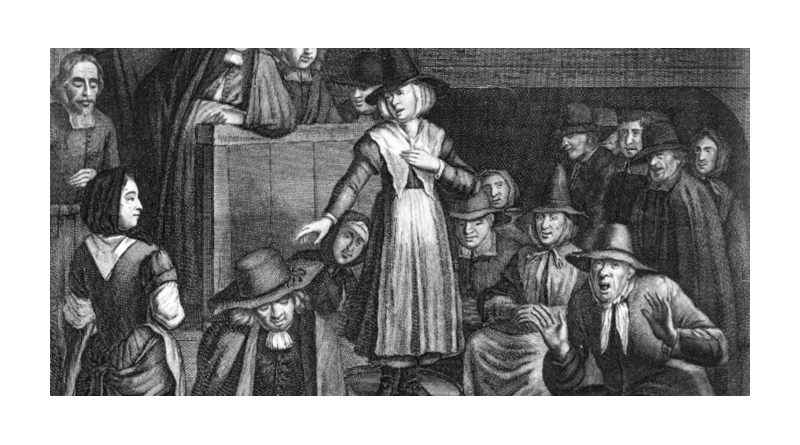
Quakers and women's rights
From the 17th century onwards, Quakers developed practices that treated women as spiritual equals, shaping women's rights movements through faith, organisation, and conscience-led action.
Spiritual equality from the outset
From their beginnings during the English Revolution, Quakers developed ideas about women and authority that were distinctive for their time. While the modern language of women’s rights lay centuries ahead, the Society of Friends placed spiritual equality at the centre of its faith, shaping patterns of worship and organisation that allowed women to speak, lead, and act publicly.
This history moves from theology and meeting practice in the 17th century, through organised reform and campaigning in the 19th century, and into present-day understandings of equality as a continuing concern in the 21st century.
17th century: Women Preachers
Early Quaker belief centred on the conviction that the The Inner Light could speak through any person, regardless of gender, class, or education. This was not an abstract principle. Women preached in public, wrote pamphlets, travelled as ministers, and directly challenged efforts to silence them.
In 1666, Margaret Fell articulated this position in her pamphlet Women's Speaking Justified. Drawing on scripture, she argued that God had always spoken through women and that denying women a voice was a failure of faith rather than tradition. Her work stands as one of the earliest sustained defences of women’s religious authority.
By the late 17th century, Quakers had established women’s meetings to oversee marriage, discipline, and welfare. These meetings gave women formal responsibility within the Society of Friends. While sometimes contested, they created rare and durable spaces for female decision-making in early modern Europe.
18th century: Leadership without slogans
Throughout the 18th century, Quaker women continued to act as ministers, elders, educators, and organisers. This period lacks dramatic turning points, but it is crucial. Equality was not argued for; it was practiced.
Quaker women were active in education, poor relief, prison visiting, and abolitionist work. These roles developed confidence, organisational skill, and public authority long before women were formally included in political life. As a result, Quaker communities quietly prepared women for leadership beyond the meeting house.
19th century: From Quaker practice to women’s rights movements
The 19th century marked a shift from internal equality to outward political action. In 1840, women delegates were excluded from speaking at the World Anti-Slavery Convention in London. For many Quaker women, this exposed a tension between moral reform and gender inequality.
In the United States, this tension helped lead to the Seneca Falls Convention of 1848. Quaker women were central to its organisation, and Lucretia Mott, a Quaker minister and abolitionist, emerged as one of its key figures. The structure of the convention reflected Quaker meeting practice, with women speaking publicly and shaping collective statements.
Susan B. Anthony sits firmly within this Quaker-influenced tradition. Raised in a Quaker family, she absorbed early assumptions of moral and spiritual equality. As an adult, she became associated with Congregational Friends, a reform-oriented Quaker group willing to pursue abolition and women’s rights more directly than some established meetings.
In 1872, Anthony deliberately voted in a United States presidential election, knowing it was illegal for women to do so. She argued that the Constitution already guaranteed her that right. Her arrest and trial transformed an act of individual conscience into a national challenge to women’s political exclusion.
Early 20th century: Suffrage, peace, and disagreement
In the early 20th century, many Quakers supported women’s suffrage, but the movement also exposed real differences of judgement within the Society of Friends. While the principle of equality was widely accepted, the militant phase of suffrage campaigning caused unease among Friends committed to peace and nonviolence. Some feared that confrontation and property damage undermined moral witness, while others believed that entrenched injustice required sustained public challenge.
This period also marked a growing Quaker engagement with formal politics, particularly at local level. One of the clearest examples is Ada Salter, a Quaker, suffragist, and social reformer who became one of the first female mayors in Britain. Elected Mayor of Bermondsey in 1922, Salter used municipal power to pursue social justice, public health, and environmental improvement, arguing that political office could be a legitimate extension of moral responsibility.
Salter’s politics reflected Quaker concerns translated into civic action. She campaigned for housing reform, opposed capital punishment, supported equal pay, and transformed Bermondsey’s streets through ambitious programmes of tree planting and green spaces. Her work demonstrated that women’s political participation was not simply about representation, but about reshaping priorities and values within public life.
At the same time, Quaker women continued to play prominent roles in peace campaigning during and after the First World War, combining opposition to violence with practical relief work and international reconciliation. These overlapping commitments—to suffrage, social reform, and peace—sometimes sat in tension, but together they broadened the idea of women’s authority in national and local decision-making.
By the end of this period, voting rights for women in Britain and the United States were largely secured. Yet for many Friends, the deeper significance lay not only in the vote itself, but in the growing acceptance of women as political actors whose ethical convictions could shape public policy as well as public conscience.
The later 20th century: Equality within Quaker life
After the Second World War, women’s leadership within Quaker meetings became increasingly assumed. Separate women's meetings declined as equality was absorbed into everyday structures.
From the 1970s onwards, Quaker women engaged critically with feminist thought, examining language, authority, and inherited power within both religious and secular life. Gender justice became more explicitly linked with peace, racial equality, and economic justice.
21st century: An ongoing responsibility
In the 21st century, the significance of Quaker history on women's rights lies less in internal arrangements and more in outward influence. Many assumptions that once set Quakers apart—women speaking publicly, exercising moral authority, and acting on conscience—are now widely accepted in principle, though still unevenly realised in practice.
Quaker organisations and individuals continue to engage with women's rights beyond the Society of Friends, particularly through work on education, peacebuilding, economic justice, and opposition to gender-based violence. This work is often undertaken in partnership with secular organisations and international movements, reflecting a long Quaker tendency to collaborate rather than claim ownership of reform.
Seen over the long term, Quaker influence on women's rights has been cumulative rather than dramatic. By treating women as moral and spiritual equals long before this was common, Friends helped normalise forms of leadership and public participation that later became central to wider movements. From Margaret Fell's defence of women’s speaking to Susan B. Anthony’s act of civil disobedience, Quaker convictions have repeatedly crossed from belief into public life.
Women's rights are therefore not a closed chapter in Quaker history, but an ongoing responsibility. The same conviction that shaped early Quaker practice continues to call Friends to support equality wherever it is denied, not as a marker of identity, but as a matter of conscience.