
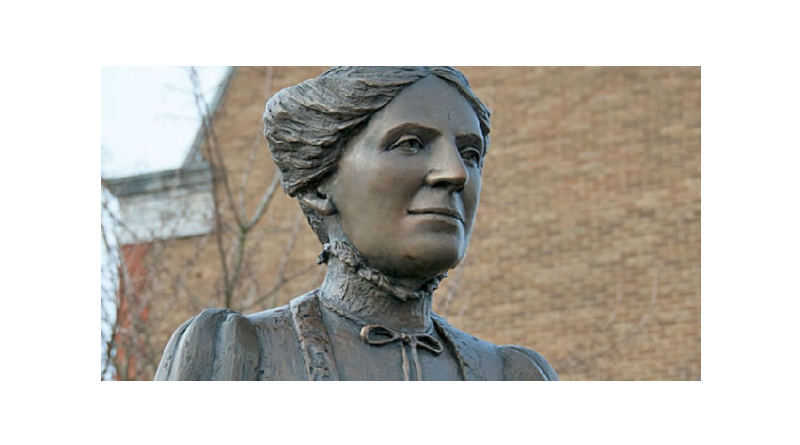
Statue of Ada Salter
The Ada Salter statue, part of a riverside bronze monument in Bermondsey, represents the deep Quaker connection between faith, equality and ethical socialism.
Dr Salter's Daydream
On the Thames Path at Bermondsey Wall East sits a bittersweet bronze installation. An elderly man rests on a bench, looking across the pavement toward a playful eight-year-old girl and her pet cat.
This is not a literal family portrait, but the physical manifestation of a memory. The man is Dr Alfred Salter, daydreaming in his twilight years about his daughter, Joyce, whom he lost decades earlier.
Standing nearby, completing a family reunited only in bronze, is his wife, Ada Salter. Together, the statues form a quiet monument to enduring love, profound loss, and a lifetime of service.
The life and times of Ada and family
Ada (1866 - 1942) and Alfred Salter (1873 - 1945) were driven by their Quaker faith to settle in the heavily deprived slums of Bermondsey in the late 19th century. They believed in sharing the living conditions of the people they sought to help.
Alfred gave up a lucrative medical career to run a 'poor man's practice', treating patients for pennies or for free. Ada entered local politics, making history in 1922 as the first female mayor in London.
She spearheaded the 'Beautification of Bermondsey', a pioneering environmental campaign. Ada drove slum clearances, built model council housing, and planted thousands of trees to clean the smog-filled air. She insisted that the working classes deserved beauty and nature just as much as the wealthy.
However, their commitment carried a tragic cost. Because the Salters chose to live in the slums rather than commute from a wealthy suburb, they were exposed to the same diseases as their neighbours.
In 1910, their only child, Joyce, contracted scarlet fever and died at just eight years old.
The Quaker Socialist Society and the Salter Lecture
The Salters' story illustrates the wider Quaker intersection of faith, political engagement, and social action. For Ada and Alfred, socialism and Quakerism were inseparable.
Both were practical expressions of the testimonies of equality and community. They demanded that faith be lived out in the streets and council chambers.
This specific brand of ethical socialism is kept alive today through the Quaker Socialist Society (QSS). The QSS provides a modern network for Friends to explore how political affairs, social justice, and peace align with Quaker values.
The legacy of the Bermondsey reformers is actively maintained through the annual Salter Lecture. Hosted by the QSS, usually during the Britain Yearly Meeting, the lecture provides a platform to discuss current economic and social issues.
It demonstrates that the Salters' commitment to tackling poverty and inequality is not merely history — it remains an ongoing, lived practice within the Society of Friends.
Return to the statue
The statues on the Thames Path today are not the original installation. When sculptor Diane Gorvin first created the artwork in 1991, the commission only featured Alfred, Joyce, and the cat.
Despite Ada's monumental achievements, she was entirely omitted from the tribute.
In November 2011, metal thieves stole the bronze figure of Alfred. This devastating loss sparked a massive local fundraising campaign to replace the artwork.
When the new statues were unveiled in 2014, the community ensured that history was corrected. Ada was finally added to the family group, marking the first public statue of a female politician in London.
Today, the Ada Salter statue stands looking at her family, holding a gardening spade in tribute to her environmental work. Her bronze hand was deliberately sculpted with a gap so that passersby can place real flowers in it.
The fresh flowers placed in her bronze hand offer a quiet testament to love, loss, and the beautification of social values.