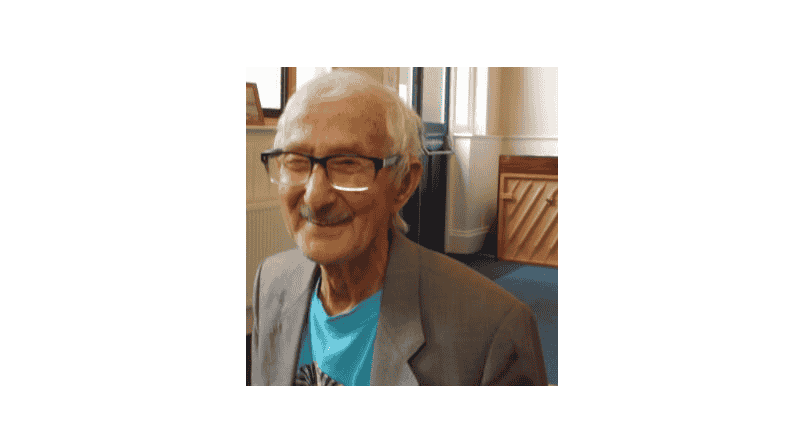
Photo of Don Sutherland in his 100th Year
The Photo of Don Sutherland in his 100th year remembers Lincolnshire's last living Second World War Conscientious Objector.
Early life
Don Sutherland (1919 - 2022) was born in Coventry on 18 June 1919 and raised as a Presbyterian Christian. In 1927, he and his family moved north to Newcastle upon Tyne, as his father had gained employment with the engineering firm Vickers Armstrong.
In the early 1930s, as part of his job, Don's father visited the Leipzig Trade Fairs in Germany and stayed with a local family. They were so warm and hospitable that Don's father invited them to visit England and stay with his family.
They replied that they would like to visit but, due to the growing turmoil in their country, would have to wait until things were calmer.
The family never visited.
During the 1930s, fascism spread and Hitler came to power in Germany. In September 1939, Germany invaded Poland, beginning the Second World War.
Earlier that year, the Military Training Act had required single men aged 20 and 21 to register for six months of military training. Don turned 20 in June and faced the prospect of military service.
Conscientious objector
Don intended to sign up but found himself unable to do so after watching young army recruits train in a local park. They were practising with bayonets, stabbing human effigies. In his Memoir of a Conscientious Objector, Don recalled, “I could not do that.” He felt it went against his Christian belief in 'loving thy neighbour'.
A conscientious objector (CO) is someone who refuses military service on grounds of conscience, including religious, ethical or political beliefs.
During the Second World War, those seeking recognition as COs had to appear before a tribunal to explain their objections. Tribunals were chaired by judges and could grant unconditional exemption, require civilian work or assign applicants to non-combatant military duties.
The hearings could be daunting, and COs sometimes faced accusations of cowardice or were dismissed as 'shirkers'. However, attitudes were generally more tolerant than during the First World War, when many COs had faced particularly harsh treatment.
Over 60,000 people in Britain applied for recognition as COs during the Second World War. Most received some form of recognition, although only a minority gained unconditional exemption. Around 3,000 COs were imprisoned.
Quakers were prominent among COs, but not all Friends refused to fight. Some Quakers chose to serve in the armed forces and fight during both the First World War and the Second World War. Others undertook civilian or non-combatant work, including service with the Friends Ambulance Unit.
Those who refused any work connected with the war effort were known as absolutists. Some faced imprisonment for refusing the duties required of them.
At his tribunal, Don stated that, as a Christian, he believed “we should love one another” and would not participate in war work of any kind. As an absolutist, Don could have gone to prison but was offered the chance to become an apprentice farm labourer in Lincolnshire's pacifist farming community.
The farm Don worked on was at Holton-cum-Beckering, and one of his first jobs was to steer the wagon and horses during ploughing the soil. Potatoes and sugar beet were the main crops on the farm.
The work was hard and the days long, but Don and the other COs grew to enjoy it and the community blossomed. In their spare time, they painted, sang and acted.
After the war ended, the farming community carried on for several years but slowly broke up as many of its original members returned to their pre-war lives.
Don's Quaker service
After the war, Don decided to stay in Lincolnshire. During the 1950s, he became a member of the Society of Friends and served as a Quaker chaplain at HMP Lincoln. Inspired by the prison reform work of Elizabeth Fry, Don spent over 36 years helping prisoners develop skills to find a better life upon release.
This included setting up a correspondence course for inmates with the Quaker-run Woodbrooke learning centre.
After his retirement in the 1990s, Don joined Amnesty International and became a school governor. In 1997, to mark the 50th anniversary of Quakers receiving the Nobel Peace Prize, Don asked primary schools across Lincoln to create an exhibition themed around peace. In 2014, Don and other Quakers became involved in the annual drone protests at RAF Waddington.
When questioned about his life and what he would say to young people today, Don's answer was:
“I try hard not to have prejudices. Accept the positive from whatever source, even if a risk is involved. Try to act on your own initiative.”
The Photo of Don Sutherland in his 100th year was taken by Mark Thomas in 2019 at Lincoln Meeting House.