
Peter Kennard
Peter Kennard is a British political artist known for photomontages opposing nuclear weapons and war. His images, including Broken Missile and Haywain with Cruise Missiles, became familiar through CND posters, badges and postcards during the 1980s. Later collaborating with Cat Phillipps as kennardphillipps, he extended his work to further conflicts, political injustice and environmental destruction.
Sections
Badges
Showing 1 to 4 of 4 total badges


Postcards
Showing 1 to 2 of 2 total postcards


In numbers
31
Works in Kennard's early STOP series of politically charged paintings.
101
Workers Press items catalogued in his online print archive.
18
Anti-nuclear posters created for the GLC's Target London campaign in 1985.
3
Kennard CND postcard designs listed in the Leeds Postcards archive-sale catalogue.
45
Guardian entries catalogued in Kennard's online print archive.
28
Book covers featuring his artwork catalogued in his print archive.
11
New Scientist entries featuring his political imagery in his print archive.
7
NME entries in his archive, connecting political art with music journalism.
200+
Artworks and related objects featured in his Imperial War Museum retrospective.
Timeline
-
1967Kennard enrols at the Slade
Studying painting in London, Kennard begins questioning art's response to contemporary politics.
-
1968The STOP paintings begin
Anti-war demonstrations and international unrest shape his early series of politically charged paintings.
-
1970sKennard turns to photomontage
He adopts cut-and-combined photographs to connect political decisions with their human consequences.
-
1980Broken Missile becomes a CND poster
A missile breaks against the peace symbol, expressing resistance to nuclear weapons.
-
1980Haywain with Cruise Missiles reaches postcards
Leeds Postcards publishes Kennard's altered Constable landscape for CND's anti-nuclear campaign.
-
1981Better Informed appears as a postcard
A skeleton reading Protect and Survive questions government advice about nuclear attack.
-
1981Crushed Missile enters Labour campaigning
Kennard's clenched fist crushing a missile becomes part of Labour's anti-nuclear imagery.
-
1985Target London challenges civil defence
The GLC commissions Kennard to challenge official claims about surviving nuclear attack.
-
1990Images for the End of the Century
The Imperial War Museum exhibits Kennard's photomontages addressing arms spending and global poverty.
-
2002The kennardphillipps collaboration begins
Kennard and Cat Phillipps begin producing anti-war artworks ahead of the Iraq invasion.
-
2005Photo Op challenges Tony Blair
The pair depict Blair photographing himself against devastation associated with the Iraq War.
-
2015An unofficial war artist retrospective opens
London's Imperial War Museum presents more than 200 works and campaign-related objects.
-
2024Archive of Dissent opens
Whitechapel Gallery brings five decades of photomontages and protest materials together.
-
Present dayArt confronting continuing conflicts
Kennard continues addressing war, environmental destruction and political power through photomontage.
Brief history
Brief history
From painting to protest (1967 - 1970s)
In 1967, Peter Kennard began studying painting at the Slade School of Fine Art in London. The following year, student demonstrations, opposition to the Vietnam War and political unrest across Europe were challenging established ideas about art and society.
Kennard joined anti-war protests and began questioning whether conventional painting could adequately confront the events unfolding around him. His early STOP series reflected the upheavals of the late 1960s, incorporating photographic imagery, distorted figures and abstract marks.
The paintings marked the beginning of his attempt to bring art and political protest together. Kennard increasingly turned to photomontage, a technique with a history of political resistance, notably in the work of the German anti-fascist artist John Heartfield.
By cutting, combining and altering photographs, Kennard could challenge familiar images of authority and expose the consequences of political decisions. The approach would become central to his work as Britain's nuclear disarmament movement gathered renewed strength.
Making nuclear weapons unacceptable (late 1970s - 1980)
By the late 1970s, the nuclear arms race between the United States and the Soviet Union was intensifying. Plans to deploy American cruise missiles in Western Europe, alongside Britain's decision to replace its Polaris nuclear submarines with Trident, brought renewed support for the Campaign for Nuclear Disarmament (CND).
Kennard was concerned that photographs of missiles and mushroom clouds had made nuclear weapons appear ordinary. He began creating images for CND that challenged their acceptance as a normal part of international politics.
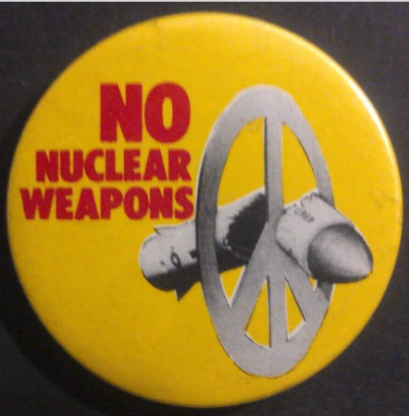
In 1980, Kennard produced Broken Missile, combining a nuclear missile with the peace symbol designed by Gerald Holtom in 1958. The missile appeared to break against the symbol, turning an image of military power into one of resistance.
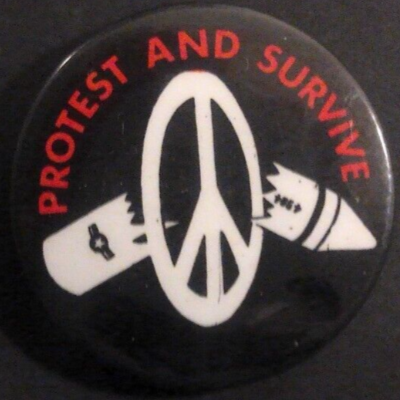
CND reproduced Broken Missile as a poster, and Kennard also contributed artwork to the Protest and Survive campaign. His images gave the movement a direct visual language, presenting nuclear disarmament not as an abstract political argument but as something ordinary people could demand.
Badges and postcards (1980s)
Kennard's anti-nuclear images also appeared on badges and postcards produced for specific political campaigns. CND reproduced Broken Missile on badges, while the Labour Party used Crushed Missile, depicting a clenched fist breaking a nuclear weapon, on its Nuclear arms no, peace yes badge.
The designs gave different political organisations recognisable images of resistance to nuclear weapons. Leeds Postcards published several Kennard photomontages for CND. Haywain with Cruise Missiles appeared in October 1980, followed by Better Informed in February 1981.
The latter showed a skeleton reading the government's Protect and Survive civil defence booklet beneath the question, “Have you ever wished you were better informed?” The image challenged official assurances that civilians could protect themselves against nuclear attack.
In September 1981, Leeds Postcards published What Price Defence?, drawing attention to the cost of nuclear armament. Another Kennard design, The Firth of Clyde, parodied a holiday postcard through photographs of nuclear submarine bases and military installations on Scotland's west coast.
Its message supported Scottish CND's opposition to the concentration of nuclear weapons around the Clyde. These designs connected Kennard's artwork to identifiable campaigns, organisations and political demands. His photomontages became part of the visual identity of Britain's anti-nuclear movement.
Target London: challenging civil defence (1985)
Kennard's work also attracted the attention of the Greater London Council (GLC), which opposed nuclear weapons and had declared London a nuclear-free zone.
In 1985, the council published Target London, a collection of 18 posters commissioned from Kennard to challenge government advice about surviving a nuclear attack. The posters combined photomontage with official reports and scientific information about the likely effects of nuclear war.
The skeleton holding Protect and Survive, already familiar from Kennard's earlier postcard, reappeared in the series. Other images placed London landmarks beneath approaching missiles or showed a missile passing through a ballot paper marked with the council's initials.
The posters confronted the government's civil defence preparations with evidence of the destruction a nuclear attack would cause. They also demonstrated how Kennard's methods had moved beyond voluntary peace organisations into a public information campaign supported by London's elected authority.
From the Cold War to the Iraq War (1990s - 2005)
The end of the Cold War did not end Kennard's political work. He continued to examine military conflict, economic inequality and the relationship between governments, corporations and the arms industry.
In 2002, Kennard began collaborating with fellow artist Cat Phillipps. Working together as kennardphillipps, they responded to the approaching invasion of Iraq, producing images for anti-war demonstrations, publications and public exhibitions.
One of their best-known works was Photo Op (2005). The photomontage showed British prime minister Tony Blair apparently taking a photograph of himself against a scene of destruction in Iraq. The contrast between Blair's smiling face and the burning landscape challenged the public presentation of Britain's involvement in the war.
Photo Op became widely reproduced as an anti-war image. The partnership continued to produce work opposing military violence and political injustice, using posters, publications and online distribution alongside gallery exhibitions.
The subjects had changed since Kennard's early CND campaigns, but his central method remained. Familiar photographs were rearranged to challenge the actions and public claims of those in power.
An unofficial war artist (2015 - 2025)
In May 2015, the Imperial War Museum in London opened Peter Kennard: Unofficial War Artist, a major retrospective covering nearly 50 years of his work. More than 200 artworks and related objects traced his development from the Vietnam War protests to contemporary conflicts.
The exhibition included his early STOP paintings, political photomontages and material associated with their use in campaigns. A new installation, Boardroom, examined the human and financial costs of war through images and statistics.
A further exhibition, Archive of Dissent, opened at London's Whitechapel Gallery in July 2024 and ran until January 2025. It brought together five decades of work, connecting Kennard's early anti-nuclear campaigning with later opposition to war, economic injustice and environmental destruction.
The exhibitions marked growing institutional recognition of an artist whose work had often been created outside the established art world. They also preserved the history of images originally made for political movements, demonstrations and public campaigns.
The continuing power of photomontage (2020s - present)
Kennard continues to use photomontage to confront war, political power and environmental destruction. His later work has addressed the conflicts in Ukraine and Gaza, alongside the connections between military violence, economic interests and damage to the natural world.
Photography and digital technology have changed the materials available to political artists, but Kennard's approach remains recognisable. Familiar images are broken apart, altered and combined to reveal relationships that ordinary news photographs may leave unseen.
Kennard has acknowledged that art alone cannot end a war or bring about political change. His work has instead developed alongside campaigns, providing images that people can use to question authority and express opposition.
More than five decades after his first political paintings, the images remain part of the history of protest. Some survive as original artworks in major collections. Others are preserved on posters, postcards and badges made for the campaigns they supported.
Kennard's contribution lies not only in the images he created, but in the political lives those images acquired beyond the artist's studio.

