Nuclear arms no, peace yes
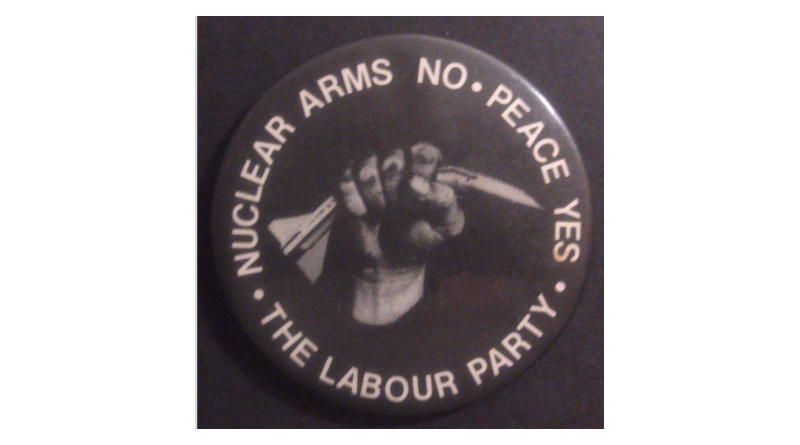
Nuclear arms no, peace yes is a vintage pin badge that brings together peace and politics for a 1983 rally in Hyde Park.
The crushed missile on a tin disc
The badge is a solid circle of dark tin, measuring just over an inch across. A crisp white ring of capital letters runs around the outer edge, separated by distinct punctuation dots. The text reads simply: • NUCLEAR ARMS NO • PEACE YES • THE LABOUR PARTY.
Inside this frame sits a grainy, monochrome image by the artist Peter Kennard. Printed in shades of charcoal grey and ash white, it shows a human fist, tightly clenched, bending and shattering a stylised military rocket. The metal fins of the missile jut out to the left, while the pointed nose cone is forced downward by the pressure of the fingers.
A gathering in Hyde Park
The badge first appeared in the autumn of 1980 in London. On 26 October, tens of thousands of people travelled by coach and train from industrial towns and northern cities, emptying out onto the damp grass of Hyde Park to join a sea of banners and placards.
The UK Labour Party, then moving towards a policy of unilateral nuclear disarmament under its leader Michael Foot, officially produced the item for the event. Organisers distributed these discs straight from heavy cardboard boxes at the park gates, selling them alongside pamphlets to fund the growing movement against the government's new Trident nuclear submarine programme.
A badge for a cold climate
The early 1980s in Britain were defined by a cold, anxious atmosphere. The reality on the ground was one of rising unemployment, tensions on the streets, and a tangible fear of conflict. People wore their politics on their lapels, pinning these tin discs onto heavy woollen overcoats, denim jackets, and hand-knitted scarves.
The central artwork itself was born from physical labour. Kennard did not use digital tools — he used a scalpel, photographic prints, and darkroom chemicals to physically slice pictures apart and glue them back together. He created a stark visual language that could be understood instantly in a crowded street.
Iconic piece of social history
The radical policy of unilateral disarmament would ultimately prove to be an electoral disaster for Labour in the 1983 general election. But this badge is not a record of that defeat. It is a physical artefact of the high-water mark of 1980 — a moment when the banners of the street protesters and the official policy of a major political party flew side-by-side.
Nuclear arms no, peace yes, being a badge that is part of the British Museum collection, confirms its status as an iconic piece of social history.