

Nuclear-free Zones
Britain's nuclear-free zone movement began with Manchester City Council's declaration in November 1980. Hundreds of councils followed, challenging nuclear weapons through local resolutions, education and resistance to civil defence planning. Campaigners across Ireland and abroad adopted similar approaches. The Nuclear Free Local Authorities network coordinated much of the work until its closure in 2026.
Sections
Badges
Showing 6 to 9 of 9 total badges

Postcards
Showing 1 to 2 of 2 total postcards

In numbers
150+
Councils in England, Scotland and Wales declaring nuclear-free zones by the end of 1982
60%+
Population of England, Scotland and Wales represented by those councils
5
Northern Irish councils identified as nuclear-free by Northern Ireland CND in 1988
200
French towns commemorated by the 200 villes pour la Paix badge in 1984
100+
Dutch municipalities reported to have adopted nuclear-free declarations
6
Nuclear-free-zone signs planned for Cork following its 1989 CND declaration
54
Authorities invited to participate in Britain's planned Hard Rock civil defence exercise
20
Authorities declining to participate in Hard Rock before its postponement
65
Councillors attending an All-Ireland NFLA conference in Drogheda in 2006
Timeline
-
1958An earlier precedent in Japan
Handa adopts an anti-nuclear declaration, long before Britain's municipal nuclear-free movement begins.
-
1979NATO announces new missile deployments
Plans for American missiles in Europe intensify public debate over nuclear weapons.
-
1980Manchester declares itself nuclear-free
On 5 November, Manchester becomes Britain's first formally declared nuclear-free city.
-
1981Nuclear Free Local Authorities takes shape
Councils establish a coordinating network, with Manchester supporting its steering committee and secretariat.
-
1981Bradford adopts a declaration
Bradford follows Manchester, later creating a Peace Action Group to support local work.
-
1982Belfast joins the movement
Belfast City Council adopts a nuclear-free declaration amid a dispute over council participation.
-
1982Hard Rock is postponed
Local authority refusals disrupt plans for a national civil defence exercise.
-
1982Declarations cover much of Britain
More than 150 councils now represent over 60% of the population across three nations.
-
1984Councils meet internationally in Manchester
Manchester hosts the first international conference of nuclear-free local authorities.
-
1984French peace towns are celebrated
The Mouvement de la Paix issues its badge commemorating 200 French towns.
-
1987New Zealand enacts national legislation
A national nuclear-free law follows years of local declarations and public campaigning.
-
1988Irish campaigners seek a national law
Irish CND campaigns for legislation restricting nuclear-armed vessels and aircraft in the Republic.
-
1989Cork unveils nuclear-free-zone signs
CND and civic supporters mark Cork's declaration with signs at city entrances.
-
2005The All-Ireland NFLA Forum launches
Local authorities north and south establish formal cooperation on nuclear issues.
-
2026The UK/Ireland NFLA network closes
Falling membership and funding end the network, although other peace organisations continue.
Brief history
The first nuclear-free city (1980)
In December 1979, NATO agreed to station new American nuclear missiles in Western Europe while pursuing arms-control talks with the Soviet Union. Britain was to receive cruise missiles, bringing the threat of nuclear war into council debates as well as national politics. Local authorities had no control over defence policy, but some began asking what they could do.
Manchester City Council had already opposed cruise missiles and Trident when, on 5 November 1980, Councillor Bill Risby moved a resolution declaring the city a nuclear-free zone. Manchester called for nuclear weapons not to be manufactured or stationed within its boundaries and encouraged other councils to make similar declarations.
The resolution could not prevent the government from deploying weapons. Manchester's councillors nevertheless made a public decision that residents could recognise, debate and ask other authorities to repeat. A local declaration had become the starting point for a wider campaign.
A movement spreads across Britain (1980 - 1982)
Manchester's declaration gave other councils a model. Leeds had passed an anti-nuclear resolution before Manchester, in July 1980, and formally declared itself nuclear-free in June 1981. Bradford followed that October. Authorities in Scotland, Wales and across England adopted resolutions of their own, often after pressure from local peace groups.
Some declarations opposed nuclear weapons alone. Others also addressed nuclear power, radioactive waste or the transport of nuclear material. The wording varied, as did the willingness of councils to fund education and other practical work. What the resolutions shared was a rejection of the idea that nuclear policy belonged entirely outside local public debate.
By the end of 1982, more than 150 councils representing over 60% of the population of England, Scotland and Wales had declared nuclear-free zones. The declarations did not make those places legally free of nuclear weapons. They did show how far a municipal campaign had spread in two years.
Nuclear Free Local Authorities takes shape (1981 - 1984)
As more councils passed resolutions, their representatives began looking for ways to work together. Meetings and correspondence could turn separate local decisions into a shared campaign. Manchester hosted a national gathering in 1981, and its Policy Committee agreed that October to support the steering committee and secretariat of Nuclear Free Local Authorities, or NFLA.
The network helped councils exchange research, coordinate publications and respond to government policy. Manchester's Nuclear Policy and Information Unit became a centre for information on nuclear weapons, civil defence, radioactive waste and public education. Council officers and elected representatives could draw on material beyond their own districts.
NFLA did not acquire powers over national defence. Its strength lay in connecting authorities that might otherwise have acted alone. By April 1984, Manchester was hosting the first international conference of nuclear-free local authorities. An initiative that began in a British council chamber had developed contacts far beyond Britain.
Ireland and the all-island campaign (1980s - 2000s)
Nuclear-free campaigning also crossed the Irish Sea. In Northern Ireland, Belfast City Council adopted a declaration in February 1982. By 1988, Northern Ireland CND identified five nuclear-free councils: Belfast, Derry, Omagh, Fermanagh and Newry. Progress was not always straightforward. Belfast's decision passed during a boycott by many Unionist councillors, and further work stalled after their return.
In the Republic, Irish CND campaigned for legislation that would restrict nuclear-armed ships and aircraft in Irish waters and airspace. Cork's nuclear-free campaign became visible in August 1989, when CND supporters unveiled signs with the participation of the city's Lord Mayor and visiting Hiroshima survivor Noriko Kobayashi. Campaigners north and south supported one another, although no single declaration made the whole island legally nuclear-free.
Local authority cooperation became more formal in September 2005, when the All-Ireland NFLA Forum was established in Dublin. Councillors from both sides of the border worked together on nuclear issues, including concerns about radioactive waste and facilities across the Irish Sea.
Nuclear-free zones around the world (1958 - 1990s)
Manchester was Britain's first formally declared nuclear-free city, but local opposition to nuclear weapons had earlier precedents abroad. Handa in Japan adopted an anti-nuclear declaration in 1958. During the 1980s, municipalities across Europe and beyond made comparable commitments. Hellevoetsluis in the Netherlands declared itself nuclear-free in 1981, and more than 100 Dutch municipalities later followed.
In France, the Mouvement de la Paix campaigned for local anti-nuclear resolutions. By 1984, 200 French municipal councils had passed anti-nuclear resolutions, an achievement celebrated by its 200 villes pour la Paix badge. The design placed a line-drawn peace dove against a nuclear rocket. Its history is explored separately in the Badger 4 Peace article 200 Cities for Peace.
Belgian, Spanish, Australian and American councils also adopted local measures. New Zealand went further: municipal nuclear-free declarations helped build support for national legislation enacted in 1987. International conferences, beginning in Manchester in April 1984, brought these different campaigns into direct contact.
Badges, postcards and signs (1980s)
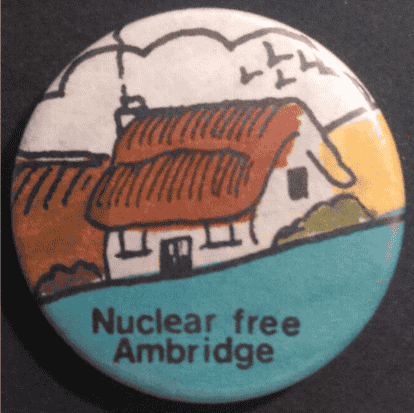
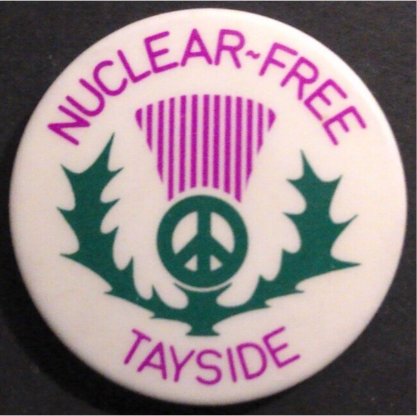
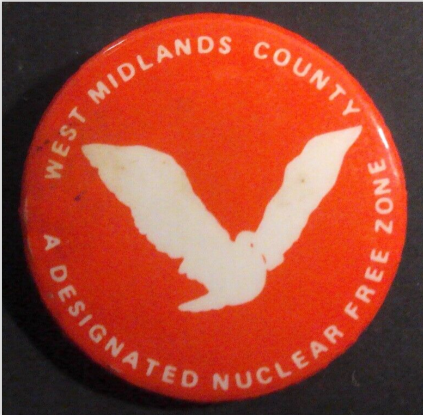
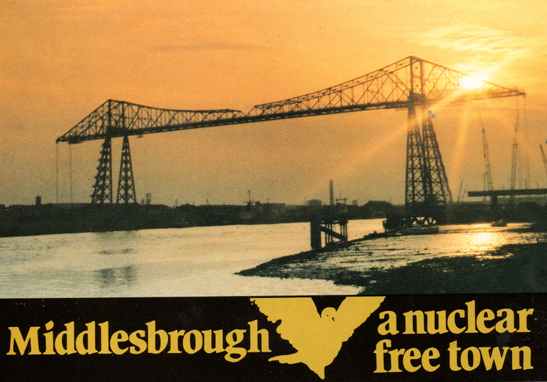
A council resolution could be recorded in meeting minutes, but campaigners wanted the public to see what it meant. Signs at town boundaries announced nuclear-free status to motorists and pedestrians. Badges allowed supporters to carry the same message on coats and bags, while postcards carried it through the post.
The designs ranged from simple prohibition signs placed over nuclear symbols to brightly printed local slogans. Leeds Postcards produced Greetings from Nuclear Free Leeds, presenting the city's declaration as a public identity. A nuclear-free-zone badge preserved by Hackney Museum shows the circular emblem worn by a local activist. In Cork, campaigners marked the 1989 declaration with signs intended for six locations around the city.
Posters offered space for more detailed arguments. Artist Peter Kennard's work for the Greater London Council used photomontage to confront viewers with the possible consequences of nuclear attack. Across these different objects, the purpose was similar: to bring a council decision into everyday life.
Peace education and local campaigns (1980s)
Declarations were only one part of the work. Some councils published material about nuclear weapons and civil defence, funded exhibitions or brought peace questions into local education. Leeds produced Leeds and the Bomb. In Bradford, a publication called The Day After examined what a one-megaton nuclear explosion could do to the metropolitan district.
Kirklees established a War and Peace Sub-Committee in 1983 and prepared information about the possible consequences of nuclear war. Outside council offices, CND branches, churches, Quaker meetings and independent peace groups held public meetings, arranged exhibitions and circulated campaign material. Local groups in smaller towns and rural districts helped extend the discussion beyond the large cities.
Public education also provoked disagreement. Councillors differed over whether explaining the effects of nuclear weapons was a proper local responsibility or a political campaign financed from public funds. That disagreement exposed a wider question: if a council was expected to prepare for nuclear war, should it also be allowed to question whether such preparations could work?
Hard Rock: the councils challenge Whitehall (1982)
The dispute became practical in 1982. The government planned a civil defence exercise called Hard Rock to test how authorities would respond to a major emergency, including nuclear attack. Many councillors questioned the assumptions behind the exercise. They argued that planning rescue services after a nuclear strike risked giving the public a misleading impression of what could be survived.
Of 54 authorities invited to take part, 20 declined and seven offered only limited participation. On 14 July 1982, Home Secretary William Whitelaw announced that Hard Rock would be postponed. Local government non-cooperation had disrupted a national exercise, although the government did not abandon civil defence policy.
Further regulations followed in 1983, increasing pressure on councils to carry out civil defence duties. Hard Rock showed both the influence and the limits of nuclear-free declarations. Councils could not control the missiles, but decisions about whether to cooperate with preparations for nuclear war had consequences beyond a symbolic vote.
Bradford: a declaration contested (1981 - 1988)
Bradford's experience showed how vulnerable nuclear-free policies could be to local elections. The city declared itself nuclear-free in October 1981 and established a Peace Action Group in 1982. Chaired by Councillor Colin Hunter, the group connected council representatives with the University of Bradford, peace organisations and people involved in education.
In April 1983, a change in political control led to the declaration being revoked and the group disbanded. Campaigners tried to restore the policy, but a further attempt that year failed. A new resolution succeeded in 1985, and the Peace Action Group was re-established the following year. Another shift in council control brought its work to an end in 1988.
Behind each decision were councillors, campaigners and local organisations arguing over the proper role of the authority. Bradford's repeated reversals demonstrated that a nuclear-free declaration could be lost without any change to Britain's nuclear weapons policy. The campaign nevertheless left publications, records and relationships that survived the votes themselves.
The end of a network, not the campaign (2026 - present)
Over the following decades, Nuclear Free Local Authorities widened its work beyond the missile deployments that had prompted the early declarations. Councils examined nuclear power, radioactive waste and the movement of nuclear material, while continuing to support disarmament. On both sides of the Irish Sea, concerns about facilities such as Sellafield gave the network a continuing purpose after the Cold War.
But council membership and subscription income declined. The UK/Ireland NFLA network ceased operating on 31 January 2026, citing reduced resources, council restructuring and changing priorities. Scottish members discussed a successor organisation, while the separate international Mayors for Peace network continued its municipal work against nuclear weapons.
The closure ended one means by which councils had acted together. It did not erase the declarations, street signs, publications or campaigns that the movement left behind. Local authorities had never possessed the power to disarm a nation. For decades, however, they had insisted that the people living under the threat of nuclear war should have a voice in the argument.
