200 cities for peace
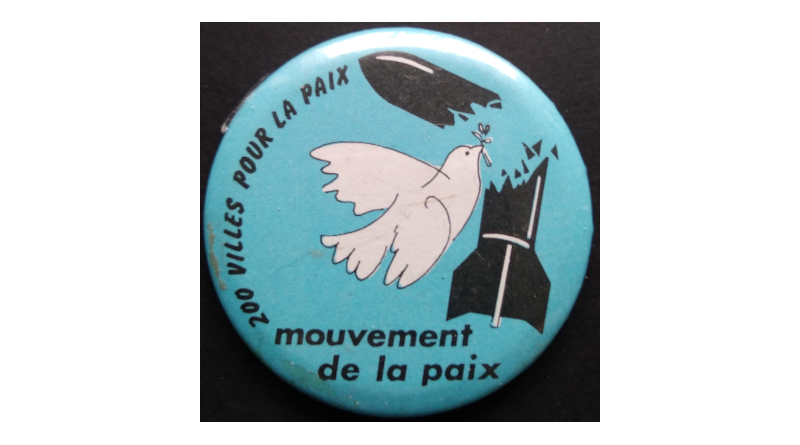
200 villes pour la Paix ('200 cities for Peace') is a vintage pin badge by the Mouvement de la Paix issued to celebrate 200 French town councils voting to become nuclear-free.
Partisans for peace
The Mouvement de la Paix was founded in 1948 by former partisan fighters who had survived the Nazi occupation.
Having lived through one catastrophe, they were not prepared to sit quietly through another. Supported by trade unionists, Christians, and the French Communist Party, the organisation had the networks to mobilise on a national scale.
Between 1981 and 1983, activists aggressively lobbied municipal councils to become nuclear-free. When 200 of them across France finally voted to pass anti-nuclear resolutions, the Mouvement de la Paix issued the badge in 1984 to commemorate the landmark achievement.
The Picasso connection
Pablo Picasso created his original peace dove symbol in 1949. He granted the Mouvement de la Paix permanent permission to use it as well as a later line-drawn version of the dove.
Picasso died in 1973, a decade before NATO's Pershing and cruise missile deployments brought the arms race back to Europe's streets. Designers took one of his authorised line-art doves and graphically altered it, setting the bird against a modern nuclear rocket — as shown on the badge.
A cross-Channel blueprint
The strategy had British roots. In November 1980, Manchester City Council became the first local authority in Britain to declare itself a nuclear-free zone, prompting other councils across the country to follow.
By 1982, over 150 British councils had adopted similar resolutions. French towns were frequently twinned with British counterparts such as Coventry, and word of the British network's success travelled quickly through these established channels.
Le Mouvement de la Paix adopted the same strategy at home, lobbying French mayors and municipal councils directly rather than waiting on national government. Local resolutions, they found, built resistance to nuclear weapons from the ground up.
The two campaigns converged in April 1984, when Manchester hosted the first International Conference of Local Authority Nuclear Free Zones. Two hundred French towns had by then passed peace resolutions, an achievement this badge was struck to mark.
Pinning peace
The Mouvement de la Paix remains active today, continuing its methodical work against nuclear armament. It still focuses on municipal action, pressing French local authorities to support the UN Treaty on the Prohibition of Nuclear Weapons.
Two hundred councils once voted, one town at a time, to keep the rocket out. This badge still pins that vote in place.