
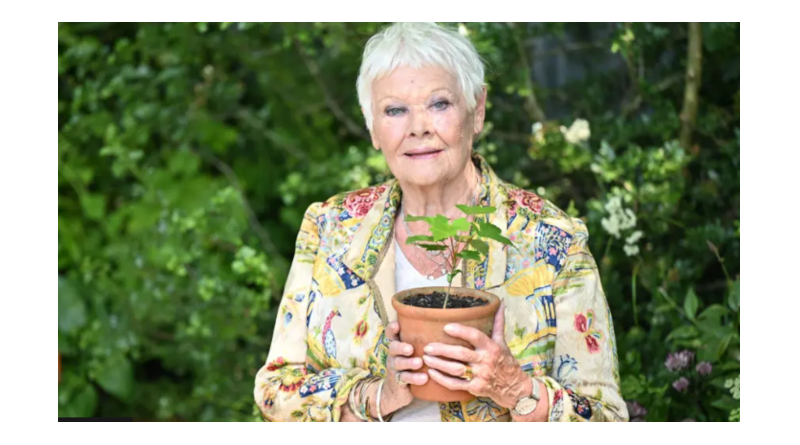
Judi Dench: A Quaker on the world stage
Dame Judi Dench (1934 - ) is one of Britain's most celebrated actors, and for decades she has also been a Quaker — a faith she says informs everything she does, shaping a public life marked by calm, reflection and quiet steadiness.
I couldn’t be without it
Few British actors have achieved the recognition of Judi Dench. Over a career spanning more than six decades, she has performed on some of the world’s greatest stages, played leading roles in Shakespeare, and become known internationally through film and television.
Behind that remarkable public career lies a quieter influence, Dench has long identified as a Quaker.
Her faith is rarely something she discusses at length in public. Yet when asked about it, she has made clear that it remains central to her life.
“I think it informs everything I do. I couldn’t be without it.”
Dench’s Quakerism is not a recent discovery or a casual association. It dates back to her teenage years and has remained a steady thread through a life largely lived in the public eye.
Discovering Quakerism at school
Dench was not born into a Quaker family. Her parents were Methodists, and religion formed part of her upbringing. Her encounter with Quakerism came through education.
As a teenager she attended The Mount School in York, a long-established Quaker boarding school. Like many Quaker schools, the Mount introduced pupils to different Christian traditions in the historic city of York. Students visited churches and cathedrals and learned about a range of religious practices.
Yet Dench later recalled that the place where she felt most at ease was the school's Quaker meeting house.
The simplicity of the room, the absence of ceremony and the discipline of silent worship made a lasting impression. In that quiet space she encountered a form of spirituality centred not on doctrine or ritual but on listening.
It was during these years that Dench became a Quaker, a commitment that would remain part of her identity throughout her life.
Maggie Smith and the “Quaker calm”
Among those who commented on Dench’s composure was her long-time friend and fellow actor Maggie Smith.
Smith was famous for her sharp wit and candid reflections on stage fright. In one interview she jokingly contrasted her own nerves with Dench’s steadiness.
“Every time I start anything, I think, ‘This time I’m going to be like Jude… the Quaker will come out in me.’ But it never works. Jude has a wonderful calm — it’s very enviable.”
The remark was affectionate, but it captures something many people notice about Dench: a sense of steadiness that accompanies her work.
Whether on stage or screen, she often projects quiet confidence rather than theatrical flamboyance. For Smith, that composure seemed inseparable from Dench’s Quaker background.
Faith behind the fame
Despite occasional remarks like this, Dench has never presented herself as a public spokesperson for religion. Her Quaker faith remains largely private.
This approach reflects a long-standing Quaker tendency to treat belief as something lived rather than displayed. Friends traditionally emphasise sincerity and simplicity over outward declarations of faith.
Dench’s career illustrates this balance. She has achieved extraordinary professional success while maintaining a personal reserve about her spiritual life.
When she does speak about faith, it is usually in simple terms: as a source of grounding, reflection and perspective.
A contempary Friend in public life
Throughout their history, Quakers have appeared in many different roles in public life. Some became reformers or activists, campaigning for causes such as the abolition of slavery or prison reform. Others contributed to education, science and business.
Not every Quaker public figure has been defined by activism. Some have simply carried the habits of Quaker life into their chosen fields.
Dench belongs to this quieter tradition.
Her contribution lies not in campaigning but in presence — the example of a life shaped by patience, discipline and inward listening.
Salter Centenary
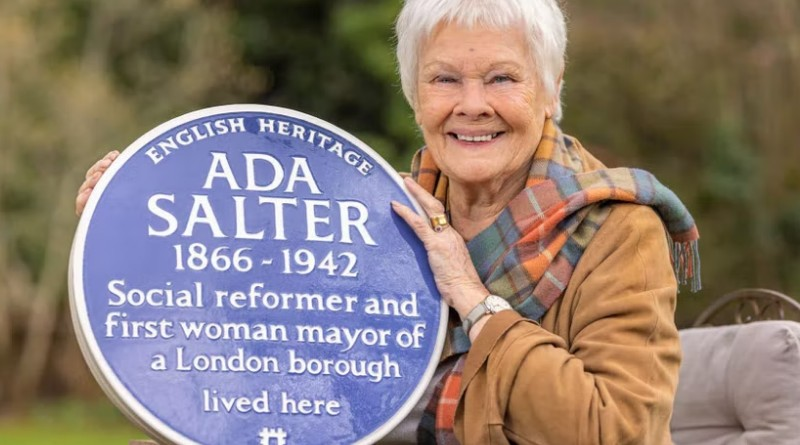
Dench is patron of the Salter Centenary, which in 2022 celebrated the 100th anniversary of the year the Quaker social reformer Ada Salter who became both London’s first female mayor and Britain’s first female Labour mayor. This happened when she was elected mayor of Bermondsey in 1922.
As part of the celebration Dench unveiled a blue plaque dedicated to salter. The plaque, awarded by English Heritage, is located at the Bermondsey Settlement, a social movement house founded by Methodist reformer John Scott Lidgett, – where Salter lived in during the 1890s.
At the unveiling ceremony, Dench described Salter as ‘heroric’ and said:
“As a champion of environmentalism and the welfare of others, Ada was a force to be reckoned with. We have so much to thank her for and so much that we can still learn from her. I’m delighted to help bring this heroic woman into the public eye.“
The quiet influence of Quaker faith
Quaker witness has never depended on grand gestures alone. Often it appears through steady influences — habits of listening, fairness and integrity that gradually shape a person’s character.
In Dench’s case, those influences began early through the experience of silent worship and Quaker education. Decades later they remain part of the background to a remarkable career.
The stage lights and film cameras that surround her profession may seem far removed from the stillness of a meeting house. Yet the qualities cultivated in that quiet space — patience, reflection and humility — have accompanied her throughout her life.
As Maggie Smith’s affectionate remark suggests, sometimes the mark of Quaker spirituality is not proclamation but presence.