Joseph Sturge memorial
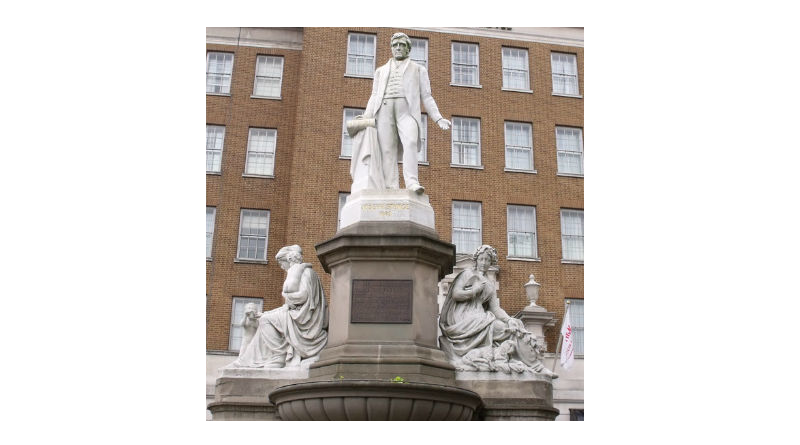
The Joseph Sturge memorial is a bronze statue in Birmingham, unveiled in 1862 before a crowd of 12,000 to honour the English Quaker philanthropist Joseph Sturge (1793 – 1859).
Anti-Slavery Society
Sturge was born in Gloucestershire, England, into a Quaker family of farmers. At 29 he moved to Birmingham and, together with his brother Charles, built up a successful corn-importing business. He also invested in the burgeoning railway industry and became both a wealthy and influential man.
He became secretary of the Anti-Slavery Society in Birmingham in 1826. He thought the London leadership was too cautious and argued for greater public agitation. He argued, "The people must emancipate the slaves for the Government never will."
In 1836 and 1837 he visited the West Indies. He witnessed a failing apprenticeship scheme for recently freed slaves. His account, The West Indies in 1837, made a major impact on the public.
This helped bring about new laws in 1840 to improve the scheme. Influenced by earlier Quaker abolitionists such as Benjamin Lay, Sturge's own efforts helped push the cause forward on both sides of the Atlantic.
Adult education
In 1842, Sturge stood as a parliamentary candidate in Nottingham. While there, he visited a school for adult education.
The Methodist William Singleton first started it for young women in the local lace and hosiery trade. The Quaker Samuel Fox (1781 - 1868) and his grocer's shop staff later built it into something larger.
Sturge was struck by the idea that adults could be taught reading and writing alongside scripture. He was also concerned by the behaviour of men and boys he saw in Birmingham's streets.
He gathered the city's younger Quakers in 1845 to found a similar school for young men. He stated it was for, “Those who are not & have not been in the way of receiving any instruction in other schools.”
Severn Street First Day School opened that October. It taught adults and teenagers in separate classes, with an hour of writing followed by scripture, reading and spelling.
Birmingham Friends opened a second school in 1848. Together, these schools helped lay the groundwork for adult education as it developed in England.
The memorial
Sturge died in Birmingham in 1859. His memorial was unveiled three years later at Five Ways, near his former home. It has been Grade II listed since 1982.
The Birmingham Civic Society, Birmingham City Council and the Sturge family restored it in 2006 - 2007 for the bicentenary of the Slave Trade Act. The restoration project included replacing a missing hand.
In the Joseph Sturge memorial he wears a lapel-less coat of Quaker Plain Dress. Lower on the plinth, two allegorical figures flank him: Peace, holding a dove and olive branch with a lamb at her feet, and Charity, comforting two Afro-Caribbean infants.
Sturge still stands as he always has — ready to teach.