
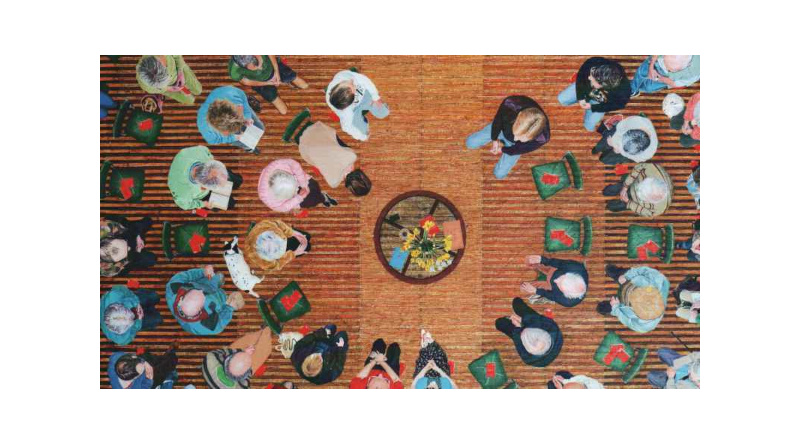
'Advices & Queries' painting
Painted by Lincolnshire artist, Graham Lewinton, Advices & Queries is inspired by his local Quaker Meeting House and its floorboards

In Lewinton's painting, written into the wooden floorboards of Lincoln Meeting House, is the complete text of Advice and Queries from Quaker Faith & Practice.
Quaker artists and the creative impulse
Although Friends are often associated with plainness, activism and social reform, there is also a rich and often overlooked tradition of Quaker creativity. From the earliest days of the Society in the seventeenth century, Friends have used visual art to explore inner experience, to express spiritual insights and to reflect the world around them with honesty and compassion. While Friends historically avoided lavish decoration, they did not avoid art itself; instead, they sought a way of creating that honoured truth, integrity and the inward Light.
Many Quaker artists speak of creativity as a form of ministry: a faithful response to something “given” rather than something manufactured. This sense of art as witness has shaped the ways Friends have approached painting, illustration, sculpture and design. The result is not a single “Quaker style,” but rather a recognisable sensibility - one that values clarity, humility, depth and the quiet strength of seeing the world as it truly is.
Early Friends and craft traditions
In the seventeenth and eighteenth centuries, the most visible Quaker artistic contribution came through crafts rather than grand painting. Friends excelled in bookbinding, furniture making, engraving, and scientific illustration. These trades aligned naturally with testimonies to simplicity and integrity; they required skill, patience and careful workmanship without ostentation. Many Quaker cabinet-makers, silversmiths and decorative artisans became renowned for producing honest, beautifully made objects designed for useful service.
Although the early Quaker emphasis on plainness discouraged ornamentation for its own sake, it encouraged Friends to see form, function and beauty as interconnected. Art was not something external to life; it was woven into daily living, the quality of one's work, and the quiet grace of useful design.
Quaker painters and illustrators
From the nineteenth century onwards, Quaker painters began to emerge with greater confidence. James Turrell, perhaps the most famous contemporary example, is known for his explorations of light, silence and perception - deeply resonant themes within Quaker spirituality. Edward Hicks, the American folk painter and lifelong Friend, created over sixty versions of The Peaceable Kingdom painting, a visual meditation on the Quaker hope for harmony and reconciliation.
Other notable Friends include the children's illustrator Margaret Fell Crosthwaite; the botanical artist Anna Maria Hussey; and the British painter Evelyn Sturge, whose work often reflected Quaker pacifism during wartime. These artists demonstrate how diverse and expressive Quaker creativity can be while still remaining rooted in spiritual reflection.
Art as ministry and witness
For many Friends, the artistic process itself is a form of worship. Sitting in stillness, waiting for inspiration, and responding faithfully to what arises mirrors the rhythm of Quaker meeting for worship. Some speak of a painting or sculpture as a “leading,” similar to vocal ministry: something that presses forward with a sense of spiritual weight and needs to be shared.
Quaker art has often served as witness, especially in contexts of peace, justice and human dignity. During the two World Wars, Friends used posters, pamphlets and political cartoons to advocate conscientious objection. In the twentieth and twenty-first centuries, Quaker artists have played strong roles in movements for racial justice, ecological awareness, anti-nuclear activism and refugee solidarity. The visual language may vary, but the underlying message remains constant: every person carries a measure of Light that demands protection and respect.
Quaker art today
Across Britain and around the world, contemporary Quaker artists continue to explore the relationship between faith, creativity and social concern. Many Meetings host exhibitions, workshops and community projects, offering space for Friends and newcomers alike to explore art in a spirit of openness. Digital media has also expanded the reach of Quaker creativity, with photographers, designers, graphic novelists and illustrators using online platforms to share work grounded in reflection and compassion.
Today, the Quaker artistic community is vibrant and varied. Some artists focus on explicitly spiritual themes; others simply allow their Quaker values - simplicity, honesty, equality and peace - to shape how and why they create. Together they show that Quaker art is not a relic of the past but a living expression of faith-in-action, continually renewed by the Inner Light.