
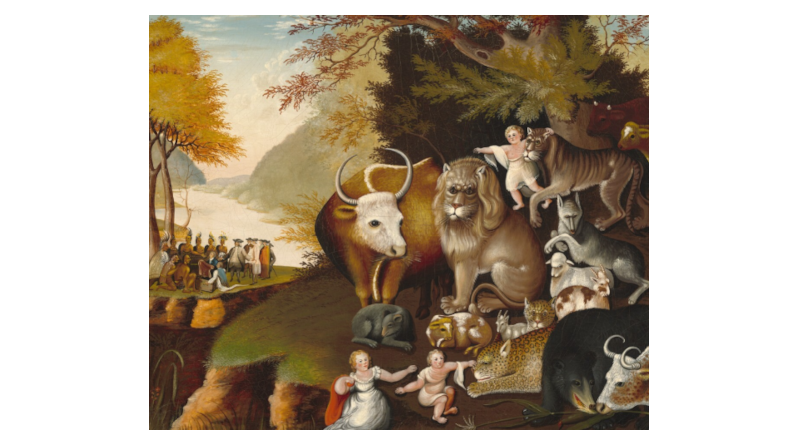
The Peaceable Kingdom painting
The Peaceable Kingdomp painting, completed around 1834 by the Quaker artist Edward Hicks (1780 - 1849), shows peace between animals and humans.
Origins in Quaker faith
Edward Hicks was a sign painter turned Quaker minister from Bucks County, Pennsylvania. As a young man he painted coaches, tavern signs, and household furniture for a living, learning the plain, decorative style later seen in his best-known work. Preaching did not pay well, so he kept painting alongside it.
From around 1820 he returned again and again to the same subject, painting it some 60 times over his life.
Hicks preached within the Hicksite branch of the Society of Friends, named for his cousin Elias Hicks. The American split between Hicksite and Orthodox Friends unsettled Quaker communities through the 1820s, and Hicks's paintings became a way of preaching peace when the pulpit alone was not enough.
Symbolism and message
The scene draws on a promise in Isaiah 11:6, a world where the wolf shall dwell with the lamb and a little child shall lead them.
Each version shows old enemies resting side by side, lion and ox, wolf and sheep, leopard and kid, with a child usually at the centre of them all.
Hicks wrote his own verse for the image and lettered lines like these along the frame of several versions:
“The wolf did with the lambkin dwell in peace, his grim carnivorous nature there did cease... The lion with the fatling on did move, a little child was leading them in love.”
The animals are calm, not caged, not tamed by force. Long before animal welfare became a public cause, Hicks was already painting them as neighbours rather than resources.
Many versions include a second scene in the background, William Penn signing his peace treaty with the Lenape people. Hicks placed a moment of real diplomacy beside a vision of paradise, so the biblical promise and Quaker history sat within the same frame.
A large legacy for a small painting
The paintings later entered major folk art collections, admired long after Hicks's death for their craft as much as their message. Beyond Quaker circles, teachers and peace groups adopted the image for its plain hope, and it still appears in children's books and religious education materials.
The image also travelled beyond Quaker meetings altogether, taken up by interfaith and ecological groups drawn to its picture of shared life.
The 1834 version of The Peaceable Kingdom painting now in hangs National Gallery of Art in Washington and is only 74.5 cm high by 90 cm wide. He returned to this scene some 60 times across three decades. His own verse called it a world where the wolf, “Did with the lambkin dwell in peace.” In the painting now in Washington, they are dwelling there still.