Guernica
Guernica (1937) turns a moment of destruction into a lasting language of protest that captures the human cost of modern warfare.
A fractured scene
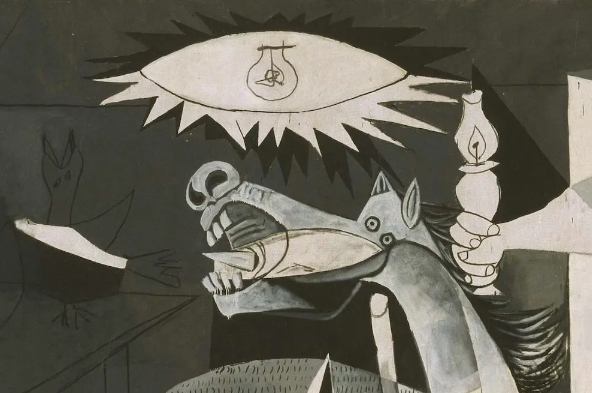
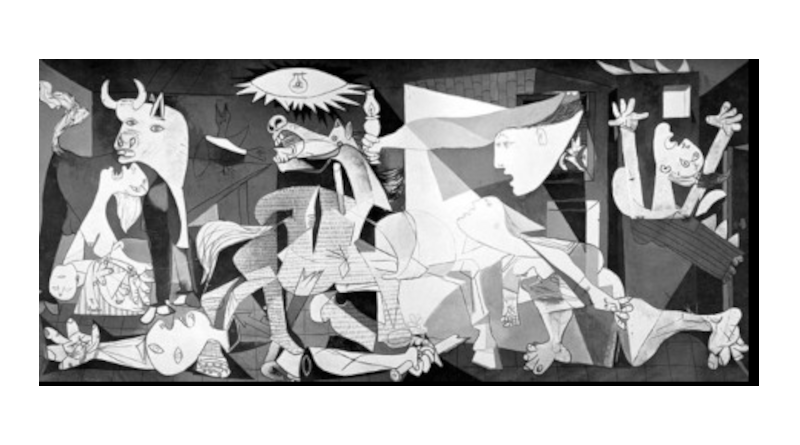
At nearly 3.5 metres high and almost 7.8 metres wide, painted in oil on canvas, Guernica overwhelms before it can be read, refusing to settle into a single, coherent scene. The composition is broken apart: a screaming horse dominates the centre, a fallen soldier lies dismembered below, a mother howls over her dead child, and a bull stands at the edge, watchful and unmoving. Light comes not from the sun but from a harsh, artificial glare, a bulb or an eye, flattening the space into something closer to a stage than a landscape.
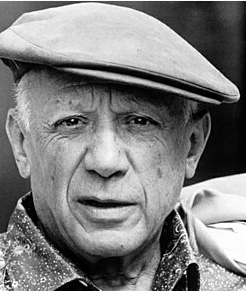
There is no colour to guide the viewer. Blacks, whites, and greys strip the scene back to form and gesture, forcing attention onto anguish itself. Painted by Pablo Picasso, a Spanish artist living in Paris and already one of the defining figures of modern art, the work draws on Cubism but pushes beyond it. Perspective collapses, bodies fracture, and multiple moments appear at once. What we are looking at is not a single scene but a continuous rupture.
The moment of rupture
The painting responds to the bombing of the Basque town of Guernica on 26 April 1937 during the Spanish Civil War. German and Italian aircraft, supporting Franco's nationalist forces, carried out an aerial attack that devastated the town and killed civilians. It marked a shift in modern warfare: violence delivered from a distance, directed at civilians with no means to resist.
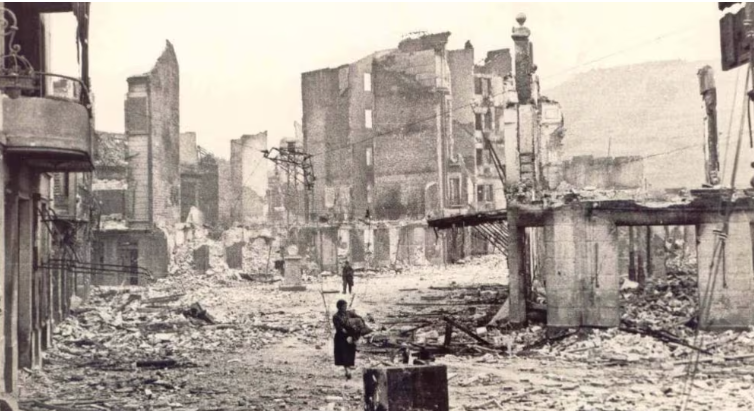
Commissioned for the Spanish Pavilion at the 1937 Paris International Exposition, the work took shape rapidly after news of the bombing reached Paris. Yet Picasso does not depict the town itself. Instead, he constructs a symbolic field of violence: the horse often read as the people, the bull as brutality or endurance, and the broken bodies as the cost of mechanised war. There is no battlefield, no visible enemy, and no resolution, only the aftermath of force turned against the defenceless.
A language of peace and protest
Guernica quickly moved beyond its original setting to become one of the most recognisable anti-war images in the world. It toured internationally during the conflict, raising awareness and funds, and later became a touchstone for protest movements, reproduced wherever war was being challenged.
Its force lies in refusal. It does not offer heroism or consolation, and it does not organise the viewer into sides. Instead, it insists on witness, holding the viewer before suffering without release or resolution. The painting's afterlife reinforces this: it has been repeatedly reworked and carried into new struggles, where its fractured forms continue to speak across time, linking different moments of violence into a shared visual language of protest.
A moment held open
What Guernica does is hold a moment open.
The town can be rebuilt and the war can end, but the image remains — not as a record of what happened, but as a form that refuses to let it settle into the past. It does not tell us what to do. It leaves us with something harder: a clarity that cannot be unseen.
And in that refusal to close, it continues to move, carried, remade, and walked through the world, as seen in Remaking Picasso's Guernica, where the image leaves the canvas and becomes a shared act of protest.