
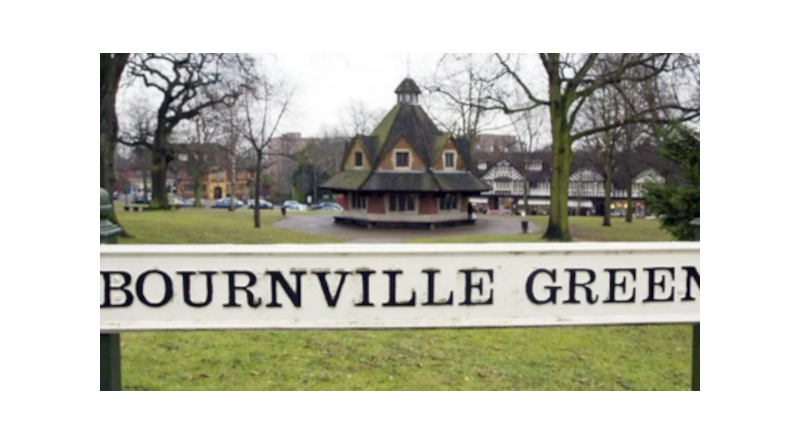
Bournville Green street sign
The Bournville Green street sign marks the heart of a model village shaped by Quaker conviction and design.
A factory in a garden
In 1879, brothers George and Richard Cadbury moved their chocolate business from central Birmingham to a green, open site a few miles south. As devout Quakers, they were troubled by the cramped, unhealthy housing that surrounded most Victorian factories, and wanted better for their own workers.
George Cadbury later bought a further 120 acres beside the factory and used it to build a model village, complete with parks, gardens and tree-lined streets. He famously said:
"No man ought to be condemned to live in a place where a rose cannot grow."
The result became known as Bournville, and was soon called 'the factory in a garden'.
Planning for dignity
Bournville's layout was ahead of its time. Roads followed the land's natural contours rather than the tight grids of industrial towns, and every house had a garden of its own. This was decades before the Garden City movement took hold elsewhere.
The Green and the Rest House
At the centre of the village lies its triangular Green, still the beating heart of the community today. Overlooking it stands the Rest House, an eight-sided building presented to George and his wife Elizabeth by Cadbury employees in 1914, to mark their silver wedding anniversary.
Nearby stand a Friends Meeting House, built in 1905, a school and a bowling green, and the Bournville Carillon, whose 48 bells still ring out over the village. In 1900, George handed control of the estate to the Bournville Village Trust, so that its benefits would outlast him.
Why Bournville still has no pubs
Bournville is famous for having no public houses, a rule rooted in Quaker temperance and still upheld through covenants on the land. George Cadbury's approach was less about restriction than substitution.
In place of pubs, the village offered sports grounds, parks and reading rooms. The belief was that people given good alternatives would have little need for the ones doing harm.
Quaker testimonies in bricks and mortar
More than any single feature, Bournville as a whole stands as an expression of Quaker testimony made in bricks and mortar.
The Bournville Green street sign is, after all, only a street sign — black letters, a white board, nothing more. That plainness is easy to miss, standing as it does at the entrance to one of the most ambitious housing experiments Britain has ever seen.
Every day, commuters, schoolchildren and shoppers pass beneath it without a second glance, on their way to work, class or the shops. It is proof, in its own quiet way, that a Quaker experiment simply became ordinary life.