
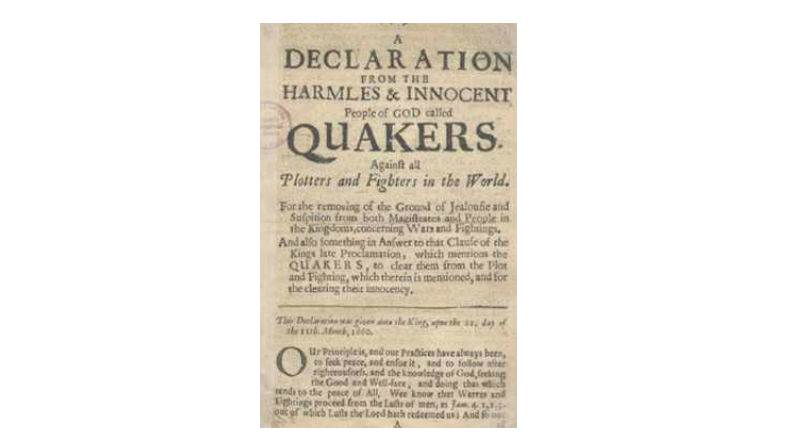
1660 declaration of peace pamphlet
The 1660 declaration of peace pamphlet is the foundation for the Quakers' Peace testimony.
Two Presentations to the king
The year 1660 marked a turning point in British history. The English Revolution (1640 - 1660) came to an end, and King Charles II was restored to the throne. created the political circumstances in which Quakers would issue their Declaration of Peace.
In 1660, founding Friend Margaret Fell presented King Charles II with a predecessor to the Declaration of Peace pamphlet, rejecting war and violence.
Months later, an uprising by the Fifth Monarchists increased suspicion of religious groups, including the Quakers In response, Friends published the Declaration of Peace pamphlet, which was formerly titled as A Declaration from the Harmless and Innocent People of God, called Quakers, Against all Plotters and Fighters in the World.
This pamphlet was also presented to King Charles II in January 1661*, making clear that Friends rejected violence and armed rebellion.
The declaration contained the following statement:
“All bloody principles and practices, we, as to our own particulars, do utterly deny, with all outward wars and strife and fightings with outward weapons, for any end or under any pretence whatsoever. And this is our testimony to the whole world.”
The Peace testimony
With the Quakers' refusal to bear arms, they positioned themselves as peacemakers. The 1660 Declaration of Peace pamphlet became the foundation of what is known as the Peace testimony.
But the commitment went beyond simply refusing to fight. Quakers live out the Peace testimony by seeking to resolve both inward and outward conflict. Inward peace comes first. From it, Quakers work outward, helping to resolve conflict and war across the world.
Pacifists, but not passive
Quakers often describe themselves as 'pacifists, but not passive'. Pacifism is the belief that war and violence are unjustifiable and that disputes should be settled by peaceful means. However, pacifism does not mean standing aside when others suffer.
Throughout their history, Quakers have actively worked for peace through conscientious objection to military service, providing humanitarian aid to victims of war, and helping opposing sides resolve their differences through dialogue and reconciliation.
For Friends, peace is not simply the absence of war. It requires people to challenge injustice, prevent violence and seek peaceful solutions to conflict.
The continuing challenge
The commitment to peace is not always easy to uphold. Quakers recognise that violence takes many forms and that working towards a more peaceful world presents continuing challenges.
Quakers in Britain acknowledge these difficulties:
“We don't assume that we can escape from the realities of a world in which violence appears so deeply rooted. We are, however, constantly challenged by the existence of weapons of mass destruction, the number and intensity of violent conflicts, the cycles of poverty, alienation and violence that destroy peace in many deprived communities, and apparently random acts of terrorism.”
More than 350 years after the Declaration of Peace pamphlet was written, the Quaker refusal to take up arms remains a central commitment. Its wider ambition of a world without war has yet to be achieved. Nevertheless, Friends continue to work towards that goal, believing that conflicts can be resolved by peaceful means.
* In the 17th century The legal calendar year (not to be confused with Julian calendar dating) ended on 25th March). So, in today's modern dating, the declaration would have been published in January 1661, the same month it was presented to the king. For historical consistency over the years, Quakers use the 1660 date for the document's creation.