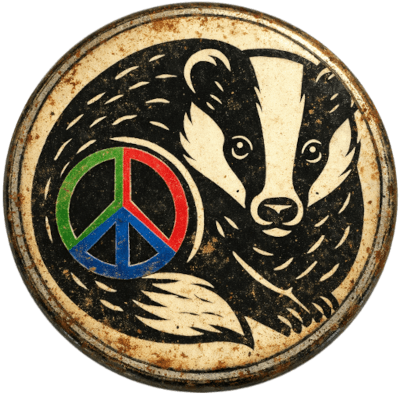

Witness for Peace badge
The Witness for Peace badge was made by Quakers for a continuous round-the-clock peace vigil in New York during the weekend of Easter 1961.
The Times Square peace vigil
On Good Friday, 31 March 1961, a group of Quakers gathered outside the Armed Forces recruiting station in New York's Times Square. Standing silently in formation, they began a peace vigil that would continue through the night and into Easter Sunday.
Organised by New York Yearly Meeting and local Quaker meetings, the vigil opposed nuclear warfare and the growing reliance on military force. Participants took turns standing in silence, enduring rain, sleet and cold winds. Over the Easter weekend, hundreds of Friends and supporters maintained their presence in one of America's busiest public spaces.
The American Friends Service Committee (AFSC) produced the Witness for Peace badge for the occasion. Its simple design, bearing two interlocking laurel branches, carried a message that needed little explanation.
From Aldermaston to America
The Easter demonstrations followed a tradition established in Britain in 1958, when thousands of peace campaigners marched from London to the Atomic Weapons Research Establishment at Aldermaston.
Organised in opposition to nuclear weapons, the Aldermaston marches inspired similar Easter peace demonstrations abroad, including in the United States.
By 1961, the American Easter peace movement had grown into a nationwide campaign. Around 3,000 people demonstrated in Washington, D.C., while thousands more participated in vigils and marches elsewhere.
In Washington, demonstrators held vigils at military and nuclear research establishments, including Fort Detrick and the Pentagon. The Times Square vigil formed part of this wider challenge to the nuclear arms race and Cold War militarisation.
Quaker peace vigils: Silence and witness
For Quakers, a peace vigil is more than a public demonstration. It is an expression of religious faith through shared silence.
Silence has long been central to Quaker worship. Friends traditionally gather without a set service, waiting attentively for spiritual guidance. Public peace vigils can carry that same stillness beyond the Meeting House and into streets, squares and other places where people gather.
Friends may stand or sit silently, hold banners, distribute leaflets or speak with passers-by. Some vigils take the form of a Meeting for Worship for Witness, while others are gatherings for reflection and solidarity.
Rather than relying on speeches or confrontation, the participants' continued presence makes their concern visible. A silent vigil offers space to remember people affected by war, express opposition to violence and demonstrate that another response to conflict is possible.
A wearable witness for peace
Although Quakers held dedicated Meetings for Peace during the First and Second World Wars, public peace vigils began taking their modern form in the late 1950s and became more widespread during the Vietnam War.
Peace vigils have continued into the present day, responding to conflicts and humanitarian crises around the world. Some are organised for a particular occasion, while others take place regularly over many years.
The Witness for Peace badge purposely pins itself to this peace vigil practice — Quakers expressing themselves through their silent presence in public places.