
Winnie the Pooh and friends
Winnie the Pooh and his friends began in A. A. Milne's children's stories in the 1920s and became internationally loved through Disney. Milne also wrote against war, while Pooh's gentle world inspired Taoist interpretations and colourful anti-nuclear peace badges. In China, the bear later became a figure of political satire and censorship.
Sections
Badges
Showing 1 to 5 of 6 total badges
In numbers
4
Original Pooh-related books written by A. A. Milne
180,000+
Copies of Winnie-the-Pooh sold in its first year
50 million+
Estimated worldwide copies of Milne's four original Pooh books
83
Language varieties and dialects documented for Winnie-the-Pooh translations
163
Distinct full translations of the first Winnie-the-Pooh book recorded by a specialist catalogue
20
Weeks the Latin translation, Winnie ille Pu, spent on the New York Times bestseller list
3
Original Disney animated shorts combined into the first feature-length Pooh film
6
Disney theatrical feature films featuring Pooh and his friends through 2018
100
Years since the publication of Winnie-the-Pooh, celebrated in 2026
Timeline
-
1914The real Winnie arrives in Britain
A Canadian soldier brings Winnipeg to Britain, inspiring the name of Christopher Robin's bear.
-
1926Winnie-the-Pooh is published
Milne and Shepard introduce Pooh and his friends in the first story collection.
-
1928The House at Pooh Corner appears
Tigger joins the Hundred Acre Wood, extending Milne's stories of friendship and difference.
-
1934Milne publishes Peace with Honour
Milne challenges the acceptance of war as a way to settle international disputes.
-
1940Milne publishes War with Honour
The threat of Nazi Germany leads Milne to reconsider his earlier pacifism.
-
1961Walt Disney acquires the film rights
Disney secures screen adaptation rights, preparing Pooh and friends for international cinema audiences.
-
1960sPooh appears on peace badges
An early badge shows Pooh promoting peace, although its precise production date remains uncertain.
-
1966Disney releases its first Pooh film
Disney's first animated Pooh short brings the characters to cinema screens worldwide.
-
1977Pooh's first feature-length Disney film
Three earlier animated shorts combine into the first feature-length Pooh film.
-
1982The Tao of Pooh is published
Benjamin Hoff uses Pooh to explore Taoist ideas of simplicity, harmony and effortless action.
-
2013Pooh becomes a figure of political satire
Chinese internet users compare Xi Jinping and Barack Obama with Pooh and Tigger.
-
2017Chinese authorities restrict Pooh imagery
Politically sensitive Pooh images face online restrictions in China, drawing international attention.
-
2018Disney releases Christopher Robin
A live-action film reunites an adult Christopher Robin with his childhood companions.
-
2026Winnie-the-Pooh celebrates 100 years
A hundred years on, Pooh remains a symbol of friendship, kindness and peace.
Brief history
A bear born after the Great War (1914 - 1928)
Before Winnie-the-Pooh appeared in print, his creator, A. A. Milne, had served in the First World War, both as an army officer and in wartime propaganda work. His later children's stories grew from a different part of his life, the toys and imaginary adventures of his son Christopher Robin.
The name Winnie came from a real bear brought to Britain by a Canadian soldier in 1914. Christopher Robin encountered the bear at London Zoo and gave the same name to his own teddy bear.
Drawing on his son's toys and the Sussex countryside, Milne created the Hundred Acre Wood. Illustrated by E. H. Shepard, Winnie-the-Pooh appeared in 1926, followed by The House at Pooh Corner in 1928.
Milne and the question of peace (1934 - 1940)
Milne's opposition to war became explicit in 1934 with the publication of Peace with Honour. Drawing partly on his experience of the First World War, he challenged the belief that nations should settle disputes through armed conflict.
His pacifism was subsequently tested by the rise of Nazi Germany. In War with Honour (1940), Milne accepted that military resistance to Hitler had become necessary, reversing his earlier opposition to war.
The Pooh stories were not political manifestos, but their creator's engagement with the moral questions of war and peace would become an important part of his wider literary legacy.
From the Hundred Acre Wood to the world (1930s - 2018)
The popularity of Pooh and his friends soon extended beyond Milne's books. Licensed toys, illustrations and merchandise introduced the characters to new audiences, but their international recognition grew substantially through animated films.
Walt Disney secured the screen rights in 1961. The first animated short, Winnie the Pooh and the Honey Tree, appeared in 1966, followed by the first feature-length film, The Many Adventures of Winnie the Pooh, in 1977.
By 2018, Disney had released six theatrical feature films featuring Pooh and his friends, alongside further films and television programmes. Their familiar faces had become part of childhood across generations and national boundaries.
Friendship between Pooh and his friends (1926 - present)
The Hundred Acre Wood is not a place without fear or disagreement. Piglet worries about almost everything, while Pooh approaches life's difficulties with patience, affection and a fondness for honey. Piglet's courage often emerges not because his fears disappear, but because friendship gives him the confidence to face them.
Eeyore remains gloomy yet belongs among his friends. Tigger's endless bouncing frequently tests their patience, but his exuberance is accepted alongside their quieter personalities.
In Milne's stories and Disney's cartoons, friendship is rarely perfect. The characters misunderstand one another, make mistakes and sometimes behave selfishly. Yet their continued companionship suggests that kindness, forgiveness and acceptance of differences are foundations of peaceful relationships.
Pooh and friends for peace (1960s - 1980s)
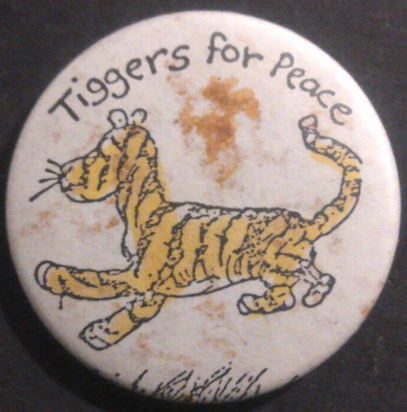
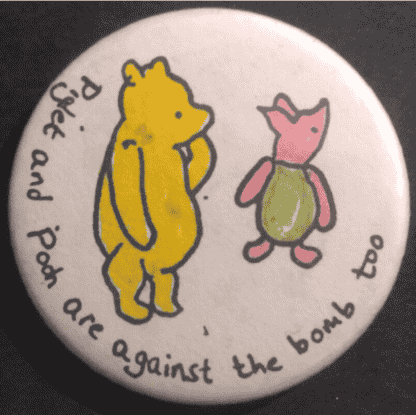
The widespread familiarity of children's characters made them natural subjects for peace badges. Across the anti-war and anti-nuclear movements, animals and cartoon figures offered humour and reassurance alongside more confrontational political slogans. Their appeal crossed generations and cultural boundaries, making serious messages approachable.
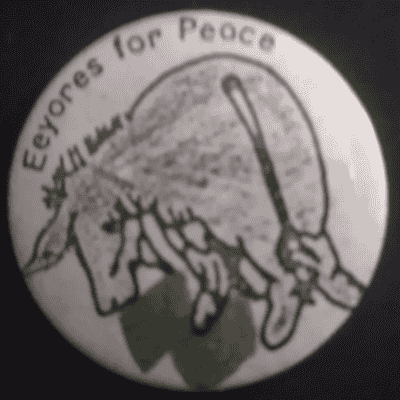
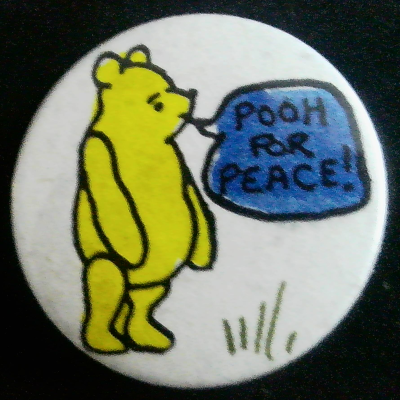
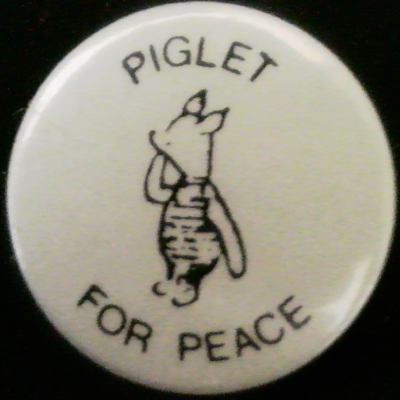
Pooh appeared on peace badges by at least the 1960s. Later designs included Pooh for Peace, Piglet for Peace, Tiggers for Peace, Eeyores for Peace, Heffalumps for Peace and Piglet and Pooh Are Against the Bomb Too.
These unofficial badges used bright colours, informal lettering and hand-drawn illustrations. Their familiar characters contrasted childhood innocence and friendship with the threat of nuclear destruction. The six designs in the Badger 4 Peace collection carry their messages without the official CND emblem.
The Tao of Pooh (1982 - 1990s)
Another interpretation of Milne's characters emerged in 1982 when American writer Benjamin Hoff published The Tao of Pooh. Rather than discussing nuclear disarmament, Hoff used the bear's uncomplicated approach to life to explain the ancient Chinese philosophy of Taoism.
Central to his interpretation was wu wei, often described as effortless action. Pooh's willingness to accept circumstances without constantly struggling against them illustrated a philosophy of simplicity, harmony and living in accordance with nature.
Hoff returned to the Hundred Acre Wood with The Te of Piglet in 1992, exploring the strength found in modesty and apparent weakness. Together, the books offered another way of understanding the peaceful qualities readers recognised in Milne's characters.
Pooh becomes political satire (2013 - 2015)
In 2013, Winnie-the-Pooh acquired an unexpected political role in China. Internet users compared a photograph of President Xi Jinping walking beside American president Barack Obama with an illustration of Pooh and his taller, slimmer friend Tigger.
Further comparisons followed. A 2014 photograph of Xi meeting Japanese prime minister Shinzo Abe was paired with an image of Pooh and the gloomy Eeyore. In 2015, another widely circulated image compared Xi riding in a parade car with a toy Pooh.
Unlike the earlier peace badges, these images were not primarily pacifist statements. Their humour lay in using familiar, harmless characters to ridicule powerful political figures.
The bear and the censors (2017 - 2020s)
By 2017, Chinese internet authorities were restricting some Winnie-the-Pooh images and references associated with comparisons to Xi Jinping. Posts disappeared, certain search terms were blocked and some cartoon images became politically sensitive.
The restrictions were not a universal ban on Winnie-the-Pooh. The character continued to appear in other contexts, but attempts to suppress the political comparisons attracted international attention.
Pooh subsequently became a recognisable figure in political satire and criticism of censorship beyond China. A bear originally created for children's entertainment had acquired another meaning, illustrating how even gentle humour could become a form of political expression.
A century of Pooh and peace (1926 - 2026)
A hundred years after Winnie-the-Pooh first appeared, Milne's characters remain familiar to generations of children and adults. Their journey has extended far beyond the Hundred Acre Wood, through books, films, philosophy, peace campaigning and political satire.
Milne did not create Pooh as a symbol of the peace movement. Yet the friendships at the heart of his stories offered qualities that peace campaigners could readily embrace. Piglet's courage, Eeyore's acceptance and Pooh's uncomplicated kindness gave familiar faces to ideas that might otherwise seem distant or abstract.
Sometimes courage is simply the choice to be kind. Peace is not only a treaty signed by governments, but also a honey pot shared between friends.
Articles
login fail 0 results