William Penn's wampum belt
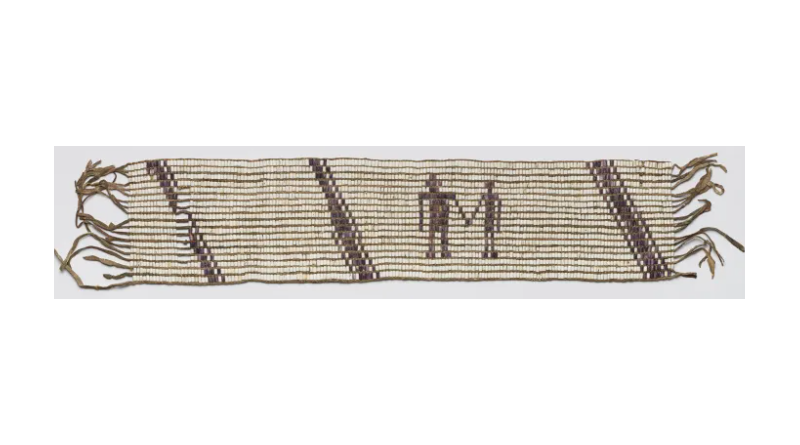
William Penn's wampum peace treaty belt is a symbol of his efforts to establish peaceful relations with the Lenape people of Pennsylvania.
A belt of friendship
William Penn's wampum belt is traditionally associated with a peace treaty between Penn and the Lenape people of Pennsylvania. Its white and purple shell beads form two human figures holding hands, with three diagonal bands completing the design.
The joined hands are understood to represent friendship between the Lenape and European settlers.
For the Lenape and other Indigenous peoples of north-eastern America, wampum belts had an established place in diplomacy. They accompanied important agreements and could be brought out again to recall the promises made.
The Lenape had their own traditions of negotiation long before Penn arrived. Their use of wampum formed part of the diplomatic practices that Penn encountered when he sought to establish peaceful relations.
Building relations with the Lenape
William Penn was a Quaker who wanted people of different religions and backgrounds to live peacefully in Pennsylvania. Although the English king had granted him the colony, the Lenape already inhabited the land. Penn sought agreements with them rather than relying solely on the royal grant.
Before travelling to America, Penn wrote to Indigenous leaders in 1681. He acknowledged the injustice inflicted by earlier European settlers and explained how he hoped to build a different relationship. He wrote:
“I desire to enjoy it with your love and consent, that we may always live together as neighbours and friends.”
Penn also proposed that disputes should be settled by representatives from both communities. He sent commissioners ahead of him to negotiate over land and establish peaceful relations.
The Lenape brought their own diplomatic experience to these encounters. They were negotiating the future of their homeland, not simply receiving Penn's proposals.
The treaty beneath the elm tree
The peace treaty traditionally associated with Penn's wampum belt is known as the Treaty of Shackamaxon.
According to tradition, Penn met Lenape leaders, including Tamanend, in 1682 or 1683 beneath a great elm tree at Shackamaxon, a Lenape settlement on the Delaware River in what is now Philadelphia. Both sides are said to have promised friendship and peaceful relations.
Nearly 90 years later, in 1771 - 1772, the artist Benjamin West depicted the meeting in his painting Penn's Treaty with the Indians. His painting shows Penn and Lenape representatives gathered beneath the elm tree, giving the traditional account a memorable visual form.
Although Penn's negotiations and agreements with the Lenape are documented, no contemporary record confirms that the Shackamaxon meeting occurred exactly as described. Nor can historians establish whether the surviving belt was presented there or during another negotiation.
A friendship remembered
Benjamin West's painting became widely known beyond Pennsylvania. Reproduced in prints and history books, it helped establish the meeting beneath the elm tree as a familiar image of Pennsylvania's beginnings and, later, part of the wider story of America's founding.
The wampum belt followed a quieter path. Penn's descendants preserved it for generations until 1857, when his great-grandson, Granville John Penn, donated it to the Historical Society of Pennsylvania.
The belt became part of a public collection, preserving a tangible connection with the treaty tradition.
Although the belt is named after William Penn, its significance is not his alone. West's painting presents the meeting through the eyes of a later European artist, while the belt belongs to the Indigenous diplomatic tradition that Penn encountered.
Both have helped preserve the encounter in historical memory, but they tell its story in different ways.