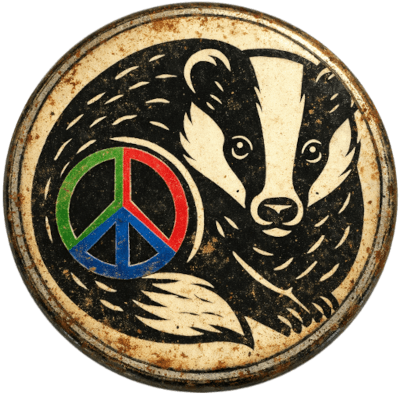
Peace symbol
The peace symbol holds a shared human refusal in a form that crosses every border.
Lines drawn against the bomb
The symbol now recognised around the world as ‘peace’ began as something far more specific. In 1958, at the height of nuclear anxiety, it was designed for a march organised by the Campaign for Nuclear Disarmament. Its purpose was not to express a general hope, but to give form to a particular demand: that nuclear weapons should be abandoned.
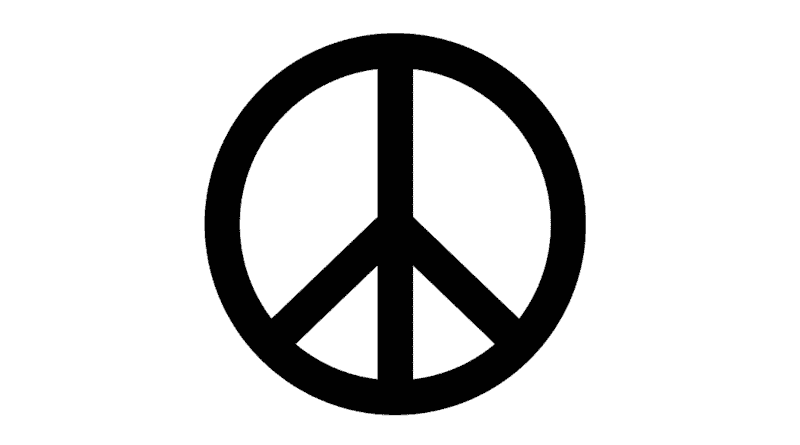
Its design is stark and deliberate. It combines the semaphore signals for ‘N’ and ‘D’ — nuclear disarmament — into a single figure: a vertical line, anchored by two downward strokes, enclosed within a circle. The lines fall rather than rise, giving the impression of weight, of something pressed down. It is less a gesture of victory than a recognition of threat.
In this original context, the symbol did not stand for peace in the abstract. It stood at the edge of a possibility — the end of human life on a scale never before imagined — and marked a line that should not be crossed.
From protest to language
What followed is unusual. Most symbols remain tied to their origins, but this one moved quickly beyond them. As nuclear anxiety spread across borders, so did the symbol. It appeared on placards, badges, and banners, carried not only in Britain but across Europe and the United States.
Over time, its meaning widened. The specific demand for nuclear disarmament gave way to a broader association with peace itself. The symbol detached from its immediate context and became a kind of shared visual language, one that could be used in different movements, in different places, without needing to be explained.
This shift did not erase its origins; it simplified them. The complexity of Cold War politics was reduced to a form that could be drawn in a moment and recognised at a glance. In that simplicity lies its power. It allows a complex position to be held, and shared, without words.
A sign anyone can make
Part of the symbol's force comes from how easily it can be reproduced. It does not require skill or materials beyond a pen and a surface. It can be drawn on a wall, stitched onto fabric, traced in the air. This accessibility turns it into something more than an image. It becomes an action.
To draw the symbol is to participate in what it represents. It is a small act, but one that connects the individual to a wider movement. Each instance adds to a larger field of visibility, where the same lines appear again and again, in different hands, in different contexts.
This repeatability matters. Like the folding of paper cranes or the wearing of a white poppy, the meaning of the symbol is not contained in a single example. It accumulates. It becomes visible through repetition, through the quiet persistence of many people making the same mark.
What the symbol holds now
Today, the peace symbol is everywhere, and this ubiquity creates a tension. Its meaning is widely understood, but often only in its most general form. It can appear decorative, detached from the urgency that first produced it. The risk is that it becomes a sign of feeling rather than a sign of position.
Yet its structure resists complete dilution. The downward lines, enclosed within a boundary, still carry the trace of their origin. They speak, however faintly, of a moment when the stakes were absolute, and when a symbol was needed to hold that reality in view.
The peace symbol does not argue its case. It does not explain itself. Instead, it offers a form that can be taken up or ignored. Its persistence suggests that even as contexts change, the need it answered has not disappeared.
What it asks, quietly, is whether a shared mark can still carry a shared refusal, and whether the simplicity that made it powerful can continue to hold meaning in a world that has learned to look past it.