
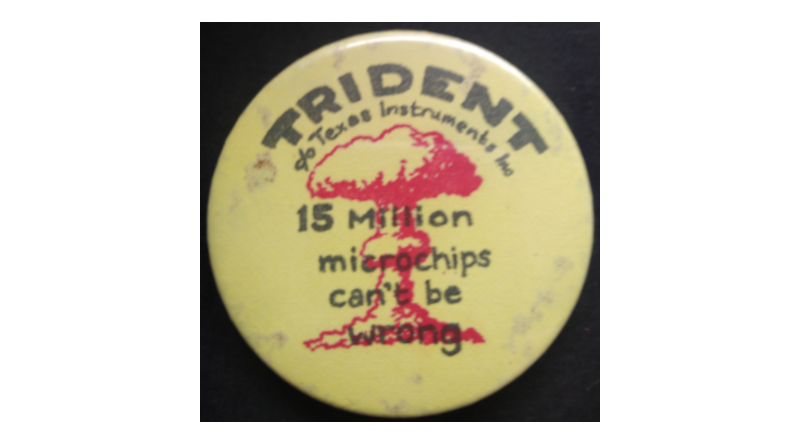
Trident do Texas Instruments Inc
Trident c/o Texas Instruments Inc is a vintage pin badge that takes a corporate testing scandal and uses it to puncture the West's claims that its nuclear arsenal are fail-safe.
Why 15 million microchips were wrong
The slogan “15 million microchips can't be wrong” sarcastically parodies RCA Records' 1959 marketing campaign for Elvis Presley, 50,000,000 Elvis Fans Can't Be Wrong. The badge swaps a rock-and-roll idol for mass-produced military silicon, measuring nuclear safety in the same terms as a fan club boasting about its numbers.
The crisis behind the badge erupted in September 1984, during a routine internal audit at an IBM facility in Owego, New York. Inspectors found that Texas Instruments, a major defence contractor best known for making pocket calculators, was skipping required military-grade screening tests on its microchips.
Over eight years, Texas Instruments had shipped roughly 15 million uncertified microchips to IBM alone, without the standard temperature, environmental stress, and electrical checks.
The fallout was immediate. The Pentagon's Defense Logistics Agency ordered a sweeping freeze, telling officers to refuse any hardware built with the untested chips. Production lines ground to a halt across the United States. Domestic corner-cutting, not foreign sabotage, had compromised the defence of the world's most advanced military.
Cold War silicon
During the 1980s, the weapons of the United States and its NATO allies shifted from mechanical guidance to digital, computerised systems. This left Cold War defence systems heavily reliant on the tiny silicon wafers made by commercial firms.
Engineers had wired the unverified TI chips into the core navigation, bombing, and targeting computers of front-line hardware, including F-15 fighter jets and B-1B strategic bombers.
Most critically, the same unverified chips sat in the guidance processors of Trident II submarine-launched ballistic missiles. A microscopic manufacturing flaw in a Trident missile's astro-inertial guidance computer could send a thermonuclear warhead miles off its planned course.
Separately, in the tense stand-offs of the late Cold War, a glitch in any command mainframe risked a false early-warning signal, one that could trigger an accidental nuclear exchange.
A nuclear postbox
The badge borrows the format of a company address to show who really kept the nuclear arms race running. By addressing the missile 'care of' Texas Instruments, the peace movement made the machinery of the nuclear state look as ordinary as a supply catalogue.
It reminded the public that the nuclear deterrent, the country's supposed guarantee of survival, ran off the same profit-driven production lines as pocket calculators.
Trident c/o Texas Instruments Inc pins the blame for this risk not on an abstract political theory, but directly onto the company that made the parts. It remains a small, tin-plate record of a moment when the mask of corporate reliability slipped, revealing the flawed wiring underneath.