
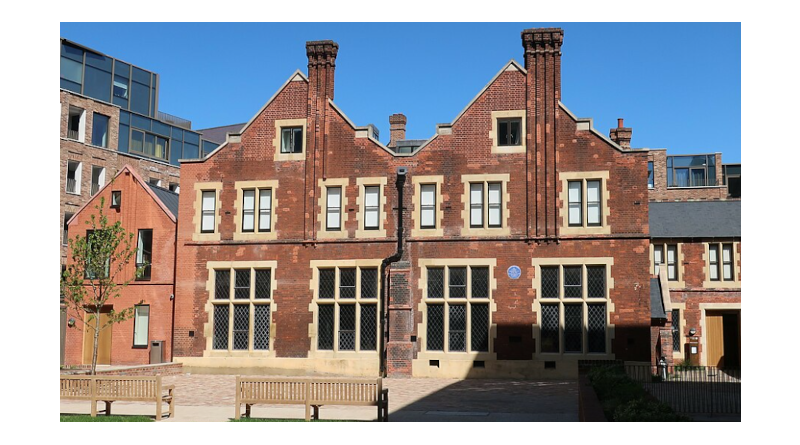
Toynbee Hall
Toynbee Hall changed social reform by insisting that poverty should be met at close quarters rather than managed from a distance.
An East End experiment
Toynbee Hall was founded in Whitechapel in 1884 by Samuel and Henrietta Barnett, at a time when the East End stood as one of the clearest symbols of urban poverty in Britain. It was named after Arnold Toynbee, the historian and social reformer whose work helped shape the Barnetts' thinking. What they created was not a mission in the usual Victorian sense, and not simply another charitable institution. It was a settlement: a place where university men, and later women, would live among working people rather than merely visit them.
That idea gave Toynbee Hall its force. The Barnetts believed that social change would remain shallow so long as the educated classes treated poverty as something observed from afar. Their answer was proximity. Residents were expected to share the life of the neighbourhood, to teach, to organise, to listen and to learn. Samuel Barnett described the principle clearly:
“to learn as much as to teach; to receive as much as to give”
That sentence still captures what made Toynbee Hall distinctive. It was built on the hope that social reform might begin with encounter: not pity alone, but relationship, understanding and responsibility.
More than charity
Toynbee Hall quickly became one of the defining institutions of the settlement movement. It offered lectures, debates, clubs, cultural activity and practical support, but its deeper purpose was larger than any single programme. It brought people across class lines into the same civic space and treated education as part of public life rather than a private advantage. In that sense, it challenged both indifference and condescension.
Its influence spread far beyond Whitechapel. Toynbee Hall became the model for later settlement houses in Britain and abroad, most famously Hull House in Chicago after Jane Addams encountered the settlement idea. It also helped shape public reform at a national level. Men such as Clement Attlee and William Beveridge passed through Toynbee Hall, carrying with them lessons formed not in theory alone but in direct contact with inequality. The line from Whitechapel to the modern welfare state is not simple, but it is real.
The tension at its centre
Toynbee Hall deserves admiration, but not sentimentality. Like much Victorian reform, it contained a tension. Its work was driven by seriousness and moral purpose, yet it also emerged from a society marked by steep inequalities of class and power. The settlement sought fellowship across that divide, but it could never fully escape the fact that one class still possessed more voice, security and authority than the other.
That tension is part of the story, not a reason to dismiss it. Toynbee Hall matters because it tried to turn privilege outward and place it under pressure. It asked whether those with education and influence might be changed by living close to hardship, and whether reform could begin not with abstraction but with shared ground. Even its limits tell us something important about how difficult real solidarity can be.
A living legacy
Toynbee Hall did not remain in the 19th century. Over the decades it helped pioneer practical forms of advice and support, including free legal help and early Citizens Advice work. Today it still operates in East London, working alongside people facing poverty, debt, injustice and inequality. The language has changed, and rightly so. Modern Toynbee Hall speaks more openly about shifting power and amplifying voices that are less likely to be heard.
That continuity gives the organisation its lasting significance. Toynbee Hall was founded on the belief that social problems should be met where they are lived, and that reform begins when people refuse the comfort of distance. At its best, it stands for a simple but demanding principle: a fairer society is built not only through ideas, but through presence.