
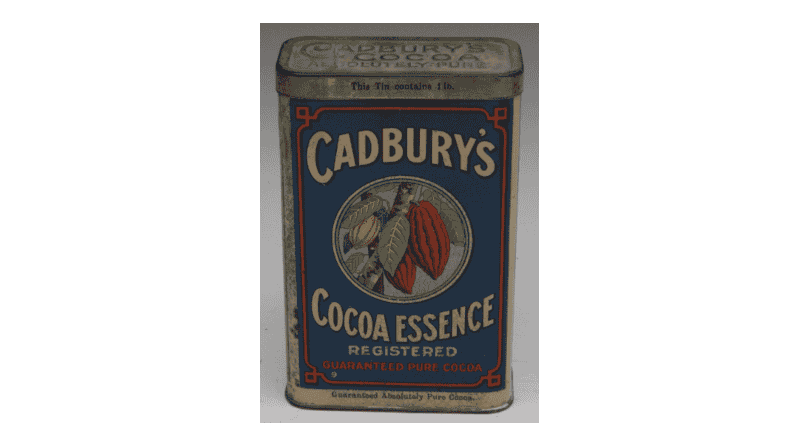
Tin of Cadbury's Cocoa Essence
Tin of Cadbury's Cocoa Essence
The Tin of Cadbury's Cocoa Essence illustrates the relationship between the Quaker chocolate industry and the temperance movement.
Drinking chocolate
Dating from around 1905, the blue tin features an illustration of cocoa pods alongside the words 'Guaranteed Pure Cocoa'. The tin once contained drinking cocoa, the product from which the Quaker chocolate industry grew.
Quakers first became involved in the chocolate trade during the 18th century, when chocolate was primarily consumed as a drink. Regarded as a nourishing beverage with medicinal properties, drinking chocolate offered an alternative to alcohol.
With the emergence of the Temperance Movement in the early 19th century, Friends actively promoted alternatives to alcoholic drinks. The manufacture and sale of drinking chocolate was therefore regarded as an Innocent Trade.
In 1824, John Cadbury opened a shop in Birmingham selling tea, coffee and drinking chocolate. He prepared cocoa using a pestle and mortar before moving into larger-scale manufacturing in 1831.
Three major chocolate manufacturers emerged from Quaker families: Fry's of Bristol, Cadbury of Birmingham and Rowntree's of York. There was friendly rivalry and a network of personal and commercial relationships between the manufacturers.
In 1857, for example, George Cadbury went to York to train in the grocery business of Joseph Rowntree senior. Their shared faith encouraged good business practices and social reform.
By the time the chocolate manufacturers emerged, Quakers had already established numerous successful businesses. Their reputation for honesty and reliability helped the manufacturers gain the confidence of the buying public.
From drinking chocolate to eating chocolate
In 1847, Fry's pioneered the modern chocolate bar by combining cocoa butter, cocoa powder and sugar to produce a paste that could be pressed into a mould. The development opened up a new market for chocolate manufacturers.
Competitors soon emerged, and some less scrupulous manufacturers used substances such as brick dust to colour their cocoa and chocolate products. The Quaker reputation for honest trading gave consumers greater confidence in the quality of their products.
When George and Richard Cadbury took over their father's struggling business in 1861, they invested in new machinery. A Dutch cocoa press enabled the brothers to remove much of the cocoa butter from the beans, eliminating the need for added starches.
In 1866, they introduced Cadbury's Cocoa Essence, advertised under the slogan, Absolutely Pure: Therefore Best. The success of the new product helped transform the fortunes of the family business.

Cadbury also became an innovator in chocolate packaging. In 1868, Richard Cadbury produced a heart-shaped box of chocolates for Valentine's Day. An accomplished artist, Richard painted some of the illustrations used to decorate the company's boxes himself.
Fancy boxes were miniature works of art and proved popular with the Victorians. After serving their original purpose, the boxes could be used to store small personal possessions such as jewellery, buttons and letters.
Elsewhere, Rowntree's expanded its confectionery business with the introduction of Fruit Pastilles in 1881 and Fruit Gums in 1893.
In 1905, Cadbury introduced Dairy Milk, which would become one of Britain's best-known chocolate products. The continued expansion of the business eventually led to its merger with Fry's in 1919.
Investing in employees
In accordance with their Quaker values, the Cadbury brothers invested in the well-being of their employees. In 1879, they moved their chocolate business from central Birmingham to a green, open site a few miles south called Bournville.
George Cadbury subsequently developed Bournville as a model village, providing healthier living conditions, gardens and recreational facilities. The company also introduced improvements in working conditions, healthcare and educational opportunities for its employees.
The end of Quaker family control
As Cadbury developed into a multinational company during the 20th century, the influence of its founding family gradually diminished.
In 1962, Cadbury became a publicly listed company, bringing direct family control to an end. Seven years later, it merged with Schweppes, although members of the Cadbury family remained involved in the management of the company until 2000.
Following the separation of Cadbury and Schweppes in 2008, Cadbury was acquired by Kraft Foods in 2010. In 2012, it became part of Mondeléz International.
What began with Quaker manufacturers promoting drinking chocolate as an alternative to alcohol developed into one of Britain's most successful confectionery industries. Guided by their faith, Friends combined commercial innovation with social reform.
/p> Although these businesses eventually passed out of Quaker hands, the Tin of Cadbury's Cocoa Essence serves as a reminder of how their founders helped shape both the chocolate industry and the way employers looked after their workers.