
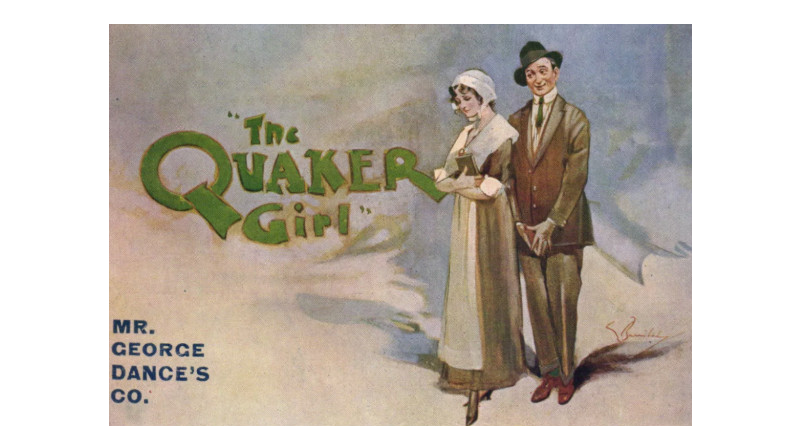
The Quaker Girl Poster
The Quaker Girl Poster advertised one of Britain's most successful stage musicals of the early 20th century.
Modesty meets modernity
The Quaker Girl, a musical comedy in three acts, debuted in 1910 and swiftly became a theatrical sensation. With music by Lionel Monckton, lyrics by Adrian Ross and Percy Greenbank, and a book by James T. Tanner, it cleverly wove themes of romance, rebellion, and religious restraint. At the heart of the story is Prudence, a young Quaker woman from a strictly plain-dressing, peace-loving community in England. She is cast out by her meeting for attending a worldly celebration, yet this exile becomes her emancipation.
Prudence finds herself in Paris, where she unexpectedly rises to fame as a fashion model. Ironically, her simple, demure Quaker dress becomes the latest haute couture trend. Amid this world of extravagance, she retains her inner principles, and her authenticity wins over the dashing Prince Carlo. The musical concludes with a joyful union of hearts and values & Prudence’s sincerity transforming not just herself, but those around her.
Production and stage success
The original London production opened at the Adelphi Theatre on 5 November 1910, starring Gertie Millar as Prudence. Produced by George Edwardes, a legendary figure in Edwardian musical theatre, the show ran for an impressive 536 performances-an exceptional achievement of the time. A Broadway run followed in 1911 at the Park Theatre in New York, further cementing its popularity.
The musical was noted for its opulent staging and Monckton’s memorable songs, including "A Runaway Match," "Tip-Toe," and "Or Thereabouts." Though it played with stereotypes of Quaker simplicity, it did so with affection and charm, often highlighting the contrast between inner peace and outer glamour. The show's costumes-ranging from Quaker bonnets to Parisian gowns-symbolised this tension.
The original production opened at the Adelphi Theatre in London on 5 November 1910 and was a major hit, running for 536 performances-a significant number at the time, marking it as one of the West End's most successful musicals of the Edwardian era. Gertie Millar, a major musical comedy star of the time, played the lead role of Prudence and helped draw large audiences. Critics praised its charm, humour, and melodic score by Lionel Monckton.
The Quaker Girl also found success across the Atlantic. A Broadway production opened in 1911 at the Park Theatre in New York City. While it was not quite as long-running as the London version, it was well-received and helped introduce Edwardian British musical theatre to American audiences, bridging a stylistic gap between Gilbert and Sullivan operettas and emerging Broadway revues. The musical was also performed in continental Europe — often in translated versions. Over the years the musical has been staged a few times. The last known time was in 2018 by Gosforth Musical Society, near Near Newcastle, England.
Cultural impact
The Quaker Girl emerged at a time when Quaker values were quietly influencing British society. The Religious Society of Friends, with its testimonies of simplicity, peace, equality, and truth, had long been associated with social reform. Yet by the early 20th century, their image in the public imagination had crystallised into a kind of historical quaintness-modest dress, thee-and-thou speech, and moral rectitude.
The musical both gently caricatured and subtly honoured this identity. In an age of increasing consumerism and rapid modernisation, Prudence’s character embodied the enduring value of integrity. Her plainness becomes stylish, her honesty attractive, and her refusal to conform turns into quiet revolution. The show’s success indicated a wider cultural fascination with Quaker ethics, especially in contrast to the glittering but hollow world of fashion and aristocracy.
Moreover, the musical’s timing coincided with the rise of the women’s suffrage movement and debates over public morality. Prudence’s journey from restriction to self-expression resonated with audiences experiencing social change. It mirrored real Quaker contributions to progressive causes-from prison reform to anti-slavery and peace campaigning-which would only deepen during the world wars and beyond.
A curious legacy
While The Quaker Girl is rarely staged today, its spirit lives on in how Quakerism is portrayed in popular culture: not as rigid doctrine, but as a quiet moral compass. The musical was both a product of its time and a gentle commentary on the tension between tradition and transformation. As Prudence might say, in plain speech and plain dress, truth does not need fashion to shine.