| | by admin | | posted on 24th May 2023 | Power to Protest | | Individuals | | views 2153 | |
Edward Wightman (d. 1612) was the last man burned for heresy in England, his death marking the end of a punishment once used to enforce religious authority.
His execution marked the end of burning for heresy in England, bringing to a close a punishment that had long defined the relationship between belief and authority.
In early 17th century England, belief was not a private matter. It was bound to law, order, and the authority of both Church and Crown. To reject accepted doctrine was not simply to be mistaken, but to stand outside the structure that held society together.
Heresy, in this context, was treated as a threat that could justify the most extreme response. Burning at the stake was intended not only to punish but to demonstrate the consequences of stepping beyond accepted belief. By the time Edward Wightman was brought to trial, this practice had already begun to sit uneasily within a changing religious landscape. His death would mark its end.
Wightman was born in the English Midlands and grew up in Burton-on-Trent, a region shaped by religious tension and reforming currents. By adulthood, he had become a preacher operating outside the authority of the Church of England.
His views drew on a mixture of radical influences. He rejected the established Church as corrupt and spoke openly against its teachings. This placed him within a broader current of dissent that questioned not only specific doctrines but the right of the Church itself to define truth.
By the early 1600s, Wightman's beliefs had moved far beyond accepted bounds. Among other positions, he taught that the soul did not depart the body at death but remained until the Day of Judgment. He rejected infant baptism and denied central doctrines concerning the nature of Christ.
These ideas were not treated as abstract theology. They were understood as a direct challenge to religious and political authority. To deny the Church's teaching was, by extension, to undermine the order it supported. In this way, belief became a matter of control as much as conviction.
In April 1611, a warrant was issued for Wightman's arrest during the reign of King James I. He was brought before ecclesiastical courts and charged with multiple counts of heresy.
The process reflected a system in which Church and state acted together. Religious deviation was examined, judged, and, if necessary, punished through legal structures designed to enforce conformity. Wightman was accused of denying core elements of Christian doctrine and of persisting in these views despite repeated opportunities to recant.
A contemporary account recorded the charges against him:
“The baptizing of infants was an abominable custom; that the doctrine was a total fabrication; that Christ was only a mere man and not the son of God; that the Lord's Supper and baptism were not to be celebrated; and that Christianity was not wholly professed and preached in the Church of England, but only in part.”
Having recanted and then withdrawn his submission, Wightman was judged an incorrigible heretic. In law, this placed him beyond further reprieve and allowed the sentence to proceed.
On 20 March 1612, Wightman was taken to the market square in Lichfield and tied to a stake. As the fire was lit beneath him, he cried out in recantation. He was pulled from the flames, badly burned but still alive.
A written retraction was prepared, and in his weakened state he appeared to accept it. Yet this submission did not hold. Recovering his resolve, Wightman refused to sign the document and returned to the beliefs for which he had been condemned.
The response was final. The order for execution was renewed. On 11 April 1612, he was again brought to the stake. As the flames rose, he once more cried out, but this time the process was not halted. The fire was intensified, and he was burned to death.
Wightman's death came only weeks after that of Bartholomew Legate, another man executed for heresy. The closeness of these events suggests not a continuation of established practice, but its limit. After 1612, burning for heresy ceased in England.
This did not mark the arrival of full religious freedom. Dissent continued to be controlled, restricted, and punished in other ways. Yet something had shifted. The spectacle of burning no longer served the same purpose, and the relationship between authority and belief began to take a different form.
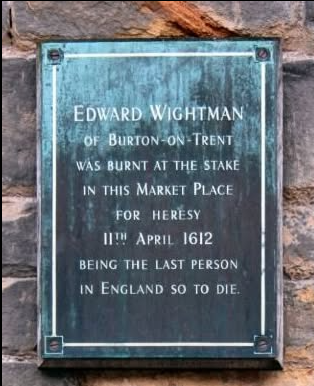
Today, a plaque in Lichfield marks the place of Wightman's execution. It preserves the language of the time, recording that Edward Wightman was “the last person in England so to die.”