
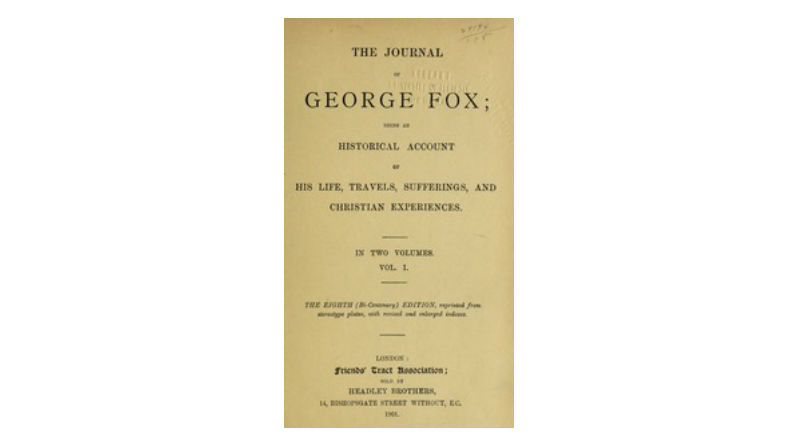
Journal of George Fox
The Journal of George Fox is arguably the best primary source for learning how Quakerism began, took shape and grew.
Fox and his journal
George Fox (1624 - 1691) is remembered as a key founder of the Society of Friends. His journal was first published in 1694, three years after his death, edited by Thomas Ellwood, a friend and associate of John Milton.
The journal carries a preface by William Penn, by then one of the most prominent Quakers alive. Penn's preface closes with the line:
“Many sons have done virtuously in this day, but, dear George, thou excellest them all.”
The version of the journal most widely read today is a 1924 re-edited edition by the Quaker theologian Rufus Jones.
A compiled account
The journal is not a daily log of events. It presents vignettes that illustrate Fox's life and the movement's early growth, compiled rather than kept as things happened. Much of it was dictated by Fox in his final years, long after the events it describes.
Parts of the text were not written by Fox at all. They were assembled from other sources and set down as though in his own words.
The disagreements that marked Quakerism's earliest years, and the part played by Friends who shaped the movement alongside Fox, are largely absent from the account. What remains shows Fox in the best possible light.
Beginnings and endings
The journal opens with the chapter Boyhood, a Seeker, tracing Fox's restless search for answers as a young man.
“In my very young years I had a gravity and stayedness of mind and spirit not usual in children; insomuch that when I saw old men behave lightly and wantonly towards each other, I had a dislike thereof raised in my heart, and said within myself, ‘If ever I come to be a man, surely I shall not do so, nor be so wanton.’ When I came to eleven years of age I knew pureness and righteousness; for while a child I was taught how to walk to be kept pure.”
From there the chapters move in chronological order through imprisonment, the formation of the Society of Friends, and years of travel across England, Wales, continental Europe, Barbados and America. At points the writing reads as much like a travelogue as a spiritual record.
The journal closes with the chapter The Seed Reigns over Death. In failing health, Fox is found in London, attending Parliament to protest at the treatment of Friends.
No singular founder
The journal has done its work so well that Fox is often called simply the founder of the Quakers. He was not. The Society of Friends had no single founder. Fox was one of several, his influence considerable but never solitary, in a movement built from the outset on shared ministry rather than one man's standing.
The faith Fox helped shape has never rested on the standing of any one Friend. It rests instead on the conviction that the Light is given to everyone, not appointed to a founder. Even Fox's own account of his last labours bears this out.
“In seeking relief for my suffering brethren I spent much time; together with other Friends, who were freely given up to that service, attending at the Parliament-House for many days together, and watching all opportunities to speak with such members of either House as would hear our just complaints.”
Even here, ill and near the end, Fox writes himself among Friends rather than above them. The Journal of George Fox remains what it always was — not a perfect record, but the fullest account Friends have of explaining their beginnings.