
Sunflower
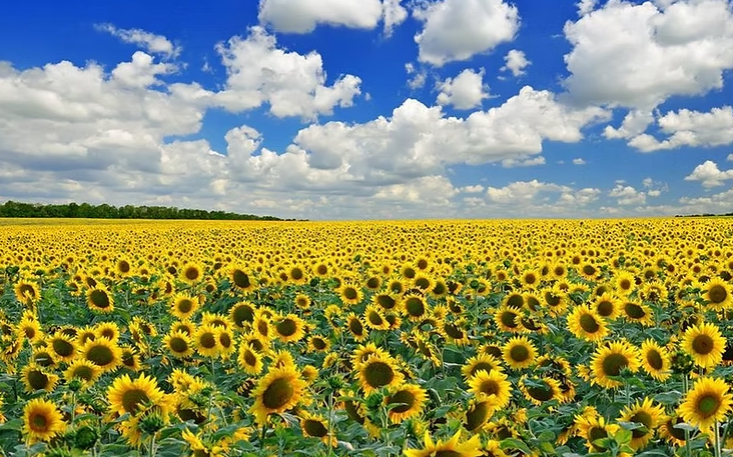
The sunflower turns toward the light, where the search for warmth becomes a quiet symbol of peace.
Warmth, openness and life
The sunflower is one of the clearest symbols in the natural world. Its large dark centre, ringed by bright petals, carries an immediate likeness to the sun itself. Even before any history or politics is attached to it, the flower suggests warmth, openness and life. It does not feel closed or defensive. It feels outward-facing.
Part of that meaning comes from the plant's own behaviour. Young sunflowers turn as they grow, following the path of the sun across the sky. That movement has made the flower a lasting image of seeking light, whether understood as hope, truth, renewal or peace. The symbolism is simple, but not shallow: the sunflower carries an idea of peace that begins not in force, but in orientation — in what people choose to face.
Sustenance, provision and continuity
Long before the sunflower became a modern emblem, it was valued as a plant of nourishment and usefulness. Indigenous peoples in North America cultivated it for food, oil and seed, giving it a place in everyday life rather than treating it as a purely decorative flower. That practical history matters. The sunflower first carried meanings of sustenance, provision and continuity.
Later traditions added further layers. In European art and literature, the flower became associated with devotion, constancy and the pull of light. Across cultures, it gathered a quiet consistency of meaning: life, steadiness, warmth and the refusal to remain in shadow. These ideas did not come from theory, but from the way the plant grows, turns and endures.
Peace that depends on recognition
In the modern world, the sunflower has taken on a more explicit public role. In Ukraine, where it is the national flower, it became a powerful peace symbol through both memory and crisis. In 1996, sunflowers were planted at a former missile base during a ceremony marking the country's move away from nuclear weapons. After Russia's full-scale invasion in 2022, the flower returned with new force as an emblem of national dignity, civilian courage and the hope that life might outlast destruction.
The sunflower also appears in quieter, everyday settings through the Hidden Disabilities Sunflower. Often worn on lanyards, it allows people with non-visible conditions to signal that they may need more time, understanding or support. It does not demand attention. It invites awareness. In this context, the meaning of peace becomes an idea lived in practice: not the absence of conflict, but the presence of patience, dignity and care in ordinary encounters.
These uses are not separate. They share the same underlying logic. Whether held in a protest or worn in an airport, the sunflower expresses a form of peace that depends on recognition — seeing others clearly, and responding without hostility.
Strength without hardness
The sunflower endures because it carries strength without hardness. It is vivid, but not aggressive. It stands tall, yet remains associated with generosity, warmth and openness. That makes it especially suited to peace culture, where ideas often need to be felt as much as understood.
In a world that often rewards speed, certainty and control, the sunflower introduces a different rhythm. Through its use as a symbol of hidden disability, it reminds us that not all needs are visible, and not all struggles announce themselves. Peace, in this sense, is not only something negotiated between nations, but something practised in small acts of attention and restraint.
The sunflower does not confront. It orients. It suggests that to seek the light is not to ignore darkness, but to refuse to let darkness decide the direction of life. That is why it still matters: it makes peace visible not as passivity, but as a steady turning toward what allows others to live and be seen.