
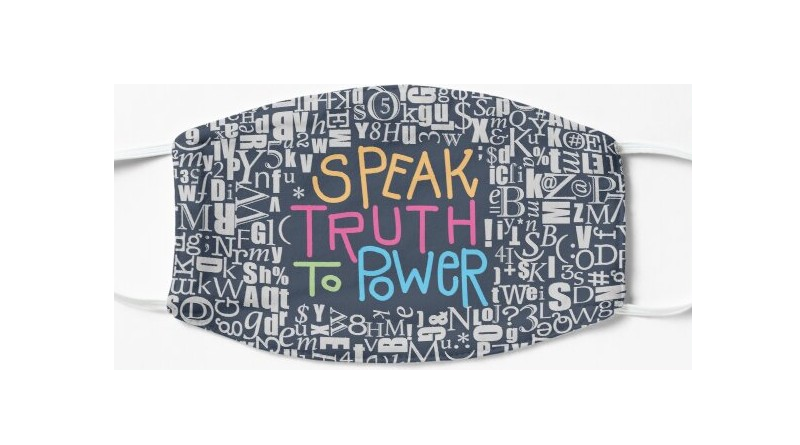
Speak Truth to Power face mask
The Speak Truth to Power face mask uses the phrase, coined by a Quaker, that has become known throughout out the world for meaning non-violent protest.
From practice to pamphlet
Since their origins in mid-17th-century England, Quakers practised speaking truth to power when addressing people in authority. Seeking religious and social equality, they challenged those who held influence and the capacity to bring about change. It was not until the 20th century, however, that 'Speak Truth to Power' became a phrase in its own right.
In 1955, the American Friends Service Committee (AFSC) published the pamphlet Speak Truth to Power: A Quaker Search for an Alternative to Violence, one of five studies exploring how to “ease tension and move toward international peace” in a nuclear-armed world.
Bayard Rustin
It was co-written by a study group of 14, including Bayard Rustin (1912–1987), a Friend and leading civil and gay rights activist.
Rustin's name was left off the pamphlet when it was first published. He had been arrested in 1953 on a morals charge relating to his homosexuality, and asked for his own name to be omitted, fearing it would be used to discredit the pamphlet's message.
The AFSC did not formally restore him as a principal author until September 2010, 55 years later.
The pamphlet's introduction opens with these words:
“Our truth is an ancient one: that love endures and overcomes; that hatred destroys; that what is obtained by love is retained, but what is obtained by hatred proves a burden. This truth, fundamental to the position which rejects reliance on the method of war, is ultimately a religious perception, a belief that stands outside of history. Because of this we could not end this study without discussing the relationship between the politics of time with which men are daily concerned and the politics of eternity which they too easily ignore.
… The urgent need is not to preach religious truth, but to show how it is possible and why it is reasonable to give practical expression to it in the great conflict that now divides the world.”
Speak truth to power today
The non-violent approach set out in the pamphlet was widely adopted by US Civil Rights movements from the late 1950s onwards. Today, shaped by that legacy, speaking truth to power has come to mean peaceful challenge to injustice and oppression in many different contexts.
Speaking truth to power means holding convictions deeply and working persistently to have them heard. It may not be popular. It involves risk. Rustin knew that when he stepped back so the words could stand on their own.
The Speak Truth to Power face mask is available to buy from TeePublic (opens in a new tab).