Socialist Republic of South Yorkshire
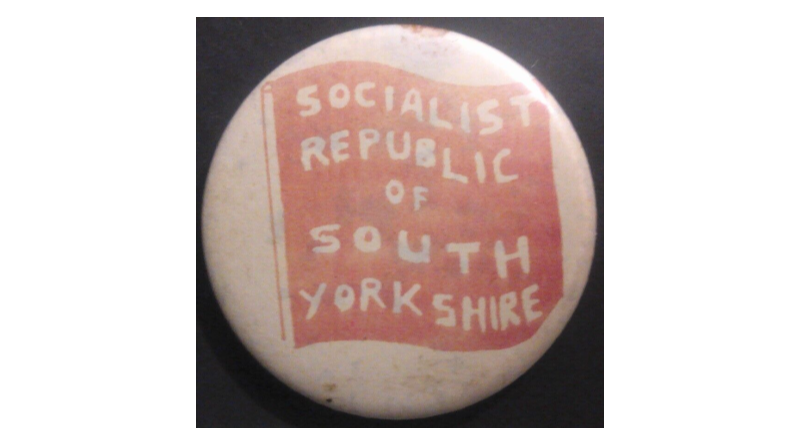
Socialist Republic of South Yorkshire is a vintage pin badge that flies the flag for the time a corner of England took a politician's insult and wore it with pride.
A red flag in a London room
The primary symbol of the international labour movement is the red flag. It predates any single party or nation, running from the Paris Commune of 1871 through the trade union marches of the nineteenth century.
On this badge, the lettering is white, now aged to cream. White is Yorkshire's heraldic colour. The flag that belongs to every workers' movement everywhere has been planted in a specific county in the north of England.
The words 'Socialist Republic of South Yorkshire' were not chosen by the people who wore them. Irvine Patnick, leader of the Conservative group on South Yorkshire County Council, is credited with coining the phrase as an insult.
In 1979 he was fighting the council from the opposition benches, reaching for the phrase as shorthand for everything he wanted to paint as Soviet-style, undemocratic, extreme.
It did not land that way. Trade unionists, activists and ordinary residents took the insult and reclaimed it by turning it into a literal badge of honour.
South Yorkshire delegates wore the badge to the 36th Congress of the Communist Party of Great Britain, held at St Pancras Town Hall in London on 10 and 11 November 1979. They pinned it on before the battles that would define the decade had even begun.
Two pence to anywhere
The delegates who made that badge came from one of the few places in Britain where Communist Party influence showed on the ground, in real seats on local councils and real weight in the region's industries. Something concrete was already being built.
The most visible sign of it was the buses. The South Yorkshire County Council had frozen fares and subsidised travel across the region. A passenger could ride almost anywhere for between 2p and 10p. In an era of high inflation, the fare didn't move.
The philosophy behind it was straightforward. Mobility was a social right, not a commodity. The county council did not present its transport policy as a concession to working people. It presented it as what a municipal government was for.
The cheap fares were the republic's most tangible daily fact, not a declaration or a resolution but something a miner's wife in Barnsley or a steelworker in Rotherham felt every morning when they boarded the bus.
A peaceful county
The county council gave its critics plenty more to work with. It declared South Yorkshire a nuclear-free zone and refused to take part in national civil defence exercises.
Sheffield City Council did the same on its own patch. It flew the red flag over the Town Hall on May Day and signed a peace treaty with the city of Donetsk in Soviet Ukraine.
In November 1982, Sheffield hosted the CND national conference. Delegates from across Britain arrived in a city that had already done what they were still resolving to do. The republic's hardest test was still to come.
The strike and the republic
In 1983, the National Union of Mineworkers moved its national headquarters to Sheffield. The following year, the miners' strike began.
South Yorkshire was the frontline. The pits at Cortonwood, Maltby and Markham Main were not peripheral to the dispute. They were its heart.
The republic that had reclaimed its name in November 1979 was now the logistical centre of a strike that would run for almost a year.
Miners' families across the region organised collectively to survive the dispute, running soup kitchens, distributing food parcels, keeping communities intact through close to a year without wages. The republic's infrastructure, built on the belief that collective provision was what local government was for, made that possible.
Leader David Blunkett had led Sheffield City Council through the Donetsk treaty and the May Day flag on the Town Hall. By this point he was a national figure.
When the Thatcher government moved to cap local authority spending, his council refused to set a conventional budget. The rate-capping rebellion risked legal action and bankruptcy. The council held its position.
The phrase that Patnick had meant as mockery was now worn openly, on lapels and on banners, by people who understood exactly what it meant to live inside the republic during the hardest years of its existence.
Still flying high
The Thatcher government abolished the South Yorkshire County Council in 1986, one of six metropolitan counties dissolved that year alongside the Greater London Council. The cheap fares ended. The NUM did not win the strike. The Communist Party of Great Britain, whose delegates carried the badge to London in 1979, dissolved in 1991.
Despite all this loss, if only in badge form, Socialist Republic of South Yorkshire still keeps the red flag flying high.