
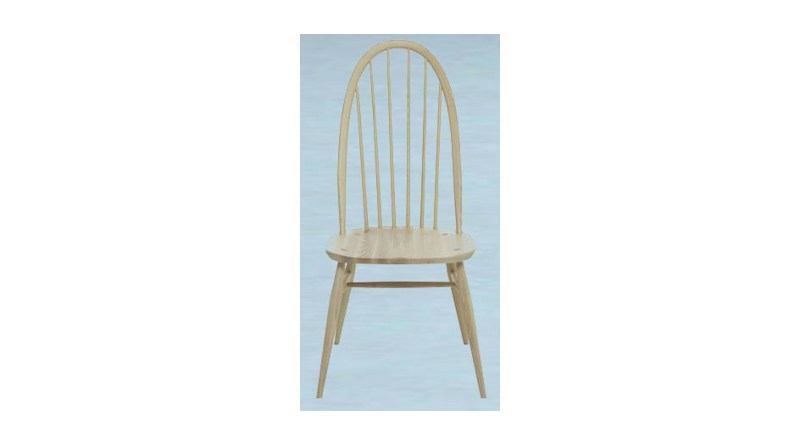
Shaking Quakers' chair
The Shaking Quakers' chair is a piece of furniture that represents the Shaking Quakers — a breakaway group of Quakers who became renowned for designing and making household furniture.
Communal experiment
In 1774, a small independent group of Shaking Quakers left home for America and conducted what was possibly the largest and most successful communal experiment in American history. Their ecstatic movement and dancing during worship saw them become known simply as Shakers.
The Shakers separated themselves from the outside world to create a self-sufficient way of life, forming several small communes. Members grew their own food, constructed their own buildings, and manufactured their own tools as well as household furnishings.
They also adhered to a strict set of rules governing their behaviour, dress, and domestic environment.
Although they lived a strict life, the Shakers held on to many Quaker values, from racial and sexual equality to pacifism and common property. Celibacy was also part of Shaker practice, and as a result members had to recruit people from the outside world to prevent their communities from dying out.
Two of their favourite sayings were, “Whatever is fashioned, let it be plain and simple and for the good,” and “Beauty rests on utility.”
Because they believed that the quality of their work was a testament to God, each item they made was painstakingly honed to perfection.
Shakers' style
- open plan
- simple and uncluttered
- limited colour palette of red, blue, yellow, and blue-green
- handcrafted wooden furniture
- natural materials
- built-in storage
- hand within a heart motif, meaning “hands to work and hearts to God”
Chairs and furniture
To support their communities, Shakers sold surplus food and goods to outsiders. By the 1860s, chairmaking had become a staple industry for the community.
With their turned posts, slat or ladder backs, and woven seats, Shaker chairs were simplified versions of a centuries-old design that remained popular in part because the component parts were comparatively quick and easy to produce.
When marketing their furniture, Shakers trumpeted their attention to detail and quality in an era when mass-produced furniture was synonymous with shoddy construction.
After the American Civil War, Shaker communities steadily lost members, as fewer people chose the ascetic, celibate life the Shakers asked of them. By the early 20th century, many communities had closed for want of new members.
Only one Shaker community remains today, at Sabbathday Lake in Maine.
Original Shaker furniture is highly collectable, and museums across the United States hold many pieces.
However, the chair lives on beyond the collections and the archives. Its plain, well-built design remains as popular as ever. New chairs are still made and sold, now known simply as the Quaker Chair.