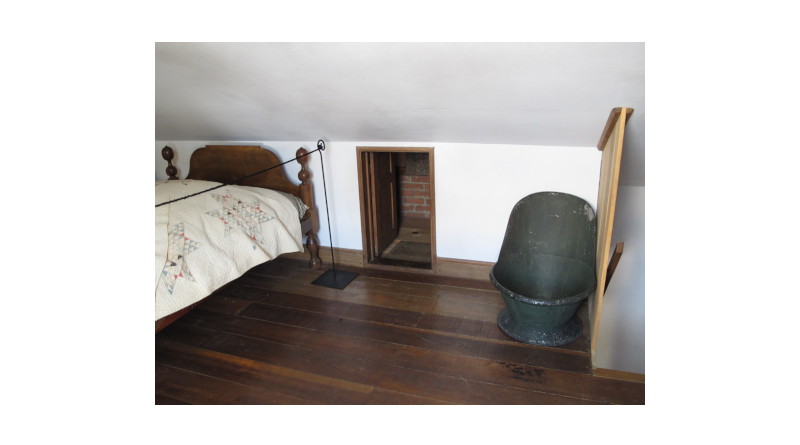
Secret door Inside the Levi Coffin house
The secret door inside the Levi Coffin House reflects the prominent role played by 19th century American Quakers in the Underground Railroad, helping enslaved people escape towards freedom.
The Underground Railroad
The Underground Railroad was neither underground nor a railway. It was an informal network of secret routes, safe houses and people who helped enslaved people escape from the southern United States towards freedom.
Freedom seekers usually travelled in stages, moving from one safe place to another with the help of people willing to provide food, shelter, directions or transport. The network had no central leadership and was never controlled by a single organisation.
Free and enslaved African Americans played a central role, alongside abolitionists and members of several Christian denominations. Among the religious groups prepared to take the risks involved, Quakers were particularly prominent.
Levi and Catharine Coffin
Two of the best known were Levi and Catharine Coffin. Their home stood in Newport, now Fountain City, Indiana, a free state immediately north of the slave state of Kentucky.
Indiana became an important gateway for freedom seekers travelling from the slaveholding South towards safer destinations farther north.
The Coffins had already been helping freedom seekers for years when they moved into their brick house in 1839. During their years in Indiana, they assisted more than 1,000 people, providing food, clothing, shelter and help with the next stage of the journey.
Levi used his business connections to arrange transport and contacts farther along the route. Catharine managed much of the practical work inside the house and worked with other women to prepare clothing, shoes and supplies.
Their home became known as the 'Grand Central Station of the Underground Railroad', while Levi became known as its 'President'.
Explaining why he continued to help, Levi wrote:
“The Bible, in bidding us to feed the hungry and clothe the naked, said nothing about colour, and I should try to follow out the teachings of that good book.”
Quakers and the Underground Railroad
The Coffins were far from the only Friends involved in the Underground Railroad. Quaker participation extended across several states. In Chester County, Pennsylvania alone, records identify 82 Quakers who took part.
One of the best known was Thomas Garrett, a Quaker in Wilmington, Delaware, who worked on the Underground Railroad for about 40 years. He is reputed to have helped more than 2,700 freedom seekers, arranging shelter and onward travel despite being fined heavily for breaking laws that protected slaveholders.
Not every Friend agreed with such action. Some Quakers believed slavery should instead be opposed through lawful campaigns for abolition. The Society of Friends therefore never operated the Underground Railroad as an organisation, but individual Friends and Quaker communities became a prominent part of the wider network.
The secret door
The Coffins' house offered practical advantages for such work. A spring-fed well in the basement provided water without anyone having to go outside, while attic and storage spaces could provide concealment. On the second floor, a narrow door opened into a hidden space where freedom seekers could be kept out of sight.
The house survives today as the Levi and Catharine Coffin State Historic Site. So does the secret door. Small and easily overlooked, it opens onto the larger story of the Underground Railroad — ordinary homes turned into places of refuge, and people prepared to help a stranger reach the next place of safety.
