
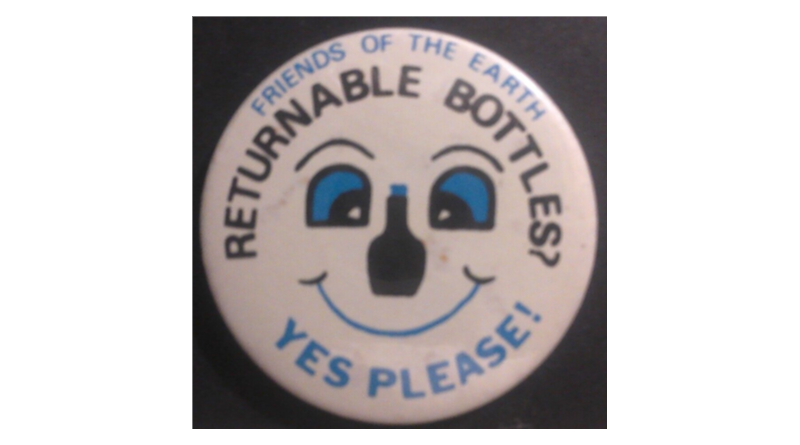
Returnable bottles? Yes please!
Returnable bottles? Yes please! is a vintage pin badge by Friends of the Earth UK that was issued as part of its first ever major nationwide campaign.
Returning the non-returnables
In May 1971, the UK branch of Friends of the Earth was barely a few months old. To capture the public's imagination, the newly formed group needed a target. They found it in the soft drinks giant Schweppes.
The company had just launched a massive advertising blitz to promote a new line of single-use, 'non-returnable' glass bottles. To protest this shift toward a disposable culture, activists organised a literal 'return to sender' stunt.
They arrived at Schweppes' London headquarters and dumped roughly 1,500 empty bottles directly onto the pavement outside the front doors. Decades later, organisers confessed to a logistical secret.
Worried they hadn't scavenged enough empty glass to make a visual impact, the cash-strapped activists spent their own budget buying full bottles of mixers. They secretly poured the liquid down the drain, just to build their mountain of protest glass.
Face of the campaign
Despite the confrontational nature of dumping a mountain of glass on a corporate doorstep, the campaign's public-facing materials were remarkably cheerful. Printed in bright blue and black against a stark white background, this badge employs a simple, clever design.
It makes its point by turning the black silhouette of a bottle into the nose of a smiling face. Rather than relying on angry slogans, the badge asks a polite question and answers it with an enthusiastic 'Yes please!'.
It was a deliberate tactic to win over ordinary consumers by reminding them of a system they already understood. For generations, children had supplemented their pocket money by returning glass bottles to the local shop. The badge framed the retention of this system as common sense, not radical environmentalism.
The throwaway society
The 'bottle dump' was a spectacular media triumph that landed Friends of the Earth on front pages worldwide. Embarrassed by the bad press, the British government offered the young activists a seat on the newly created Waste Management Advisory Council.
Eager to be taken seriously as policy insiders, the young activists accepted the seat — and industry representatives on the council used it well. Rather than statutory reuse laws, the conversation shifted toward consumer recycling.
By shifting the financial and logistical burden of managing waste onto local councils, corporations protected their single-use pipelines.
The UK invested heavily in crushing and melting glass, leading to the nation's first 'bottle banks' in 1977. The corporations retained their profits. The public covered the cost.
From dump to deposit
Today, as the world confronts a plastic pollution crisis, the global supply chain is finally realising that melting down packaging requires immense energy.
Washing and refilling existing containers does not. Governments across Europe have already implemented mandatory Deposit Return Schemes, while the UK's own version has been delayed for years and is not due to launch until October 2027.
Manufacturers have largely resisted extended responsibility for the waste their packaging creates. England, Northern Ireland and Scotland alone still send an estimated 6.5 billion single-use containers to waste every year.
The face on Returnable bottles? Yes please! is still smiling. On paper, at least, its question finally has an answer, one dated October 2027.