
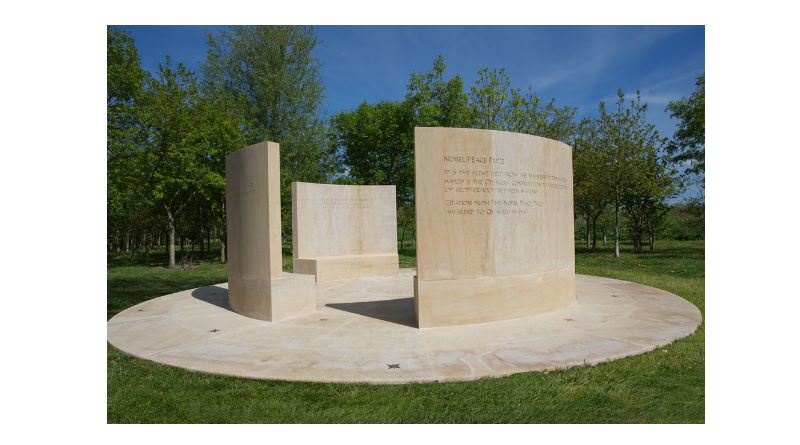
Quaker stone bench memorial
Standing in a quiet grove of trees are four curved Rutland limestone benches that form the Quaker stone bench memorial.
Quaker presence at the National Memorial Arboretum
The stone benches sit on the fringe of the National Memorial Arboretum in Staffordshire, England.
The choice of the National Memorial Arboretum is perhaps surprising for a Quaker memorial. It is Britain's site of national remembrance of war, honouring those who have died and encouraging pride in the Armed Forces.
However, British Quakers wanted a presence in the arboretum to remember the contribution the Society of Friends has made in both peace resolution and humanitarian work during wartime.
There are hundreds of individual memorials and military emblems in the arboretum, almost all of which commemorate armed service.
As the trustees of the new Quaker Stone Benches memorial acknowledge, some Friends may initially feel out of their comfort zone here. “This has led to a lot of discernment,” says Anthony Wilson, clerk to the Quaker Service Memorial Trust.
Friends had considered trees or wooden benches at first. “Then they saw just how many trees and benches the arboretum already has,” says Wilson. There are thousands, and almost all are in memory of armed service.
The trust wanted something distinctive, but not showy. It was encouraged in this by the arboretum itself, which is conscious that too many ‘samey’ memorials risk dulling both the landscape and visitors' feelings.
Friends were reassured by the support of the Royal British Legion, which manages the park in the spirit of its founding aim, “A place of joy where the lives of people would be remembered … in a world of peace.”
The four benches
There are 10 texts in total. Four are carved on the backs of the stone seats, two on the front, and four are single words carved into the base of each seat. Two of the four seats also carry a longer inscription on the front; the other two carry only their base word.
1: RELIGIOUS SOCIETY OF FRIENDS (QUAKERS): The Society emerged after the civil war of the 1640s with a commitment to live by “the virtue of that life and power that takes away the occasion of all wars”. Quakers continue to work worldwide for peace and reconciliation.
On the front of this seat:
Quaker Meetings for Worship are often held in a circle, a symbol of unity and equality.
On the front base: TRUTH
2: FRIENDS AMBULANCE UNIT: The Unit enabled conscientious objectors to serve in theatres of war. They cared for civilian and military casualties of any nation in both World Wars. Seventeen members lost their lives in World War II.
On the front base: EQUALITY
3: FRIENDS RELIEF SERVICE: Friends set up the Service in 1939 to relieve civilian distress. It worked in a spirit of peace at a time of war in the UK, Europe and further afield.
On the front base: SIMPLICITY
4: NOBEL PEACE PRIZE: “It is the silent help from the nameless to the nameless which is the Quakers' contribution to the promotion of brotherhood between nations.” This is the citation from the Nobel Peace Prize awarded to Quakers in 1947.
On the front of this seat:
“Let your life speak, answering that of God in everyone”
George Fox, 1624–1691.
On the front base: PEACE
The four stone benches remain in their quiet circle beneath the trees, their carved words waiting for whoever chooses to sit. Truth, Equality, Simplicity, Peace — four words, four seats, one meeting that never quite ends.