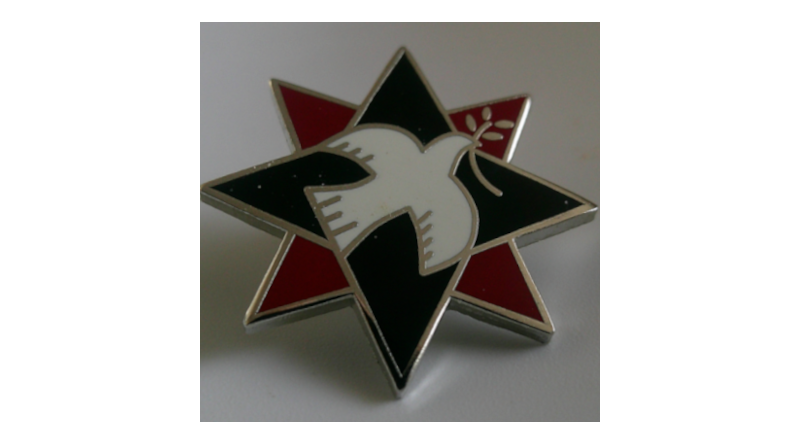
Quaker Star badge
The Quaker Star badge represents the Quaker Star being the recognisable logo that identifies the Society of Friends.

Adoption of the star
British Quaker relief workers first wore the eight-pointed red and black star during the Franco-Prussian War of 1870 to 1871.
The Friends War Victims Relief Committee (FWVRC) was created by British Quakers to work among the civilian population of towns and villages devastated by the war.
Quakers at the time wanted an identification to differentiate both themselves and their supplies from other groups carrying out similar efforts.
Until the star was adopted, Quaker workers had used the British Union Jack as well as the Red Cross flag as symbols.
This combination caused confusion among Prussian soldiers and made it easy for French civilians to mistake the Quakers for Red Cross workers. Neither relief group desired this confusion of identity.
At the time, a red and black star was in use by the London Daily News Fund on shipments to aid the poor in war-torn France. Quakers decided to use the star as their symbol, with the newspaper's approval.
This enabled Quaker relief supplies to receive the same reduction in duty fees as shipments made by the Daily News.
Addition of a dove

The FWVRC was revived at the outset of the First World War in 1914, and the star was again adopted as its emblem. American Quakers also adopted the star symbol in 1917.
The star has been used in a variety of forms ever since, representing Quaker work for peace and the relief of suffering caused by war. When British and American Friends were awarded the Nobel Peace Prize in 1947, they added the emblem of a dove of peace.
Both Quaker Peace & Social Witness and the American Friends Service Committee still wear the star as their symbol today. In 1991, a rose in Northern Ireland was named the Quaker Star.