Pulsar star graph
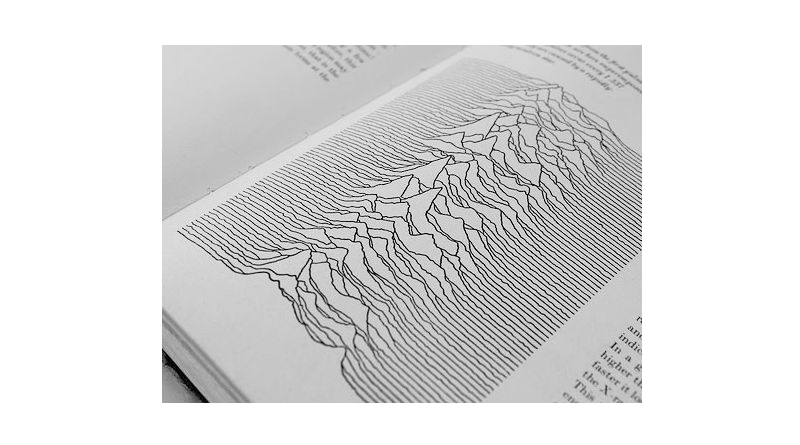
Pulsar star graph is a chart of radio pulses from the first pulsar, discovered in 1967 by the Quaker astrophysicist Jocelyn Bell Burnell.

Jocelyn Bell Burnell
The subsequent paper that presented the findings was published under the names of four senior scientists who had supervised Bell Burnell's work. As a result, she was excluded from the 1974 Nobel Prize in Physics.
Bell Burnell would later gain recognition in her own right, as a pioneering scientist who championed women in the sciences.
Bell Burnell was born in Northern Ireland and as a child she attended The Mount School, a Quaker girls' boarding school in York, England. There she was inspired by her physics teacher, Mr Tillott, who taught her that physics required grasping only a few key principles, which could then be built upon and developed. It was a lesson she carried into her scientific career.
Little green men
By late November 1967, while a student at Cambridge, Bell Burnell detected a bit of 'scruff' on her chart-recorder papers as she tracked stars.
At first it was thought the 'scruff' was simply an error in the data. But once the data was confirmed, the team jokingly named the signal LGM-1, for Little Green Men.
Further observations soon showed that Bell Burnell had not found alien life forms, but radio pulsars, stars that pulse out light.
This would prove to be one of astronomy's greatest finds of the 20th century, as the timing of the pulses allowed far more accurate measurements of time and space in the universe.
Prize money and popular culture
Bell Burnell continued to have an active career in science and teaching, both in the UK and the United States.
In 2018, she was awarded the Special Breakthrough Prize in Fundamental Physics, with a prize of $3 million, for her discovery of radio pulsars. She donated all of the money to fund women, under-represented ethnic minorities and refugee students to become physics researchers.

Inadvertently, she also entered popular culture. An image of her pulsar's radio waves, plotted by astronomer Harold Craft from data recorded at the Arecibo Observatory, was later published in The Cambridge Encyclopaedia of Astronomy (main picture).
The British punk rock band Joy Division included the image in a folder of reference material for their 1979 album Unknown Pleasures and it was subsequently chosen for the front cover. The album became a best-selling classic and the striking image is now known the world over.
Quakers and science
In 2013, Bell Burnell gave a lecture entitled A Quaker Astronomer Reflects: Can a Scientist Also Be Religious? The lecture addresses the often perceived friction between science and religion.
Throughout their history, Quakers have held 'science' as one way of finding the truth, and experimentation has been a key part of the faith. Many early Friends therefore found themselves observing the processes of the natural world and recording their findings.
This was at a time when science was in its infancy and many Friends involved themselves in botany. Centuries later, that same habit of quiet, patient observation led one Quaker to notice a small patch of scruff on a chart — and in doing so, change the shape of the night sky.
For more see Quakers and science.