
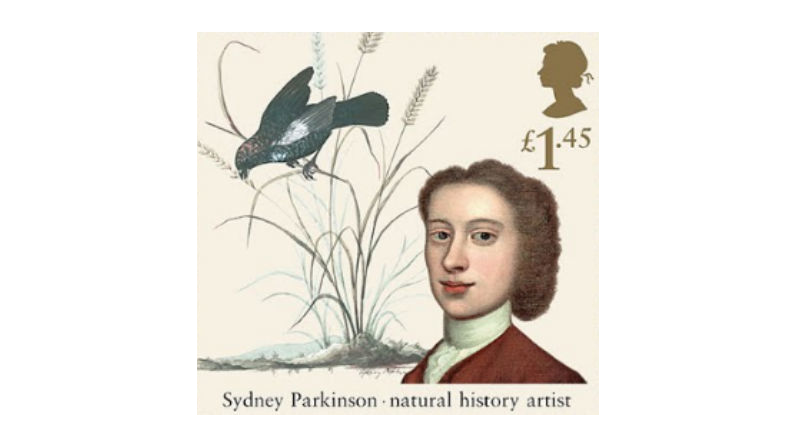
Postage Stamp of Sydney Parkinson
The Postage stamp of Sydney Parkinson, issued in 2018 to mark the 250th anniversary of Captain Cook's most famous voyage, represents the connection between Quakers and botany.
From drawing on land to illustrating on sea
Parkinson began his career by drawing plants in London. The Quaker nurseryman James Lee, who employed him as a drawing tutor for his daughter, introduced him to the naturalist Joseph Banks.
Banks took him on as one of two illustrators aboard Captain Cook's crew, tasked with recording the plants found on the voyage. The other illustrator died during the early stages of the expedition, and it fell to Parkinson to complete the work alone.
In total, the voyage lasted three years. Parkinson sketched over 900 specimens and painted nearly 300 illustrations of plants that had never been seen before in Europe. He also wrote a journal entitled A Journal of a Voyage to the South Seas, in His Majesty's Ship the Endeavour.
On the return leg of the voyage, HMS Endeavour stopped at Jakarta for repairs and many of the crew fell ill. Parkinson was among them, and he died at sea in January 1771. His drawings, however, survived the journey and reached the British Museum.
The network of botanical knowledge
The network of Friends across Britain and the New World built botanical knowledge together, exchanging letters, seeds and specimens between Meetings. Recording and classifying plants came naturally to the highly organised Society of Friends. Wealthier Quakers also funded Friends who needed to travel to further their research.
Quakers also had a ready-made trading network to help move this knowledge along. Quaker merchants and ship captains carried seeds and specimens across the Atlantic as part of ordinary business.
Their shared reputation for plain dealing meant Friends trusted each other to look after fragile cargo and pass on honest findings. This turned everyday trade routes into channels for botanical knowledge as well as goods.
William Penn, founder of Pennsylvania, put this network into action, transporting several trees from Britain to his garden to grow alongside existing native species. These included fruit and nut trees such as walnut and hazelnut.
Penn's aim was to encourage, “A green country town.” Most houses built in Penn's new settlement included plots large enough for small orchards. As a result, settlers named many streets after trees such as Chestnut, Mulberry and Vine, which still survive today.
Botanical Magazine and other achievements
In 1787, the Quaker William Curtis started the Botanical Magazine, which is still in existence today. Curtis designed the magazine to educate and inform both specialists and the general public about new discoveries.
Quakers became known for teaching others about the natural world, and for looking after it. Curtis created a botanical garden in Lambeth, London, and other botanic gardens founded by Friends sprang up in Britain and America.
Other notable Friends who worked in botany include the illustrators William Bartram (1739 - 1823) and William Weston Young (1776 - 1847). There was also Graceanna Lewis (1821 - 1912), who produced 50 watercolour representations of leaves in Pennsylvania that won national recognition.
The Postage stamp of Sydney Parkinson was one of six in a set issued by Royal Mail to commemorate the 250th anniversary of Captain Cook's voyage.
