
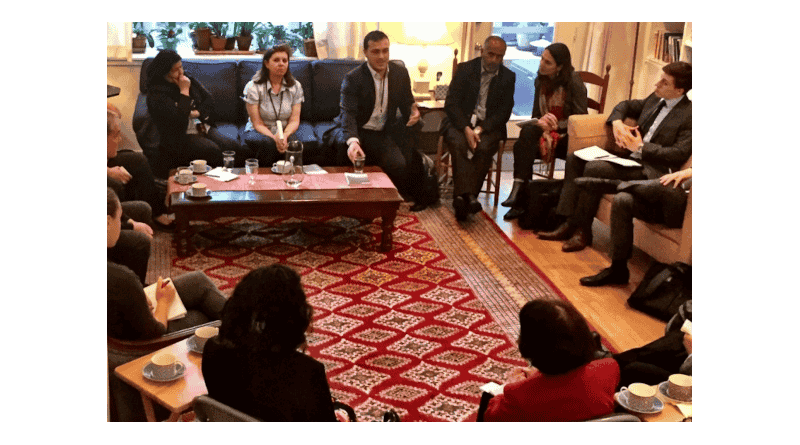
Photograph of a United Nations discussion at Quaker House
The Photograph of a United Nations discussion at Quaker House records a 2015 gathering with Palestinian refugees, hosted by Quakers in New York.
A discussion at Quaker House
In June 2015, three Palestinian refugees from the West Bank and Gaza spoke about their experiences at Quaker House. Representatives of non-governmental organisations attended. The Quaker United Nations Office (QUNO) arranged the gathering with the United Nations Relief and Works Agency, marking 65 years of work with Palestinian refugees.
The discussion took place in a four-storey brownstone on East 48th Street, near the UN headquarters. Built in 1861, the house has been used by Quakers since 1953. Its living and dining rooms provide a comfortable setting for international discussions, while Friends occasionally gather there for Meetings for Worship.
Quakers and the United Nations
Quakers were involved in international cooperation long before the United Nations was established in 1945. During the League of Nations years, the American Friends Service Committee promoted cooperation between countries, including through an illustration later reproduced on the Co-operation is better than conflict postcard.
In 1947, QUNO began its work with the United Nations in New York, with Quakers also establishing a presence in Geneva. That same year, British and American Quaker organisations jointly received the Nobel Peace Prize on behalf of Friends worldwide, recognising their humanitarian relief work and longstanding efforts for peace.
Quakers gained formal UN accreditation in 1948. By 1953, Quaker House provided a permanent base near the UN where diplomats, officials and people affected by international conflicts could meet away from formal negotiating chambers.
The art of quiet diplomacy
At Quaker House, guests collect lunch from a buffet and choose their own seats. They may find themselves eating beside someone they have never met, with a plate balanced on their knees. There are no assigned places for ambassadors or visiting speakers.
The informal atmosphere is carefully arranged. QUNO staff speak with participants beforehand and invite people who may find it difficult to talk openly during official negotiations. Over the years, these gatherings have helped diplomats work through disagreements that might otherwise have remained unresolved.
In 1995, diplomats preparing for a United Nations conference on women's rights were struggling to agree on certain proposals. Quakers arranged a private lunch at which the participants could discuss their differences without the pressures of formal negotiations. The conversation helped move the discussions forward.
QUNO brings people with first-hand experience of conflict into contact with international officials. Following violence after Kenya's disputed elections in 2007, Kenyan peace activist Dekha Ibrahim Abdi spoke at Quaker House about efforts to prevent further violence. She described how local peacebuilders were using mobile-phone messages to challenge dangerous rumours and reduce tensions.
The people in the room
The Palestinian refugees photographed at Quaker House in June 2015 had been invited to share their experiences with people concerned about the situation of Palestinian refugees. The gathering marked the 65th anniversary of the UN agency established to provide assistance to displaced Palestinians following the 1948 Arab-Israeli war.
The three speakers came from the West Bank and Gaza, where the experiences of refugees were shaped by different circumstances. Their participation gave representatives of organisations working on refugee issues an opportunity to hear personal accounts directly.
For decades, QUNO has brought diplomats together during difficult negotiations and invited people affected by conflict to speak about their experiences. The photograph records that second part of its work. In the same rooms where diplomats have discussed international disagreements, three Palestinian refugees were given an opportunity to speak for themselves.