
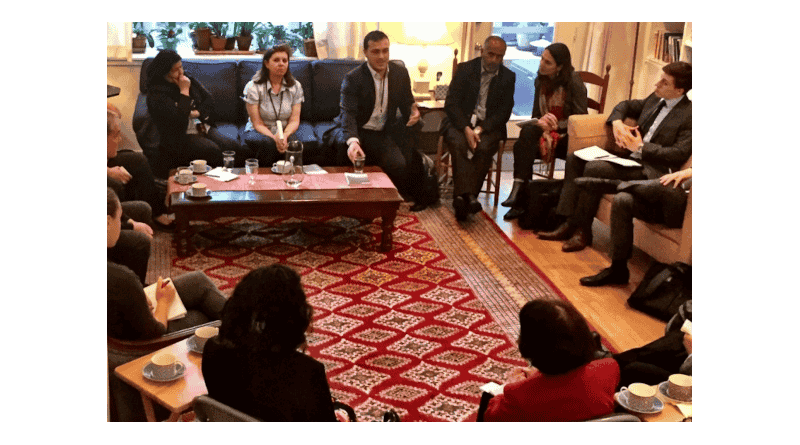
Photograph of a gathering at Quaker House
The Photograph of a gathering at Quaker House illustrates the Quaker approach to diplomacy at the United Nations
The gathering at Quaker House
On 3 June 2015, the Quaker United Nations Office (QUNO) hosted a gathering at Quaker House in New York to mark the 65th anniversary of the United Nations Relief and Works Agency for Palestine Refugees in the Near East (UNRWA).
Established following the 1948 Arab-Israeli War, UNRWA began operations in 1950 to provide humanitarian assistance to Palestinian refugees. Its work includes education, healthcare and social services.
Organised in partnership with UNRWA, the gathering brought together representatives of non-governmental organisations to hear from three Palestinian refugees from the West Bank and Gaza.
The discussion was arranged under the Chatham House Rule, which allows participants to share information gained during a conversation without revealing the identity or affiliation of other participants. The aim is to encourage people to speak openly.
Quaker House and quiet diplomacy
In 1953, a group of donors gave a four-storey brownstone townhouse to the American Friends Service Committee (AFSC) to establish a permanent Quaker presence close to the United Nations headquarters in New York.
Situated just a few blocks away, Quaker House provides a setting for conversations outside formal UN proceedings. QUNO also makes use of a Quaker House in Geneva, Switzerland, another major centre of United Nations activity.
At Quaker House, guests collect lunch from a buffet and choose their own seats. They may find themselves eating beside someone they have never met, with a plate balanced on their knees. There are no assigned places for ambassadors or visiting speakers.
The informal atmosphere is carefully arranged. QUNO staff speak with participants beforehand and invite people who may find it difficult to talk openly during official negotiations.
An important part of this approach, often referred to as 'quiet diplomacy', is listening to people with differing perspectives and exploring where common ground might be found. QUNO also creates opportunities for people directly affected by international issues to be heard by those involved in shaping policy.
Quakers and the United Nations
Quaker involvement with international institutions predates the formation of the United Nations in 1945.
In the early 1920s, Friends established a centre in Geneva to maintain relations with the League of Nations, an organisation formed following the First World War to promote international cooperation and prevent future wars.
During the 1930s, AFSC used an illustration of two mules to promote cooperation between nations. An early version survives in the League of Nations archives, and the illustration was later reproduced on the Quaker Co-operation is better than conflict postcard.
In 1947, Quakers were awarded the Nobel Peace Prize in recognition of their humanitarian relief work and longstanding efforts for peace. The following year, QUNO was established to represent Friends at the United Nations.
Through official consultative status at the UN, QUNO can participate in discussions, present research and make recommendations. Although it has no voting rights, QUNO can contribute to the development of international policy.
Quakers were also working directly with the newly formed United Nations on humanitarian relief. Following the 1948 Arab-Israeli War, the UN asked AFSC to organise relief services for nearly 250,000 Palestinian refugees in Gaza. UNRWA took over this work in 1950.
Influencing international affairs
Quakers have long defended the right of individuals to refuse military service on grounds of conscience. Following years of advocacy by QUNO and others, the United Nations Commission on Human Rights recognised conscientious objection as a legitimate exercise of freedom of conscience in 1987.
During negotiations leading to the 1997 international treaty banning anti-personnel landmines, QUNO helped shift attention from the military usefulness of the weapons to their devastating effects on civilian populations.
Friends have also drawn attention to the difficulties experienced by children whose parents are in prison. In 2011, the United Nations Committee on the Rights of the Child devoted a day of discussion to their needs, hearing from children who had experienced parental imprisonment.
The Photograph of a gathering at Quaker House captures one occasion in the continuing work of QUNO — bringing people together and creating opportunities for those affected by international decisions to have a voice in shaping them.