Paper Crane
The paper crane turns a simple act of folding into a shared symbol of peace.
A bird that lives a thousand years
Long before it was made from paper, the crane was already a creature of meaning. Across Japan and much of East Asia, it was understood as a bird of unusual grace and endurance, said in folklore to live for a thousand years. That imagined lifespan gave it a quiet authority: the crane became a symbol of longevity, good fortune, and protection, often depicted standing still, wings poised, as if holding something steady in the world.
This older meaning matters because the paper crane does not invent its symbolism from nothing. It inherits it. When folded, the crane carries forward the idea of a life extended, a future hoped for, and a care that shelters rather than harms. What changes is not the meaning itself, but the way that meaning is handled — no longer observed in nature, but made by human hands.
Folding as a form of intention
Origami transforms a flat sheet into something that feels alive, and the crane became its most recognisable form. The act of folding is slow, deliberate, and repeatable. Each crease must be made with care, and the final shape only emerges through a sequence that cannot be rushed. In this way, the crane becomes less an object and more a process — a small discipline of attention.
From this grew the tradition of senbazuru, the folding of one thousand cranes. The number reflects the crane's mythical lifespan, but it also creates a structure for hope. A single crane can carry a wish, but a thousand demands persistence. They are often made for someone who is ill, or at a moment when the future feels uncertain, turning repetition into a visible form of care. The cranes are then gathered together, strung in strands, and offered as a collective gesture.
Hiroshima, hibakusha, and the shift in meaning
The paper crane's modern meaning emerges from a specific historical moment. After the atomic bombing of Hiroshima in 1945, the act of folding cranes became bound to the experience of loss and the desire for healing. The story most often told is that of Sadako Sasaki, a young girl who developed leukaemia as a result of radiation exposure and began folding cranes while she was ill.
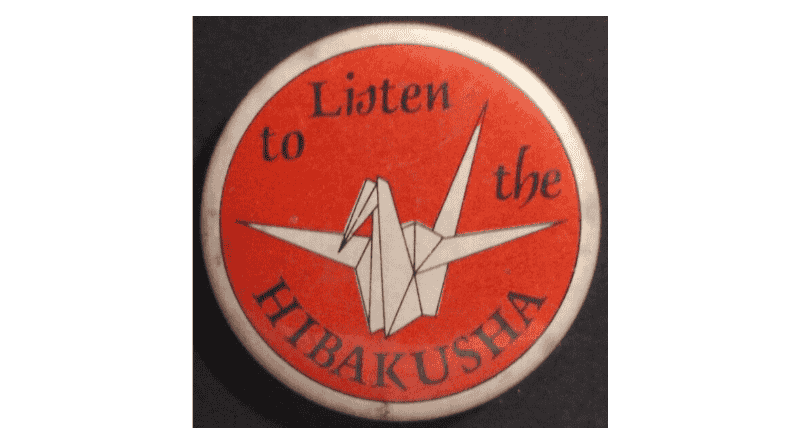
Sadako was one of the hibakusha — a Japanese term meaning ‘bomb-affected people’, used to describe those who survived the atomic bombings of Hiroshima and Nagasaki and lived with their consequences. The term includes not only those present at the moment of the blast, but also those exposed to radiation afterwards, and even those affected before birth. It names both a physical condition and a shared human experience.
Whether understood as literal history or as a story that has grown in the telling, the effect is the same. The crane becomes something more than a personal wish. It becomes a way of responding to destruction without reproducing it — a quiet act set against overwhelming force. Children began sending cranes to Hiroshima, and over time the gesture spread, until the paper crane came to stand for peace itself.
This is the point at which the symbol shifts. The crane is no longer only about longevity or good fortune. It becomes a form of memory, carrying the weight of what has happened and the insistence that it should not happen again. Through the experience of the hibakusha, the crane holds not only hope for the future, but witness to the past.
What the paper crane holds now
Today, the paper crane moves easily between contexts, but its meaning remains layered. It still carries the older associations of healing and hope, but these are now inseparable from its role as a peace symbol. It appears at memorials, in classrooms, in protests, and in quiet personal rituals, each crane adding to a larger, shared language.
What gives the crane its force is its scale. It is small, fragile, and easily damaged. Yet it is also endlessly repeatable. One crane can be overlooked; a thousand cannot. In this way, it suggests that peace is not declared in a single moment, but built through accumulation — through many small acts that, taken together, become visible.
The paper crane does not argue. It does not demand attention. Instead, it offers a simple proposition: that even in the shadow of violence, something careful and human can still be made, and that this act, repeated enough times, can begin to change what is seen and what is hoped for.